
The Toyota Tundra is not officially classified as a 3/4-ton truck. While it offers impressive towing and payload capabilities, it falls into the half-ton pickup category. However, its robust performance often rivals heavier-duty trucks, making it a strong contender for many heavy-duty tasks.
In This Article
- 1 Key Takeaways
- 2 📑 Table of Contents
- 3 Is a Toyota Tundra a 3/4 Ton Truck? Let’s Clear the Confusion
- 4 Understanding Truck Classifications: Half-Ton, 3/4-Ton, and One-Ton
- 5 Toyota Tundra: Half-Ton Truck with Heavy-Duty Ambitions
- 6 How the Tundra Compares to True 3/4-Ton Trucks
- 7 Why the Tundra Feels Like a 3/4-Ton Truck
- 8 Who Should Buy a Toyota Tundra?
- 9 Conclusion: The Tundra Is a Half-Ton Hero
- 10 Frequently Asked Questions
- 10.1 Is the Toyota Tundra classified as a 3/4-ton truck?
- 10.2 Can the Toyota Tundra tow as much as a 3/4-ton truck?
- 10.3 What is the payload capacity of the Toyota Tundra?
- 10.4 Why do some people think the Tundra is a 3/4-ton truck?
- 10.5 Should I buy a Tundra or a 3/4-ton truck for heavy towing?
- 10.6 Does the Tundra have a hybrid engine?
Key Takeaways
- Truck Classifications Explained: Understanding half-ton, 3/4-ton, and one-ton trucks helps clarify where the Tundra fits in the pickup market.
- Toyota Tundra Is a Half-Ton Truck: Despite its power, the Tundra is engineered and marketed as a half-ton pickup, similar to the Ford F-150 or Chevrolet Silverado 1500.
- Impressive Towing and Payload: Depending on the configuration, the Tundra can tow up to 12,000 pounds and carry over 1,900 pounds, rivaling some 3/4-ton trucks.
- Engine and Drivetrain Matter: The Tundra’s available V8 and hybrid powertrains contribute to its strong performance, but its chassis and suspension are designed for half-ton use.
- Real-World Capability vs. Official Rating: While not a 3/4-ton truck, the Tundra handles many tasks that require heavier-duty trucks, especially for daily drivers and weekend warriors.
- Choose Based on Needs: If you need maximum towing or frequent heavy hauling, a 3/4-ton may be better. For most users, the Tundra offers the perfect balance of power and efficiency.
- Future of the Tundra: With the introduction of the i-FORCE MAX hybrid engine, Toyota is pushing the Tundra closer to heavy-duty performance without changing its classification.
📑 Table of Contents
- Is a Toyota Tundra a 3/4 Ton Truck? Let’s Clear the Confusion
- Understanding Truck Classifications: Half-Ton, 3/4-Ton, and One-Ton
- Toyota Tundra: Half-Ton Truck with Heavy-Duty Ambitions
- How the Tundra Compares to True 3/4-Ton Trucks
- Why the Tundra Feels Like a 3/4-Ton Truck
- Who Should Buy a Toyota Tundra?
- Conclusion: The Tundra Is a Half-Ton Hero
Is a Toyota Tundra a 3/4 Ton Truck? Let’s Clear the Confusion
If you’ve been shopping for a full-size pickup truck, you’ve probably come across terms like “half-ton,” “3/4-ton,” and “one-ton.” These labels can be confusing, especially when trucks like the Toyota Tundra seem to blur the lines between categories. You might be wondering: Is a Toyota Tundra a 3/4-ton truck? The short answer is no—but the longer answer is more interesting.
The Toyota Tundra is officially classified as a half-ton pickup truck. That means it’s in the same category as the Ford F-150, Ram 1500, and Chevrolet Silverado 1500. However, just because it’s a half-ton doesn’t mean it’s weak. In fact, the Tundra packs a serious punch when it comes to towing, hauling, and overall durability. Many owners and reviewers have noted that it feels more robust than some of its competitors, leading to the common misconception that it might be a 3/4-ton truck.
So why the confusion? It comes down to a mix of marketing, real-world performance, and outdated naming conventions. The “ton” ratings originally referred to a truck’s payload capacity—how much weight it could carry in the bed. A half-ton truck could carry 1,000 pounds, a 3/4-ton could carry 1,500 pounds, and a one-ton could carry 2,000 pounds. While those numbers aren’t as accurate today due to advances in materials and engineering, the labels have stuck around.
The Tundra, especially in recent years, has pushed the boundaries of what a half-ton truck can do. With powerful V8 engines and a new hybrid powertrain, it’s capable of towing heavy trailers and carrying substantial loads. But despite its strength, Toyota has never marketed the Tundra as a 3/4-ton truck, and its design, suspension, and frame are built for half-ton duty.
In this guide, we’ll break down the differences between truck classes, explore the Tundra’s actual capabilities, and help you decide whether it’s the right truck for your needs—even if it’s not officially a 3/4-ton.
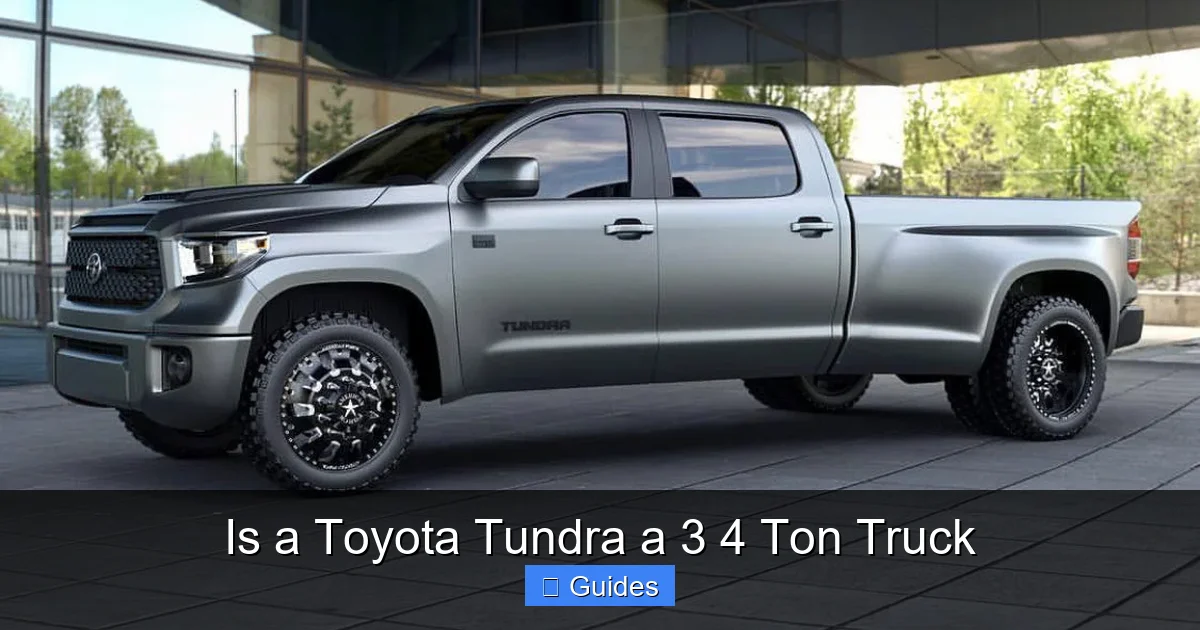
Understanding Truck Classifications: Half-Ton, 3/4-Ton, and One-Ton
Visual guide about Is a Toyota Tundra a 3 4 Ton Truck
Image source: tnstatic.net
Before we dive deeper into the Tundra, it’s important to understand what these “ton” ratings actually mean. These terms have been used for decades to help buyers compare trucks, but they’re not as straightforward as they seem.
What Do “Half-Ton,” “3/4-Ton,” and “One-Ton” Really Mean?
Originally, these labels were based on a truck’s payload capacity—the maximum weight it could safely carry in the cargo bed. A half-ton truck could carry up to 1,000 pounds, a 3/4-ton up to 1,500 pounds, and a one-ton up to 2,000 pounds. These numbers were set in the mid-20th century when trucks were much simpler and less powerful.
Today, those original payload limits don’t hold up. Modern half-ton trucks often exceed 1,000 pounds of payload, and some can even approach 2,000 pounds. For example, the 2024 Toyota Tundra can carry up to 1,940 pounds in certain configurations—well beyond the old half-ton definition. Yet, it’s still called a half-ton truck.
So why do manufacturers still use these terms? It’s mostly about tradition and marketing. Buyers are familiar with the labels, and they help differentiate between light-duty, medium-duty, and heavy-duty trucks. But the real way to compare trucks is by looking at their actual towing capacity, payload capacity, and Gross Vehicle Weight Rating (GVWR).
How Are Trucks Classified Today?
Modern truck classifications are based on the Federal Highway Administration’s (FHWA) vehicle weight classes:
- Class 1: Up to 6,000 pounds GVWR (e.g., compact trucks like the Ford Ranger)
- Class 2: 6,001 to 10,000 pounds GVWR
- Class 2a: 6,001–8,500 lbs (half-ton trucks like the Tundra, F-150, Ram 1500)
- Class 2b: 8,501–10,000 lbs (3/4-ton trucks like the Ford F-250, Ram 2500)
- Class 3: 10,001 to 14,000 pounds GVWR (one-ton trucks like the Ford F-350, Ram 3500)
As you can see, the Tundra falls into Class 2a, which is the half-ton category. In contrast, 3/4-ton trucks like the Ford Super Duty F-250 are in Class 2b, and one-ton trucks like the F-350 are in Class 3.
This classification system is more accurate than the old “ton” labels because it’s based on the truck’s total weight capacity, including passengers, cargo, fuel, and accessories. It also helps determine things like registration fees, licensing requirements, and whether you need a commercial driver’s license (CDL).
Why the Confusion Persists
Despite these clear classifications, many people still refer to trucks by their “ton” ratings. This is partly because manufacturers continue to use the terms in marketing materials. For example, Ford calls the F-150 a “light-duty” truck, the F-250 a “Super Duty,” and the F-350 a “heavy-duty” truck—but many buyers still think of them as half-ton, 3/4-ton, and one-ton trucks.
The confusion is also fueled by real-world performance. Some half-ton trucks, like the Tundra, can tow as much as older 3/4-ton models. This makes it seem like they belong in a higher class, even though their design and engineering are still focused on light-duty use.
In short, the “ton” labels are outdated, but they’re still useful for quick comparisons. Just remember that the real measure of a truck’s capability is its GVWR, towing capacity, and payload rating—not the name it’s given.
Toyota Tundra: Half-Ton Truck with Heavy-Duty Ambitions
Visual guide about Is a Toyota Tundra a 3 4 Ton Truck
Image source: tfltruck.com
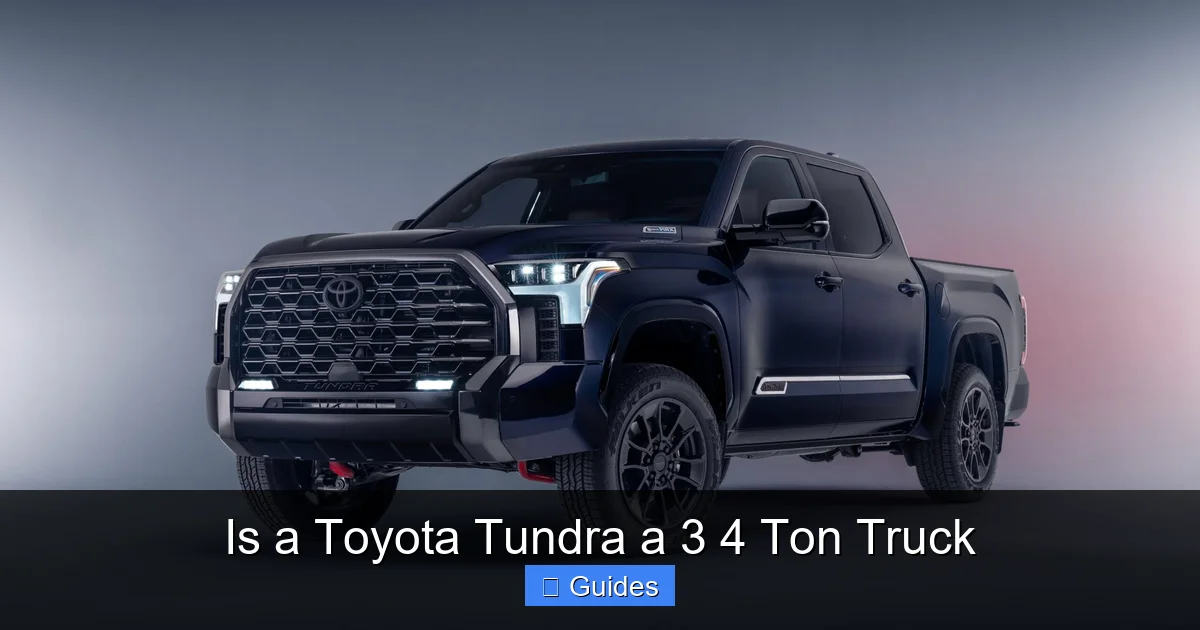
Now that we’ve cleared up the classification system, let’s take a closer look at the Toyota Tundra. Despite being a half-ton truck, it’s one of the most capable pickups in its class. Toyota has consistently pushed the envelope with the Tundra, offering powerful engines, a rugged frame, and impressive towing and payload numbers.
Tundra’s Official Classification
The Toyota Tundra is firmly in the half-ton category. It’s built on a body-on-frame chassis, uses independent front suspension (a rarity among full-size trucks), and is designed for everyday driving, light towing, and moderate hauling. Toyota markets it as a “full-size pickup” but never as a “3/4-ton” or “heavy-duty” truck.
That said, the Tundra’s capabilities often rival those of 3/4-ton trucks from just a few years ago. For example, the 2024 Tundra can tow up to 12,000 pounds when properly equipped—more than enough for most boat trailers, campers, and small construction equipment. Its maximum payload is 1,940 pounds, which is higher than many half-ton competitors.
Engine Options and Performance
One reason the Tundra feels so strong is its engine lineup. For years, it was one of the few half-ton trucks to offer a V8 engine as standard. The current generation (introduced in 2022) features two main powertrains:
- i-FORCE 3.4L Twin-Turbo V6: Produces 389 horsepower and 479 lb-ft of torque. This engine replaces the old 5.7L V8 and offers better fuel efficiency without sacrificing power.
- i-FORCE MAX 3.4L Twin-Turbo V6 Hybrid: Adds an electric motor for a combined 437 horsepower and 583 lb-ft of torque. This hybrid system provides instant torque and improved towing performance.
Both engines are paired with a 10-speed automatic transmission and are available in rear-wheel drive or four-wheel drive. The hybrid version, in particular, gives the Tundra a significant advantage in towing and acceleration, making it feel more like a heavy-duty truck.
Towing and Payload Capabilities
Let’s look at the numbers. The 2024 Toyota Tundra has the following maximum capacities (depending on cab, bed, drivetrain, and engine configuration):
- Maximum Towing Capacity: 12,000 pounds
- Maximum Payload Capacity: 1,940 pounds
- Gross Vehicle Weight Rating (GVWR): Up to 7,580 pounds
To put that in perspective, here’s how it compares to other trucks:
- Ford F-150 (half-ton): Up to 14,000 lbs towing, 3,325 lbs payload
- Ram 1500 (half-ton): Up to 12,750 lbs towing, 2,300 lbs payload
- Chevrolet Silverado 1500 (half-ton): Up to 13,300 lbs towing, 2,280 lbs payload
- Ford F-250 (3/4-ton): Up to 22,800 lbs towing, 4,270 lbs payload
As you can see, the Tundra’s towing is competitive with other half-ton trucks, but it doesn’t match the 3/4-ton F-250. However, its payload is actually higher than some half-ton rivals, which is impressive.
Real-World Performance
In real-world use, the Tundra shines. Owners report smooth towing with minimal sway, even with large trailers. The hybrid powertrain provides excellent low-end torque, making it easy to get a heavy load moving. The truck’s suspension is tuned for comfort, but it’s also capable off-road, especially in the TRD Pro trim.
One practical example: A Tundra owner towing a 10,000-pound travel trailer through the mountains reported stable handling and strong braking, thanks to the integrated trailer brake controller and robust chassis. Another owner used their Tundra to haul a 1,800-pound load of construction materials to a job site—well within its payload limit.
These examples show that while the Tundra isn’t a 3/4-ton truck, it can handle many of the same tasks—especially for weekend adventurers, small business owners, and daily drivers who occasionally need extra power.
How the Tundra Compares to True 3/4-Ton Trucks
Visual guide about Is a Toyota Tundra a 3 4 Ton Truck
Image source: toyotafiringorder.com
To truly answer the question “Is a Toyota Tundra a 3/4-ton truck?” we need to compare it directly to actual 3/4-ton trucks like the Ford F-250, Ram 2500, and Chevrolet Silverado 2500.
Key Differences in Design and Engineering
3/4-ton trucks are built with heavier-duty components to handle more stress. Here’s how they differ from the Tundra:
- Frame: 3/4-ton trucks have thicker, reinforced frames made from high-strength steel. The Tundra’s frame is strong, but not as heavy-duty.
- Suspension: 3/4-ton trucks use heavier springs, larger shocks, and often solid rear axles. The Tundra uses independent front suspension and a leaf-spring rear, which is lighter but less rugged.
- Axles and Differentials: 3/4-ton trucks have larger axles and locking differentials for better traction under heavy loads. The Tundra’s axles are designed for half-ton use.
- Brakes: 3/4-ton trucks have larger brakes to handle the extra weight. The Tundra’s brakes are adequate but not as robust.
- Towing Packages: 3/4-ton trucks often come with factory-installed gooseneck hitches, fifth-wheel prep, and enhanced cooling systems. The Tundra offers towing packages, but not to the same extent.
These differences mean that 3/4-ton trucks can handle heavier loads more safely and reliably over time. They’re better suited for commercial use, frequent towing, and extreme conditions.
Towing and Payload Comparison
Let’s compare the numbers:
- Toyota Tundra (half-ton): 12,000 lbs towing, 1,940 lbs payload
- Ford F-250 (3/4-ton): 22,800 lbs towing, 4,270 lbs payload
- Ram 2500 (3/4-ton): 19,680 lbs towing, 4,010 lbs payload
- Chevrolet Silverado 2500 (3/4-ton): 20,000 lbs towing, 3,968 lbs payload
As you can see, 3/4-ton trucks have nearly double the towing and payload capacity of the Tundra. This makes them ideal for heavy trailers, large RVs, and commercial hauling.
When to Choose a 3/4-Ton Over the Tundra
You should consider a 3/4-ton truck if:
- You regularly tow over 12,000 pounds
- You need to carry heavy loads frequently (e.g., construction materials, equipment)
- You plan to use a fifth-wheel or gooseneck trailer
- You drive in extreme conditions (mountains, deserts, off-road)
- You need a truck for commercial or fleet use
For most personal use—like towing a boat, hauling firewood, or weekend camping—the Tundra is more than capable. It’s also more fuel-efficient and easier to drive in the city than a bulky 3/4-ton truck.
Why the Tundra Feels Like a 3/4-Ton Truck
Even though the Tundra isn’t a 3/4-ton truck, many owners say it feels like one. This perception comes from several factors:
Robust Build Quality
Toyota is known for building durable, long-lasting vehicles, and the Tundra is no exception. It has a reputation for reliability, with many owners reporting 200,000+ miles with minimal issues. The truck’s solid feel on the road, combined with its high-strength steel frame, gives it a sense of toughness that rivals heavier-duty trucks.
Powerful Engine Options
The Tundra’s V6 and hybrid engines deliver strong performance, especially in low-end torque. The i-FORCE MAX hybrid, in particular, provides instant power that makes towing feel effortless. This gives the impression of a more capable truck, even if the underlying design is half-ton.
Competitive Towing and Payload
With 12,000 pounds of towing and nearly 2,000 pounds of payload, the Tundra outperforms many older 3/4-ton trucks. For example, a 2010 Ford F-250 could only tow around 12,500 pounds—just slightly more than the modern Tundra. This makes the Tundra feel like it’s in a higher class, even though it’s not.
Marketing and Perception
Toyota has marketed the Tundra as a “no-compromise” truck, emphasizing its power, reliability, and capability. This messaging, combined with its real-world performance, has led many buyers to believe it’s a 3/4-ton truck—even though it’s not.
Who Should Buy a Toyota Tundra?
The Tundra is an excellent choice for a wide range of buyers. Here’s who it’s best suited for:
- Weekend Warriors: If you tow a boat, camper, or ATV on weekends, the Tundra has the power and stability you need.
- Small Business Owners: For hauling tools, materials, or equipment, the Tundra’s payload and bed space are more than adequate.
- Daily Drivers: The Tundra is comfortable, quiet, and easy to drive in the city—unlike bulkier 3/4-ton trucks.
- Off-Road Enthusiasts: The TRD Pro trim offers excellent off-road capability with upgraded suspension, skid plates, and all-terrain tires.
- Long-Term Owners: Toyota’s reputation for reliability means the Tundra can last for decades with proper maintenance.
If you need maximum towing or frequent heavy hauling, a 3/4-ton truck may be a better fit. But for most people, the Tundra offers the perfect balance of power, efficiency, and everyday usability.
Conclusion: The Tundra Is a Half-Ton Hero
So, is a Toyota Tundra a 3/4-ton truck? The answer is clear: no. It’s a half-ton pickup truck, built and classified as such. But that doesn’t mean it’s any less capable.
The Tundra stands out in the half-ton category with its powerful engines, impressive towing and payload, and Toyota’s legendary reliability. It may not have the heavy-duty frame or suspension of a 3/4-ton truck, but it handles most tasks with ease—and often outperforms older models in that class.
Whether you’re towing a trailer, hauling gear, or just commuting to work, the Tundra delivers a confident, comfortable ride. It’s not trying to be a 3/4-ton truck—it’s just being the best half-ton truck it can be.
If you’re in the market for a full-size pickup, don’t dismiss the Tundra because of its classification. Test drive one, compare its specs, and see how it fits your needs. You might be surprised by how much this half-ton hero can do.
Frequently Asked Questions
Is the Toyota Tundra classified as a 3/4-ton truck?
No, the Toyota Tundra is officially classified as a half-ton truck. It falls into the same category as the Ford F-150 and Ram 1500, despite its strong towing and payload capabilities.
Can the Toyota Tundra tow as much as a 3/4-ton truck?
Not quite. The Tundra can tow up to 12,000 pounds, while most 3/4-ton trucks can tow over 20,000 pounds. However, the Tundra’s towing is competitive with other half-ton trucks and sufficient for most personal use.
What is the payload capacity of the Toyota Tundra?
The 2024 Toyota Tundra has a maximum payload capacity of 1,940 pounds, depending on the configuration. This is higher than many half-ton competitors but less than 3/4-ton trucks.
Why do some people think the Tundra is a 3/4-ton truck?
Because of its powerful engines, robust build quality, and strong towing capacity, the Tundra feels more capable than typical half-ton trucks. This leads to the misconception that it’s a 3/4-ton model.
Should I buy a Tundra or a 3/4-ton truck for heavy towing?
If you regularly tow over 12,000 pounds or need maximum payload, a 3/4-ton truck like the Ford F-250 is a better choice. For most other uses, the Tundra is more than capable and easier to drive daily.
Does the Tundra have a hybrid engine?
Yes, the 2024 Tundra offers the i-FORCE MAX hybrid powertrain, which combines a 3.4L twin-turbo V6 with an electric motor for 437 horsepower and 583 lb-ft of torque.

At CarLegit, we believe information should be clear, factual, and genuinely helpful. That’s why every guide, review, and update on our website is created with care, research, and a strong focus on user experience.