
The Nissan 56 V8, also known as the VK56DE, is a robust and powerful engine found in trucks and SUVs like the Titan and Armada. While it delivers strong torque and towing capability, it has some fuel efficiency and maintenance drawbacks. Overall, it’s a solid choice for those prioritizing power over economy.
In This Article
- 1 Key Takeaways
- 2 📑 Table of Contents
- 3 Introduction: The Legacy of the Nissan 56 V8
- 4 Engine Specifications and Design
- 5 Performance and Real-World Driving Experience
- 6 Reliability and Common Issues
- 7 Fuel Economy and Environmental Impact
- 8 Maintenance and Ownership Costs
- 9 Conclusion: Is the Nissan 56 V8 a Good Engine?
- 10 Frequently Asked Questions
Key Takeaways
- Powerful Performance: The VK56DE produces up to 320 horsepower and 390 lb-ft of torque, making it ideal for towing and heavy-duty use.
- Reliability with Maintenance: With proper care, the engine can last over 200,000 miles, but neglect can lead to timing chain and oil consumption issues.
- Fuel Economy Concerns: Expect 13–15 mpg combined, which is low compared to modern V6 and turbocharged engines.
- Common in Trucks and SUVs: Found in the Nissan Titan, Armada, and Infiniti QX56, it’s built for durability in full-size vehicles.
- Timing Chain Design: Unlike many engines with belts, the VK56 uses a timing chain, reducing replacement frequency but increasing repair complexity if it fails.
- Aftermarket Support: Moderate tuning and upgrade options exist, though not as extensive as GM or Ford V8s.
- Best for Towing and Hauling: If you need a dependable engine for work or recreation, the Nissan 56 V8 is a strong contender despite its flaws.
📑 Table of Contents
Introduction: The Legacy of the Nissan 56 V8
When you think of American muscle or Japanese engineering, the Nissan 56 V8 might not be the first engine that comes to mind. But for over a decade, this powerhouse has been quietly earning its place under the hood of some of Nissan’s most capable vehicles. Known officially as the VK56DE, the Nissan 56 V8 is a 5.6-liter naturally aspirated V8 engine that has powered everything from the rugged Nissan Titan pickup to the luxurious Infiniti QX56 SUV.
Launched in the mid-2000s, the VK56DE was Nissan’s answer to the growing demand for powerful, full-size trucks and SUVs in the North American market. At a time when domestic brands like Ford, GM, and Ram were dominating with their V8 offerings, Nissan needed a competitive engine that could hold its own in towing, hauling, and everyday driving. The result was a robust, aluminum-block V8 designed for durability and performance—though not without its quirks.
But is the Nissan 56 V8 a good engine? That’s the million-dollar question. The answer isn’t a simple yes or no. It depends on what you’re looking for in a vehicle. If you need raw power, towing capacity, and a proven track record in heavy-duty applications, the VK56DE shines. However, if fuel efficiency, low maintenance costs, or cutting-edge technology are your top priorities, you might want to look elsewhere. In this guide, we’ll dive deep into the strengths, weaknesses, and real-world performance of the Nissan 56 V8 to help you decide if it’s the right engine for your needs.
Engine Specifications and Design
Visual guide about Is the Nissan 56 V8 a Good Engine
Image source: low-offset.com
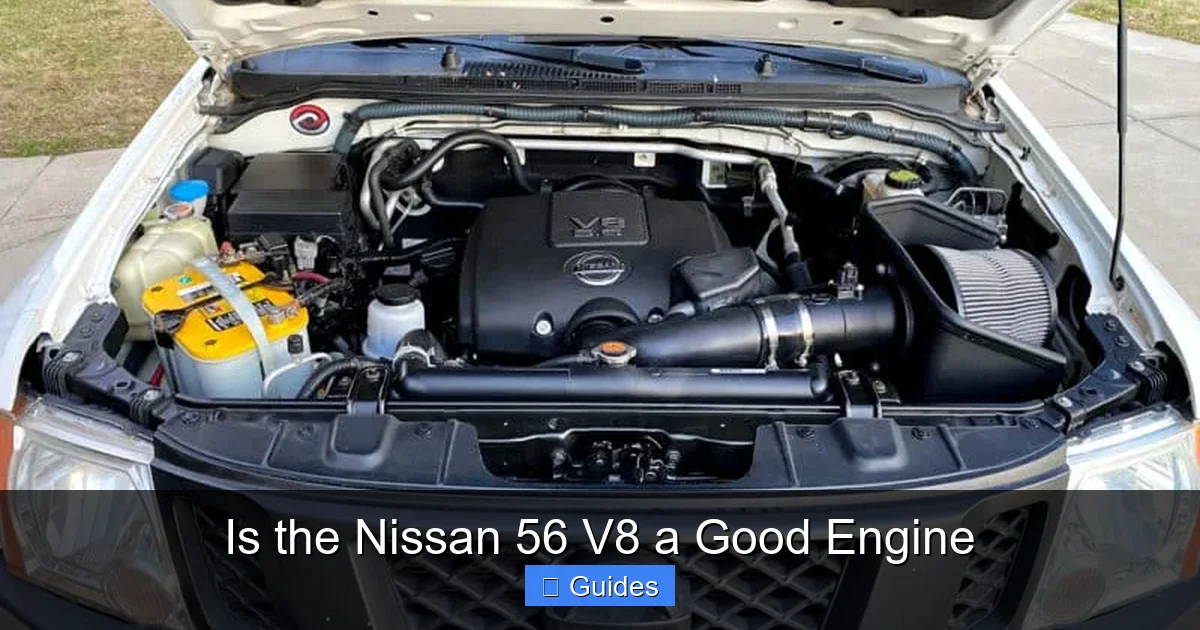
To truly understand whether the Nissan 56 V8 is a good engine, we need to start with the basics: what’s under the hood? The VK56DE is a 5.6-liter (5,552 cc) V8 engine with a 98mm bore and 92mm stroke. It features an aluminum block and cylinder heads, which help reduce overall weight compared to cast-iron designs. This lightweight construction contributes to better weight distribution and improved handling in vehicles like the Titan and Armada.
One of the standout features of the VK56DE is its timing chain system. Unlike many engines that use a timing belt—requiring replacement every 60,000 to 100,000 miles—the Nissan 56 V8 uses a durable timing chain. This means fewer scheduled maintenance interruptions and greater peace of mind for long-term ownership. However, if the chain does fail (usually due to poor oil maintenance), repairs can be expensive and labor-intensive, often requiring partial engine disassembly.
The engine operates on a dual overhead cam (DOHC) configuration with four valves per cylinder, allowing for efficient airflow and better combustion. It’s paired with a variable valve timing system (Nissan’s VVEL—Variable Valve Event and Lift), which helps optimize performance and fuel economy across different driving conditions. While not as advanced as some modern turbocharged systems, VVEL does give the VK56DE a smoother power delivery and improved responsiveness.
In terms of output, the VK56DE has seen slight variations over the years. Early versions (2004–2010) produced around 320 horsepower and 390 lb-ft of torque. Later revisions, especially in the 2017+ Titan, bumped output to 390 horsepower and 394 lb-ft of torque thanks to refinements in fuel injection and engine management. These numbers are competitive with other V8s in its class, such as the Ford 5.0L Coyote and the GM 5.3L V8, though they still lag behind high-output variants like the Ram 5.7L HEMI.
The engine is typically mated to a 5-speed automatic transmission in older models or a 7-speed automatic in newer applications. While not the most modern gearbox, it’s smooth and reliable, especially when paired with the V8’s broad torque curve. The combination delivers strong acceleration from a standstill and confident highway passing power.
Performance and Real-World Driving Experience
Visual guide about Is the Nissan 56 V8 a Good Engine
Image source: low-offset.com
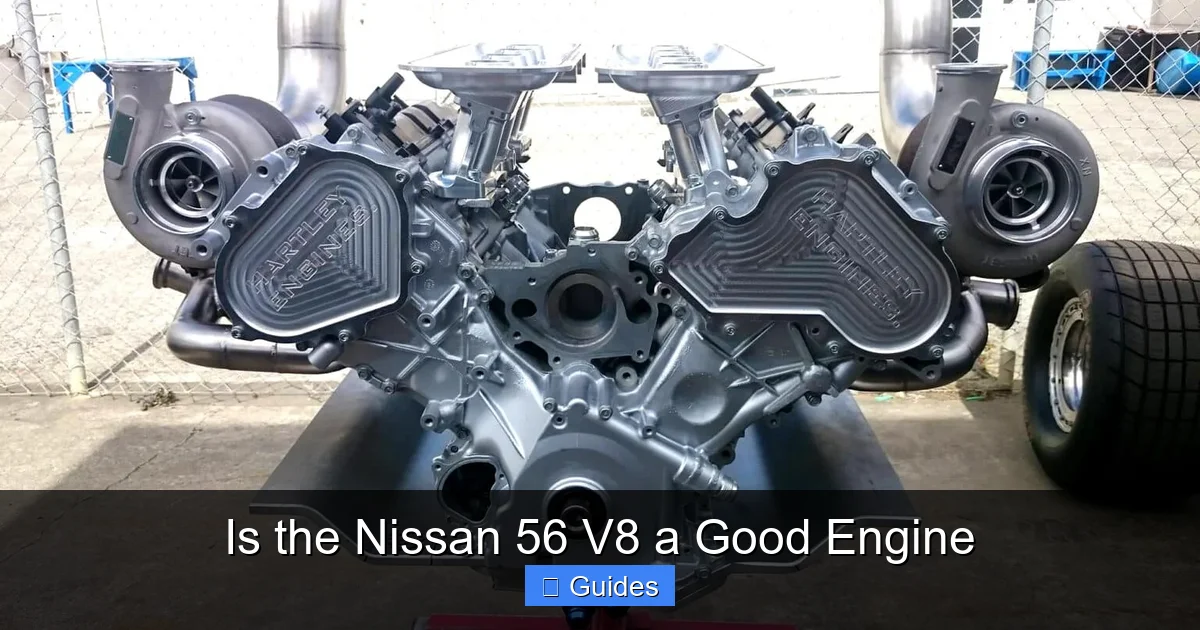
So, how does the Nissan 56 V8 actually perform on the road? In a word: solid. Whether you’re behind the wheel of a Nissan Titan or an Infiniti QX56, the VK56DE delivers a satisfying blend of power and refinement. The engine’s torque-rich nature means it feels strong even at low RPMs, making it ideal for towing trailers, hauling gear, or navigating steep inclines.
One of the biggest advantages of the VK56DE is its towing capacity. In the Nissan Titan, this engine can tow up to 9,740 pounds when properly equipped—enough to handle most boats, campers, and work trailers with ease. That’s on par with many competitors, and in some cases, it outperforms them. For example, the 2020 Titan with the VK56DE could out-tow the Ford F-150 with the 5.0L V8 in certain configurations, thanks to its higher torque output and robust chassis design.
Acceleration is another strong point. The Titan can go from 0 to 60 mph in around 6.5 seconds, which is impressive for a full-size truck. The Infiniti QX56, despite its size, feels surprisingly nimble for an SUV, with smooth power delivery and minimal turbo lag (since it’s naturally aspirated). The engine revs freely and sounds muscular under hard acceleration, giving drivers a sense of confidence and control.
However, performance doesn’t come without trade-offs. The Nissan 56 V8 is not known for its fuel efficiency. Expect real-world mileage in the range of 13–15 mpg combined, with highway numbers occasionally reaching 17–18 mpg if you drive conservatively. In city driving, especially with frequent stops and starts, you might see as low as 11–12 mpg. This is significantly worse than modern V6 engines or turbocharged four-cylinders, which can achieve 20+ mpg while still offering strong performance.
That said, if you’re using the vehicle for work or recreation—towing a trailer, hauling equipment, or driving long distances with a full load—the power and reliability of the VK56DE often outweigh the fuel costs. Many owners report that the engine feels “bulletproof” when maintained properly, and the peace of mind that comes with strong towing capability is worth the extra trips to the gas station.
Another aspect of the driving experience is noise and vibration. The VK56DE is relatively smooth for a V8, with minimal engine shake at idle and a refined exhaust note. It’s not as quiet as a luxury sedan, but it’s far from harsh or unpleasant. The engine compartment is well-insulated in vehicles like the Armada and QX56, so cabin noise remains manageable even at highway speeds.
Reliability and Common Issues
Visual guide about Is the Nissan 56 V8 a Good Engine
Image source: low-offset.com
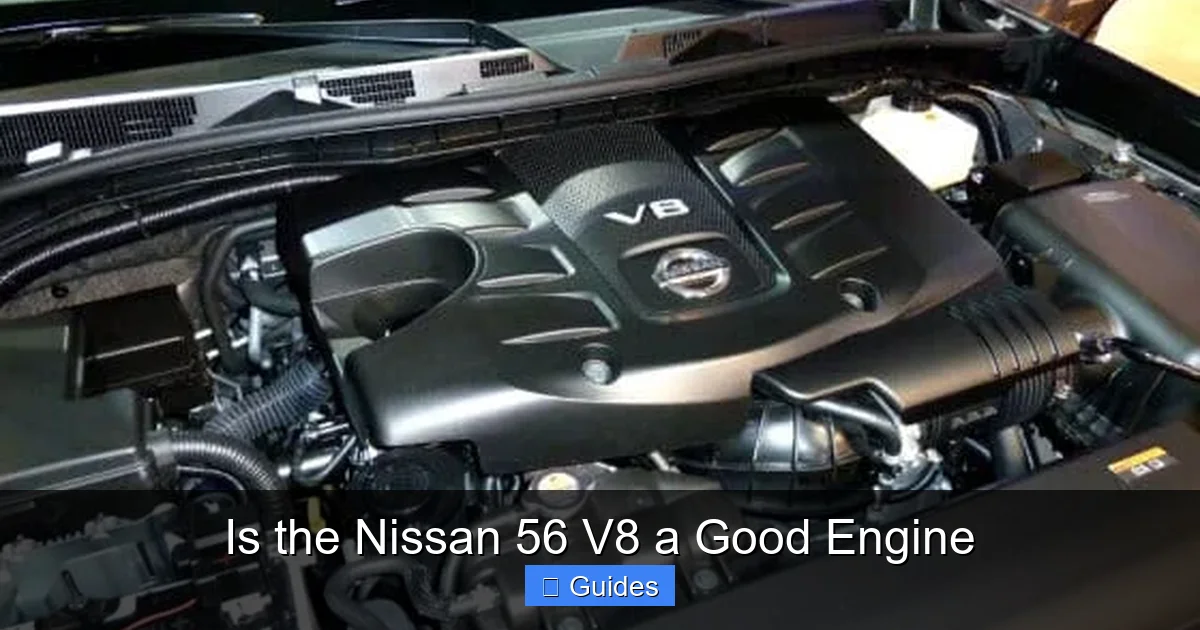
Now, let’s talk about one of the most important factors when evaluating any engine: reliability. Is the Nissan 56 V8 a good engine in terms of longevity and dependability? The short answer is yes—but with some caveats.
On the positive side, the VK56DE has a reputation for durability when properly maintained. Many owners report driving their Titan or Armada well beyond 200,000 miles without major engine issues. The aluminum block and heads are resistant to corrosion, and the timing chain design reduces the risk of catastrophic failure compared to belt-driven engines. Regular oil changes, using the correct viscosity (typically 5W-30), and following the maintenance schedule are key to keeping the engine running smoothly.
However, there are some known issues that potential buyers should be aware of. One of the most common problems is oil consumption. Some VK56DE engines, particularly those built between 2004 and 2010, have been known to burn oil at a higher rate than normal. This isn’t necessarily a sign of imminent failure, but it does require vigilance. Owners are advised to check oil levels regularly and top off as needed. In severe cases, worn piston rings or valve seals may be to blame, which can lead to more expensive repairs if left unaddressed.
Another concern is the timing chain tensioner. While the timing chain itself is durable, the hydraulic tensioners that keep it tight can wear out over time. If the tensioner fails, it can cause the chain to skip or make a rattling noise at startup. This is more common in high-mileage engines or those with poor oil maintenance. Replacing the tensioner is not a DIY job—it requires removing the front cover and often the oil pump—so labor costs can be high.
There have also been isolated reports of crankshaft position sensor failures, which can cause stalling or no-start conditions. These sensors are relatively inexpensive to replace, but diagnosing the issue can be tricky. Additionally, some early VK56DE engines experienced issues with the mass airflow (MAF) sensor, leading to poor fuel economy and rough idling. Cleaning or replacing the MAF sensor usually resolves the problem.
It’s worth noting that Nissan issued a technical service bulletin (TSB) for certain model years regarding excessive oil consumption, and in some cases, extended the warranty coverage for affected vehicles. If you’re considering a used Titan or Armada, it’s a good idea to check the vehicle’s service history and whether any recalls or TSBs have been addressed.
Overall, the Nissan 56 V8 is a reliable engine—especially in later model years—when cared for properly. It’s not perfect, but it’s far from the problematic powerplants of the past. With regular maintenance and attention to potential weak points, it can serve you well for many years.
Fuel Economy and Environmental Impact
Let’s face it: the Nissan 56 V8 is not winning any awards for fuel efficiency. With a combined EPA rating of around 13–15 mpg, it’s one of the thirstiest engines in its class. For comparison, the Ford F-150 with a 3.5L EcoBoost V6 can achieve over 20 mpg combined, while the Toyota Tundra’s 5.7L V8 manages about 15–16 mpg—only slightly better than the VK56DE.
So why does the Nissan 56 V8 consume so much fuel? Several factors contribute to its high fuel consumption. First, it’s a large-displacement, naturally aspirated V8. Without turbocharging or hybrid assistance, it relies on sheer engine size to produce power, which inherently requires more fuel. Second, the vehicles it powers—like the Titan and Armada—are heavy, with curb weights often exceeding 5,500 pounds. More weight means more energy is needed to move the vehicle, especially during acceleration.
Additionally, the VK56DE’s engine management system, while advanced for its time, lacks some of the efficiency-focused technologies found in newer engines. For example, it doesn’t feature cylinder deactivation (like GM’s Active Fuel Management) or stop-start systems that shut off the engine at idle. These features can improve fuel economy by 5–10%, but they’re absent in the Nissan 56 V8.
The environmental impact is another consideration. Higher fuel consumption means higher CO2 emissions. The VK56DE emits roughly 450–500 grams of CO2 per kilometer, which is significantly more than smaller, more efficient engines. For eco-conscious buyers, this is a major drawback. However, if you’re using the vehicle for work or towing, the emissions may be justified by the utility it provides.
That said, Nissan has made efforts to improve efficiency in later versions of the engine. The 2017+ Titan, for example, features improved aerodynamics, a more efficient transmission, and refined engine tuning that slightly boosts fuel economy. Still, it’s unlikely to match the efficiency of modern turbocharged or hybrid powertrains.
For buyers who prioritize fuel economy, the Nissan 56 V8 may not be the best choice. But if you need the power and capability it offers, the fuel costs may be a worthwhile trade-off. Just be prepared to visit the pump more often than you might like.
Maintenance and Ownership Costs
Owning a vehicle with a Nissan 56 V8 isn’t just about the initial purchase price—it’s also about long-term costs. So, is the VK56DE expensive to maintain? The answer depends on how you drive and care for it.
On the plus side, routine maintenance is straightforward and relatively affordable. Oil changes every 5,000 to 7,500 miles, air filter replacements, and spark plug changes every 100,000 miles are standard. The timing chain eliminates the need for costly belt replacements, and the engine’s design is generally serviceable with common tools.
However, when problems do arise, repairs can be pricey. As mentioned earlier, timing chain tensioner issues or oil consumption problems may require specialized labor and parts. Additionally, because the VK56DE is used in full-size trucks and SUVs, components like brakes, suspension parts, and tires wear out faster and cost more to replace than in smaller vehicles.
Fuel costs are another ongoing expense. At current gas prices (as of 2024), driving 15,000 miles per year in a vehicle that gets 14 mpg will cost around $3,500–$4,000 annually in fuel. That’s significantly more than a more efficient vehicle.
Insurance and depreciation are also factors. Full-size trucks and SUVs tend to have higher insurance premiums and lose value faster than smaller cars. The Nissan Titan, for example, has historically had lower resale value compared to the Ford F-150 or Chevrolet Silverado, partly due to brand perception and market demand.
That said, many owners find the total cost of ownership reasonable given the vehicle’s capabilities. If you’re using the truck for work or recreation, the utility often outweighs the expenses. And with proper maintenance, the engine itself can last a long time without major overhauls.
Conclusion: Is the Nissan 56 V8 a Good Engine?
So, after all this—what’s the final verdict? Is the Nissan 56 V8 a good engine? The answer is: it depends on your needs.
If you’re looking for a powerful, reliable engine for towing, hauling, or driving a full-size truck or SUV, the VK56DE is an excellent choice. It delivers strong performance, proven durability, and a satisfying driving experience. It’s not the most fuel-efficient or technologically advanced engine on the market, but it makes up for it with raw capability and simplicity.
However, if you prioritize fuel economy, low maintenance costs, or cutting-edge features, you might want to consider alternatives like turbocharged V6s, hybrid systems, or diesel engines. The Nissan 56 V8 is a workhorse, not a racehorse—and that’s exactly what many drivers want.
In the end, the VK56DE stands as a testament to Nissan’s commitment to building tough, capable vehicles for the North American market. It may not be perfect, but for the right buyer, it’s a solid, dependable engine that gets the job done.
Frequently Asked Questions
Is the Nissan 56 V8 reliable?
Yes, the Nissan 56 V8 (VK56DE) is generally reliable when properly maintained. Many owners report driving over 200,000 miles without major engine issues, though oil consumption and timing chain tensioners can be concerns in some models.
What vehicles use the Nissan 56 V8 engine?
The VK56DE is found in the Nissan Titan pickup truck, Nissan Armada SUV, and the Infiniti QX56 luxury SUV. It has been used in these models from the mid-2000s through the 2020s.
How much horsepower does the Nissan 56 V8 produce?
Early versions produce around 320 horsepower, while later models (2017+) output up to 390 horsepower and 394 lb-ft of torque, depending on the vehicle and tuning.
What is the fuel economy of the Nissan 56 V8?
Expect 13–15 mpg combined, with highway driving potentially reaching 17–18 mpg. City mileage can drop to 11–12 mpg, especially under heavy load or towing.
Does the Nissan 56 V8 have a timing belt or chain?
The VK56DE uses a timing chain, which is more durable than a belt and doesn’t require regular replacement. However, if it fails, repairs can be complex and expensive.
Can the Nissan 56 V8 be tuned or modified?
Yes, there are aftermarket tuning options available, including performance chips, exhaust systems, and cold air intakes. However, support is not as extensive as for GM or Ford V8s.

At CarLegit, we believe information should be clear, factual, and genuinely helpful. That’s why every guide, review, and update on our website is created with care, research, and a strong focus on user experience.