
The Toyota 46 V8—more accurately known as the 1UZ-FE or 2UZ-FE—is widely regarded as one of the most reliable and durable engines ever built by Toyota. Found in luxury sedans and rugged SUVs alike, this V8 delivers smooth power, impressive longevity, and surprisingly good fuel economy for its size.
In This Article
- 1 Key Takeaways
- 2 📑 Table of Contents
- 3 Introduction: The Legend of the Toyota V8
- 4 What Is the Toyota 46 V8?
- 5 Performance and Power Output
- 6 Reliability and Longevity
- 7 Fuel Economy and Efficiency
- 8 Applications and Vehicle Compatibility
- 9 Cost of Ownership and Resale Value
- 10 Conclusion: Is the Toyota 46 V8 a Good Engine?
- 11 Frequently Asked Questions
Key Takeaways
- Exceptional Reliability: The Toyota 46 V8 is built with over-engineered components, allowing it to easily surpass 300,000 miles with proper maintenance.
- Smooth and Quiet Operation: Thanks to its 90-degree V8 design and advanced balance shafts, the engine runs with minimal vibration and noise.
- Proven Track Record: Used in high-mileage fleets and taxis worldwide, the engine has earned a reputation for durability in extreme conditions.
- Strong Towing and Hauling Capability: Especially in the 2UZ-FE variant, the engine delivers ample low-end torque, making it ideal for trucks and SUVs.
- Fuel Efficiency for a V8: While not a hybrid, the engine offers respectable fuel economy—especially in later models with electronic fuel injection and VVT-i.
- Low Maintenance Costs: Parts are widely available and repairs are straightforward, thanks to Toyota’s global service network.
- Resale Value Retention: Vehicles equipped with the Toyota 46 V8 often hold their value better than competitors due to engine reputation.
📑 Table of Contents
Introduction: The Legend of the Toyota V8
When people talk about legendary engines, names like the Ford Coyote, Chevrolet LS, or BMW M54 often come up. But quietly, in the background, Toyota has been building one of the most dependable V8 engines ever made—the so-called “Toyota 46 V8.” While it doesn’t have a flashy nickname like “Hemi” or “Godzilla,” this engine has earned respect through decades of real-world performance.
You might be wondering: “Is the Toyota 46 V8 a good engine?” The short answer is yes—especially if you value reliability, longevity, and smooth operation over raw horsepower. This engine powers some of Toyota’s most iconic vehicles, from the luxurious Lexus LS 400 to the rugged Land Cruiser and Tundra. It’s not the most powerful V8 on the market, but it’s one of the most trustworthy. Whether you’re considering buying a used Lexus, restoring a Land Cruiser, or just curious about engine engineering, understanding the strengths and quirks of the Toyota 46 V8 is essential.
What Is the Toyota 46 V8?
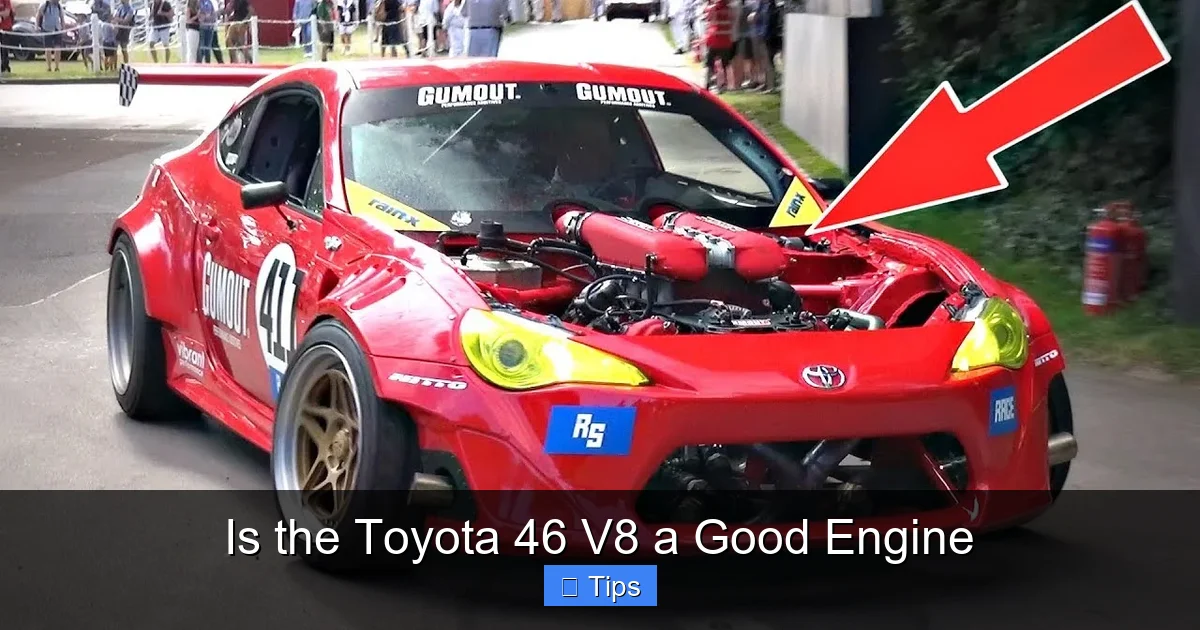
First things first—there’s a bit of confusion around the name. Toyota doesn’t officially call this engine the “46 V8.” That nickname comes from its approximate 4.6-liter displacement in some variants, though the engine family actually spans several sizes. The most common versions are the 1UZ-FE (4.0L) and the 2UZ-FE (4.7L), both of which are V8 engines built by Toyota from the late 1980s through the early 2010s.
Visual guide about Is the Toyota 46 V8 a Good Engine
Image source: i.ytimg.com
The 1UZ-FE: The Luxury Workhorse
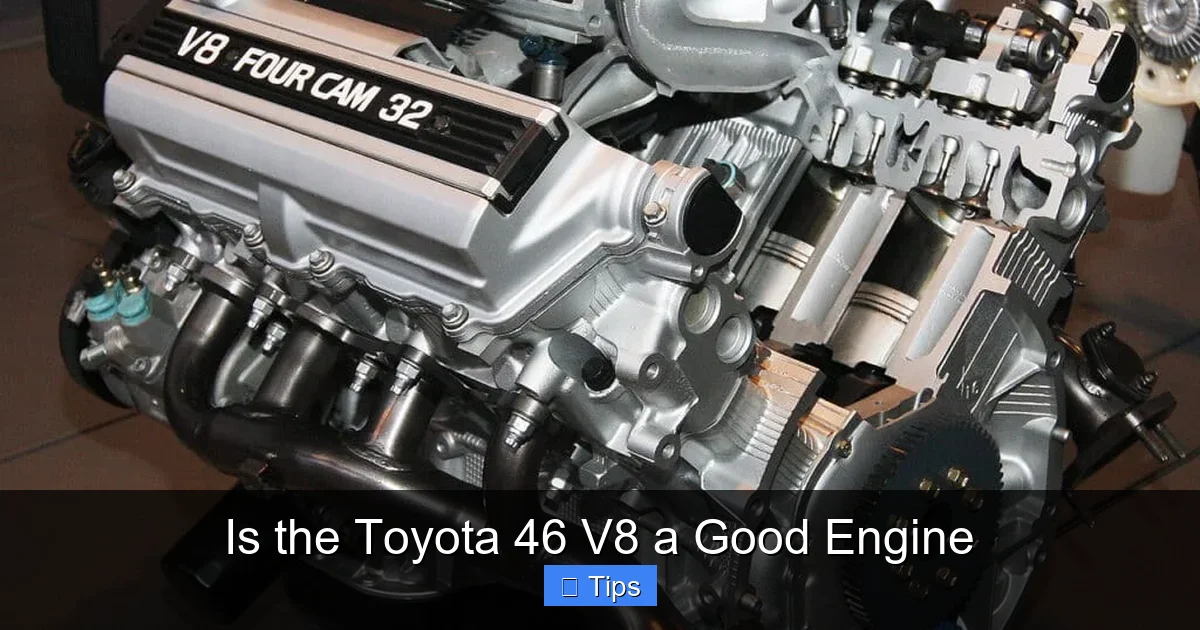
The 1UZ-FE debuted in 1989 with the first-generation Lexus LS 400. It was a 4.0-liter V8 that put out around 250 horsepower—modest by today’s standards, but groundbreaking at the time for its smoothness and quiet operation. Toyota designed it to compete with German luxury sedans, and it succeeded by focusing on refinement over brute force. The engine featured an aluminum block and heads, dual overhead camshafts (DOHC), and a 90-degree V-angle for optimal balance.
The 2UZ-FE: Built for Toughness
The 2UZ-FE arrived in 2000, primarily for the Toyota Land Cruiser and Tundra. Displacing 4.7 liters, it produced around 235–270 horsepower and a stout 315–325 lb-ft of torque. Unlike the 1UZ-FE, the 2UZ-FE used a cast-iron block for added durability, making it ideal for towing, off-roading, and long-haul driving. It also introduced variable valve timing (VVT-i) in later models, improving efficiency and emissions.
Why “Toyota 46 V8”?
The nickname “Toyota 46 V8” likely stems from the 2UZ-FE’s 4.7-liter (285 cubic inch) displacement, which is close to 4.6 liters when rounded. Some enthusiasts also use it to refer to the engine’s torque output—around 320 lb-ft—which feels like “46” in a playful, exaggerated way. Regardless of the name, the engine family is known for one thing: doing its job without drama.
Performance and Power Output
Let’s be honest—the Toyota 46 V8 isn’t going to win any drag races against a Hellcat or a twin-turbo Supra. But that’s not what it was built for. This engine prioritizes smooth, linear power delivery over explosive acceleration. It’s the kind of engine that gets you from point A to point B with comfort and confidence, whether you’re cruising the highway or hauling a trailer up a mountain pass.
Visual guide about Is the Toyota 46 V8 a Good Engine
Image source: low-offset.com
Horsepower and Torque Numbers
The 1UZ-FE typically produces between 250 and 290 horsepower, depending on the model year and tuning. The 2UZ-FE, with its larger displacement and torque-focused design, delivers 235–270 horsepower and 315–325 lb-ft of torque. While these numbers may seem modest compared to modern turbocharged engines, they’re more than adequate for full-size SUVs and luxury sedans.
Real-World Driving Experience
Behind the wheel, the Toyota 46 V8 feels relaxed and effortless. There’s no need to rev it high to access power—the torque comes on early and stays strong through the mid-range. This makes it excellent for towing. A Land Cruiser with a 2UZ-FE can easily pull 7,000+ pounds, and the engine doesn’t break a sweat. The power delivery is so smooth that passengers barely notice gear shifts, especially in vehicles with well-tuned automatic transmissions.
0-60 and Top Speed
Acceleration times vary by vehicle weight and gearing. A Lexus LS 400 with a 1UZ-FE can do 0-60 mph in about 6.5 to 7.5 seconds—respectable for a luxury sedan of its era. The Land Cruiser, being heavier, takes closer to 9 seconds. Top speeds are electronically limited to around 115–130 mph, depending on the model. Again, this engine isn’t about speed—it’s about sustained performance and reliability.
Reliability and Longevity
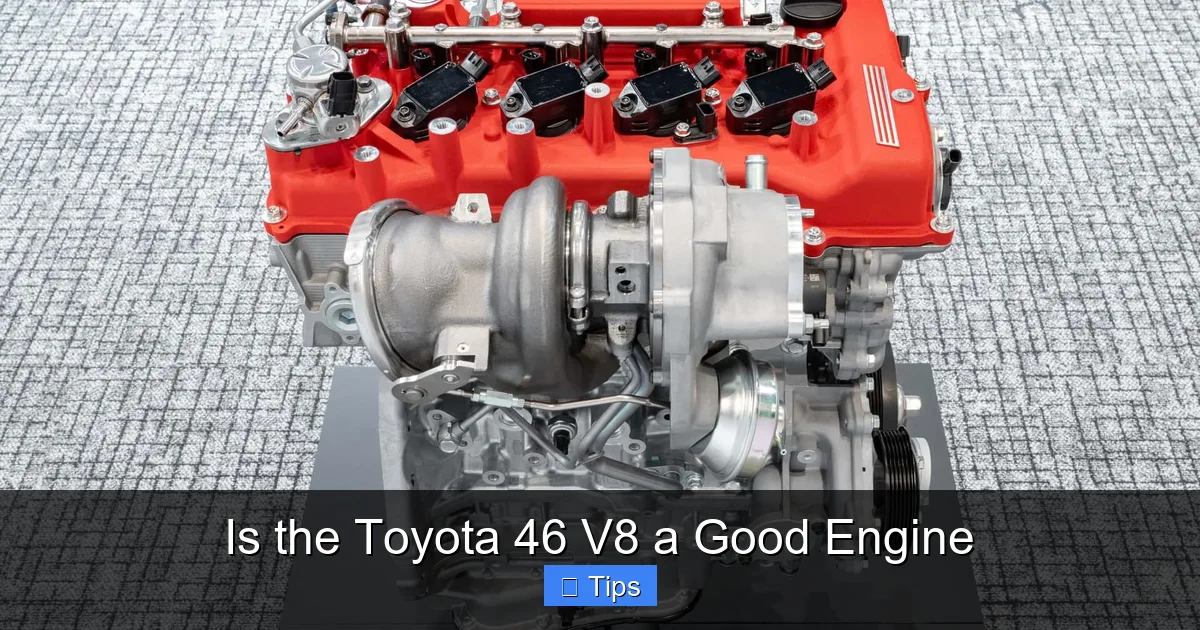
This is where the Toyota 46 V8 truly shines. If you’re looking for an engine that can run for decades with minimal issues, this is one of the best choices in the automotive world. Toyota engineered it with a “built to last” philosophy, using high-quality materials and conservative tuning.
Visual guide about Is the Toyota 46 V8 a Good Engine
Image source: cdn.motor1.com
Over-Engineered Design
The 1UZ-FE and 2UZ-FE were designed with a large margin of safety. Components like the crankshaft, connecting rods, and bearings are overbuilt compared to many competitors. The oiling system is robust, and the cooling system is efficient, even under heavy load. This means the engine can handle high mileage, extreme temperatures, and occasional neglect without catastrophic failure.
Real-World Mileage Examples
It’s not uncommon to find 1UZ-FE and 2UZ-FE engines with 250,000 to 350,000 miles still running strong. There are documented cases of these engines surpassing 400,000 miles with only routine maintenance. Fleet operators, taxi services, and long-haul drivers have relied on them for years. In fact, some Lexus LS 400s used as airport shuttles have logged over 500,000 miles with the original engine.
Common Issues (and How to Avoid Them)
No engine is perfect, and the Toyota 46 V8 has a few known quirks. The most common issue is the plastic timing belt tensioner on early 1UZ-FE engines, which can fail and cause timing belt slippage. The fix is simple: replace it with an upgraded metal tensioner during timing belt service. Another issue is oil consumption in high-mileage engines, often due to worn piston rings or valve seals. Regular oil changes with high-quality synthetic oil can help mitigate this.
Maintenance Tips for Longevity
- Change the oil every 5,000–7,500 miles using 5W-30 or 10W-30 synthetic oil.
- Replace the timing belt every 90,000–100,000 miles (or every 7–10 years).
- Use genuine Toyota coolant and flush the system every 2–3 years.
- Inspect and replace spark plugs every 60,000–100,000 miles.
- Keep the air filter clean and replace it annually.
Fuel Economy and Efficiency
For a V8 engine, the Toyota 46 V8 is surprisingly efficient—especially considering its size and torque output. While it won’t match a hybrid or a turbocharged four-cylinder, it holds its own against other naturally aspirated V8s of its era.
Real-World MPG Numbers
The 1UZ-FE in a Lexus LS 400 averages around 17–20 mpg in mixed driving, with highway numbers reaching 24–26 mpg. The 2UZ-FE in a Land Cruiser or Tundra gets about 14–17 mpg combined, depending on driving habits and load. These numbers are impressive for vehicles weighing over 4,500 pounds.
Factors That Affect Fuel Economy
Several factors influence fuel efficiency. Aerodynamics play a big role—sedans like the LS 400 are more efficient than boxy SUVs like the Land Cruiser. Driving style also matters; gentle acceleration and cruising at steady speeds can improve mileage. Later models with VVT-i and electronic throttle control are more efficient than early versions.
Is It Efficient Enough Today?
In today’s world of electrification and strict emissions standards, the Toyota 46 V8 isn’t the most efficient engine. But for drivers who need a reliable V8 for towing or long-distance travel, it’s still a solid choice. Plus, its durability means you’ll keep it longer, reducing the environmental impact of manufacturing a new vehicle.
Applications and Vehicle Compatibility
The Toyota 46 V8 has powered some of the most respected vehicles in Toyota’s lineup. Its versatility is a testament to its design—it works equally well in a luxury sedan and a rugged off-roader.
Lexus LS 400 and GS 400
The 1UZ-FE was the heart of the original Lexus LS 400, a car that shocked the luxury market with its quiet ride and bulletproof reliability. It also powered the GS 400, offering a sportier driving experience without sacrificing comfort. These cars are now classics, and their engines are a big reason why they’re still on the road.
Toyota Land Cruiser and Sequoia
The 2UZ-FE found a home in the Toyota Land Cruiser and Sequoia, where its torque and durability were put to the test. These vehicles are known for their off-road capability and towing strength, and the engine delivers without complaint. Even today, used Land Cruisers with the 2UZ-FE are in high demand.
Toyota Tundra (First Generation)
The first-gen Tundra (2000–2006) used the 2UZ-FE to compete with American full-size trucks. While it didn’t have the horsepower of a Ford or Chevy V8, it made up for it with reliability and smooth operation. Many Tundras from this era are still used as work trucks.
Other Applications
The engine also appeared in the Toyota Century (Japan’s luxury flagship), the Lexus LX 470, and even some industrial and marine applications. Its adaptability speaks to its robust design.
Cost of Ownership and Resale Value
One of the biggest advantages of the Toyota 46 V8 is its low cost of ownership. Parts are widely available, repairs are straightforward, and the engine’s reputation helps maintain strong resale values.
Parts Availability
Because these engines were used in so many vehicles over a long production run, parts are easy to find. You can get everything from gaskets and belts to complete long blocks from salvage yards, OEM suppliers, and aftermarket manufacturers. This keeps repair costs down, even for high-mileage vehicles.
Repair Costs
Routine maintenance is affordable, and major repairs—like timing belt replacements or water pump changes—are typically under $1,000 if you do some of the work yourself. Even engine rebuilds are relatively inexpensive compared to European or American V8s, thanks to the engine’s simple, durable design.
Resale Value
Vehicles with the Toyota 46 V8 tend to hold their value well. A well-maintained Land Cruiser or Lexus LS 400 can still fetch a good price, even with high mileage. Buyers know they’re getting a reliable engine, which reduces the perceived risk of purchasing a used car.
Conclusion: Is the Toyota 46 V8 a Good Engine?
So, is the Toyota 46 V8 a good engine? Absolutely—especially if you’re looking for reliability, longevity, and smooth performance. It may not have the horsepower of a modern turbocharged engine or the prestige of a German V8, but it excels in the areas that matter most to everyday drivers: dependability and ease of ownership.
This engine was built to last, and it shows. Whether you’re driving a Lexus across the country, towing a trailer with a Tundra, or exploring remote trails in a Land Cruiser, the Toyota 46 V8 delivers consistent, trouble-free performance. It’s a testament to Toyota’s engineering philosophy: build it right, and it will serve you well for decades. If you’re in the market for a used vehicle with a proven powerplant, you can’t go wrong with one powered by the Toyota 46 V8.
Frequently Asked Questions
What vehicles came with the Toyota 46 V8?
The Toyota 46 V8—referring to the 1UZ-FE and 2UZ-FE engines—was used in the Lexus LS 400, GS 400, Toyota Land Cruiser, Sequoia, Tundra (first generation), and Lexus LX 470. It also powered the Toyota Century in Japan.
How long does a Toyota 46 V8 engine last?
With proper maintenance, the Toyota 46 V8 can easily last 300,000 miles or more. Many examples have surpassed 400,000 miles with the original engine still running strong.
Is the Toyota 46 V8 fuel efficient?
For a V8, it’s quite efficient. The 1UZ-FE averages 17–20 mpg combined, while the 2UZ-FE gets 14–17 mpg. This is impressive for full-size vehicles with strong towing capacity.
What are common problems with the Toyota 46 V8?
The most common issue is the plastic timing belt tensioner on early 1UZ-FE engines, which can fail. Oil consumption in high-mileage engines is also possible. Both issues are preventable with regular maintenance.
Can you turbocharge a Toyota 46 V8?
Yes, the 2UZ-FE in particular responds well to turbocharging. Enthusiasts have built high-horsepower versions for drag racing and off-roading, though this requires significant modifications and tuning.
Is the Toyota 46 V8 expensive to maintain?
No, maintenance costs are relatively low. Parts are widely available, and the engine’s simple design makes repairs straightforward. Routine services like oil changes and timing belt replacements are affordable.

At CarLegit, we believe information should be clear, factual, and genuinely helpful. That’s why every guide, review, and update on our website is created with care, research, and a strong focus on user experience.