
Deciding on collision insurance for your 10-year-old car primarily hinges on whether its actual cash value truly outweighs the annual premium costs and your deductible. If your car’s market worth is low and you can comfortably afford potential out-of-pocket repairs or a replacement, dropping collision might be a smart financial move. Always weigh the financial risk against your peace of mind and the car’s importance to your daily life.
In This Article
- 1 Should I Have Collision Insurance On My 10 Year Old Car Now?
- 1.1 Key Takeaways
- 1.2 📑 Table of Contents
- 1.3 Understanding Collision Insurance: What It Covers and Why It Matters
- 1.4 The Core Dilemma: Vehicle Value vs. Insurance Cost
- 1.5 Factors to Consider When Deciding
- 1.6 Scenarios Where Collision Insurance Might Still Be a Good Idea (Even for a 10-Year-Old Car)
- 1.7 Scenarios Where Dropping Collision Insurance Makes Sense
- 1.8 Practical Steps for Making Your Decision and Saving Money
- 1.9 Data Table: Illustrative Cost-Benefit Analysis for Collision Insurance on a 10-Year-Old Car
- 1.10 Conclusion
- 1.11 Frequently Asked Questions
- 1.11.1 Should I keep collision insurance on my 10-year-old car?
- 1.11.2 What key factors should I consider when evaluating collision insurance for an older vehicle?
- 1.11.3 My 10-year-old car doesn’t have much value; does collision insurance still make sense?
- 1.11.4 What are the risks if I don’t have collision insurance on my 10-year-old car and get into an at-fault accident?
- 1.11.5 When is it generally a good idea to drop collision insurance on a 10-year-old car?
- 1.11.6 Are there any alternative coverages to consider if I decide to drop collision on my 10-year-old car?
Should I Have Collision Insurance On My 10 Year Old Car Now?
The rumble of a well-maintained, decade-old car can evoke a sense of pride and practicality. You’ve shared countless memories, navigated countless miles, and perhaps even mastered the art of DIY repairs. Your trusty vehicle, now celebrating its tenth birthday (or more!), has proven its worth time and again, becoming less of a mere asset and more of a loyal companion. But as the odometer ticks upward and the years roll by, a crucial question arises for every savvy car owner: Is it still financially sensible to carry collision insurance on a car that has seen a decade of service?
This isn’t just a simple yes or no question. The decision to keep or drop collision insurance on your older vehicle is a complex one, deeply intertwined with your personal finances, risk tolerance, driving habits, and the ever-changing market value of your beloved car. While the sentimental value might be through the roof, the cold, hard numbers often tell a different story when it comes to insurance payouts. Striking the right balance between protecting your investment and not overpaying for coverage requires careful consideration and a clear understanding of what collision insurance truly entails.
In this comprehensive guide, we’ll delve into the intricacies of collision insurance for your 10-year-old car. We’ll explore the factors that influence its value, the scenarios where retaining coverage might still be a wise choice, and when it might make more financial sense to self-insure. Our goal is to equip you with the knowledge and practical tools to make an informed decision that aligns perfectly with your individual circumstances, ensuring you drive forward with confidence, knowing you’ve made the smartest choice for your wallet and your peace of mind.
Key Takeaways
- Know Your Car’s ACV: Determine your vehicle’s actual cash value (ACV) immediately.
- Compare ACV to Deductible: If ACV is low, collision payout might not justify premium.
- Evaluate Premium vs. Risk: Is the collision premium worth the potential financial payout?
- Assess Your Replacement Fund: Can you afford to replace the car yourself if totaled?
- Consider Repair Cost Ratio: Will potential repair costs significantly exceed your car’s ACV?
- Calculate Savings Potential: Dropping collision can free up funds for other priorities.
📑 Table of Contents
- Understanding Collision Insurance: What It Covers and Why It Matters
- The Core Dilemma: Vehicle Value vs. Insurance Cost
- Factors to Consider When Deciding
- Scenarios Where Collision Insurance Might Still Be a Good Idea (Even for a 10-Year-Old Car)
- Scenarios Where Dropping Collision Insurance Makes Sense
- Practical Steps for Making Your Decision and Saving Money
- Data Table: Illustrative Cost-Benefit Analysis for Collision Insurance on a 10-Year-Old Car
- Conclusion
Understanding Collision Insurance: What It Covers and Why It Matters
Before we can decide whether collision insurance is right for your 10-year-old car, it’s essential to have a crystal-clear understanding of what this specific type of coverage provides. Many drivers often confuse collision insurance with other components of their auto policy, leading to misconceptions about its true value.
Defining Collision Insurance
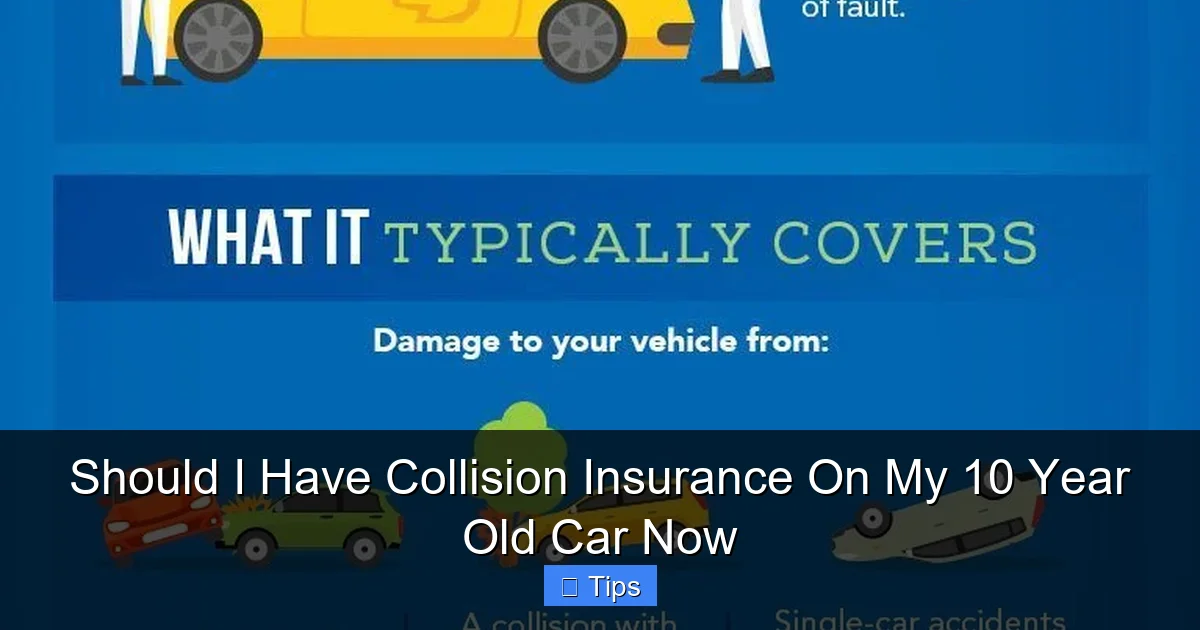
At its core, collision insurance is designed to cover the costs of repairing or replacing your car if it’s damaged in an accident with another vehicle or object, regardless of who is at fault. This includes hitting another car, a tree, a fence, or even rolling over. If you are involved in a fender bender or a more significant crash, your collision insurance policy is what typically kicks in to help cover the damage to your own vehicle. It’s important to note that this differs significantly from liability insurance, which covers damages you cause to other people’s property or injuries you inflict.
For instance, if you accidentally back into a pole in a parking lot, or if another driver broadsides you and they are uninsured or underinsured, your collision insurance would be the primary avenue for getting your car fixed. Without collision insurance, any damage to your vehicle resulting from such incidents would be an out-of-pocket expense.
The Role of Deductibles
An integral part of any collision insurance policy is the deductible. This is the amount of money you agree to pay out-of-pocket before your insurance company starts covering the remaining costs of a claim. Common deductible amounts range from $250 to $1,000, or even higher. For example, if you have a $500 deductible and your car sustains $3,000 worth of damage in an accident, you would pay the first $500, and your collision insurance provider would pay the remaining $2,500.
The deductible directly influences your premium: a higher deductible typically means a lower monthly or annual premium, and vice-versa. This relationship becomes particularly important when considering older vehicles, as adjusting your deductible can significantly impact the cost-benefit analysis of carrying collision insurance.
What Collision Insurance Doesn’t Cover (Briefly Differentiate from Comprehensive)
While crucial for accident-related damages, it’s equally important to understand what collision insurance does not cover. It specifically addresses damage from collisions. It does not cover:
- Damage from non-collision events like theft, vandalism, fire, natural disasters (hail, floods), or hitting an animal. These types of damages are typically covered by comprehensive insurance.
- Medical expenses for injuries to you or your passengers (covered by personal injury protection or medical payments coverage).
- Damage to other people’s property or their medical expenses (covered by liability insurance).
When assessing your overall insurance needs, especially for an older car, it’s vital to consider all these components. However, for the purpose of this discussion, our focus remains squarely on the utility and cost-effectiveness of collision insurance itself.
The Core Dilemma: Vehicle Value vs. Insurance Cost
The heart of the “should I have collision insurance on my 10-year-old car” debate lies in a fundamental financial comparison: the actual cash value of your vehicle versus the ongoing cost of the insurance premiums. As cars age, their financial worth typically diminishes significantly, creating a tipping point where paying for collision insurance may no longer make economic sense.
Visual guide about Collision Insurance 10 Year Old Car
Image source: allstate.com
How a Car’s Value Depreciates Over 10 Years
One of the most significant factors influencing this decision is depreciation. Most new cars lose a substantial portion of their value the moment they’re driven off the lot. This rapid decline continues, albeit at a slower pace, for the first few years. By the time a car reaches its 10th anniversary, its market value (often referred to as Actual Cash Value or ACV by insurance companies) can be a fraction of its original purchase price.
For example, a car that cost $30,000 new might only be worth $5,000-$8,000 after a decade, depending on its make, model, condition, mileage, and maintenance history. You can estimate your car’s current value using reliable resources like Kelley Blue Book (KBB.com), Edmunds.com, or NADAguides.com. These tools provide a realistic snapshot of what your car is worth if you were to sell it or what an insurance company would likely pay out in a total loss scenario.
When you purchase collision insurance, you’re essentially paying to protect that current market value. If your car is only worth $6,000, paying $800-$1,200 annually for collision insurance starts to look less appealing, especially when you factor in your deductible.
Calculating the “Worth It” Threshold: Premium vs. Payout
To determine if collision insurance is “worth it,” you need to do a simple calculation: compare the annual cost of your collision insurance premium (plus your deductible) to your car’s actual cash value (ACV).
Let’s consider an example:
- Your Car’s ACV: $7,000
- Annual Collision Insurance Premium: $900
- Your Deductible: $500
In this scenario, if your car is declared a total loss, the maximum payout you would receive from your insurer would be $7,000 (ACV) minus your $500 deductible, equaling $6,500. You’re paying $900 a year for the chance to receive $6,500. Over just a few years, your accumulated premiums could quickly eat into that potential payout. If you pay $900 for three years and then total the car, you’ve paid $2,700 in premiums for a $6,500 potential payout. This calculation becomes even more critical for a 10-year-old car where the ACV continues to decline.
A common rule of thumb is that if your annual collision insurance premium approaches or exceeds 10% of your car’s ACV, it might be time to reconsider the coverage. In our example, $900 is roughly 12.8% of $7,000, suggesting it might be on the higher side. This threshold is a guideline, not a hard rule, but it helps put the cost-benefit into perspective.
The “Total Loss” Scenario for Older Cars
For a 10-year-old car, even seemingly minor accidents can quickly lead to a “total loss” declaration. Insurance companies typically declare a car a total loss when the cost of repairs (plus salvage value) exceeds a certain percentage of its actual cash value (ACV). This percentage varies by state and insurer, but it’s often in the 70-80% range.
For instance, if your 10-year-old car has an ACV of $5,000, and it sustains $4,000 worth of damage in an accident, many insurers would declare it a total loss because $4,000 is 80% of $5,000. In such a case, you would receive the ACV (minus your deductible), which might only be $4,500 ($5,000 – $500 deductible). This payout might not be enough to replace your vehicle with another comparable 10-year-old car, let alone a newer one. This stark reality underscores why the decision about collision insurance becomes so critical for older vehicles.
Factors to Consider When Deciding
The decision to keep or drop collision insurance on your 10-year-old car is highly personal and depends on a confluence of individual circumstances. There’s no one-size-fits-all answer, so it’s essential to weigh various factors carefully.

Visual guide about Collision Insurance 10 Year Old Car
Image source: engineerine.com
Your Car’s Actual Cash Value (ACV)
As discussed, the ACV is arguably the most crucial financial metric. Before making any decisions, get an accurate, up-to-date valuation of your specific vehicle. Use multiple online resources (KBB, Edmunds) and consider your car’s condition, mileage, and any added features. If your car’s ACV is very low (e.g., below $3,000-$4,000), the cost of collision insurance might quickly outweigh any potential payout, making it less economical. Remember, the payout limit for collision insurance is your car’s ACV minus your deductible.
Practical Tip: Regularly check your car’s ACV. It’s not a static number, and it continues to decrease with time and mileage.
Your Financial Situation and Risk Tolerance
Can you afford to replace your 10-year-old car out-of-pocket if it’s totaled in an accident?
- If you have robust savings: If you have an emergency fund sufficient to buy another comparable used car (or even make a down payment on a newer one) without financial strain, then dropping collision insurance becomes a more viable option. You are essentially “self-insuring” the physical damage to your vehicle.
- If your budget is tight: If losing your car would create a significant financial hardship and you don’t have readily available funds for a replacement, then maintaining collision insurance, even on an older car, might be a necessary safety net. The peace of mind might be worth the premium.
Your personal comfort with risk also plays a role. Are you someone who prefers to minimize financial surprises, even at a recurring cost, or are you comfortable taking calculated risks?
Your Driving Habits and Accident History
Consider how and where you drive:
- Low-risk driver: If you have an impeccable driving record, rarely drive during peak hours, avoid congested areas, and generally drive fewer miles, your statistical risk of an accident is lower. This might lean you towards dropping collision insurance.
- High-risk driver or frequent commuter: If you have a history of minor accidents, commute daily in heavy traffic, or frequently drive in challenging conditions (e.g., icy roads, busy city centers), your risk exposure is higher. In such cases, the likelihood of needing collision insurance increases, making it a more prudent choice, even for an older vehicle.
Think about who else drives your car too. If a new, less experienced driver in your household also uses the 10-year-old car, that also increases the overall risk profile.
The Cost of Your Collision Insurance Premium
Get a precise quote for collision insurance on your specific 10-year-old car. Premiums can vary significantly based on your location, driving record, credit score (in some states), and even the make/model of the car itself. A premium that seems excessively high compared to your car’s ACV is a red flag.
Practical Tip: Don’t just accept your current insurer’s rate. Shop around with multiple insurance providers to ensure you’re getting the most competitive price for collision insurance. Even a few hundred dollars difference can change the entire cost-benefit analysis for an older vehicle.
Availability of Alternative Transportation
What would you do if your 10-year-old car was suddenly inoperable after an accident?
- Multiple vehicles: If you have a second family car, or ready access to public transportation, ride-sharing services, or a bicycle, the immediate need for a replacement vehicle might not be as pressing.
- Sole mode of transport: If your 10-year-old car is your only means of getting to work, school, or essential appointments, losing it without funds for a quick replacement could severely disrupt your life. In this scenario, collision insurance provides a financial buffer.
The practical implications of being without a car should heavily factor into your decision-making process.
Scenarios Where Collision Insurance Might Still Be a Good Idea (Even for a 10-Year-Old Car)
While the depreciated value of a 10-year-old car often makes dropping collision insurance seem logical, there are several compelling reasons why maintaining this coverage might still be a wise financial and practical decision for some car owners.

Visual guide about Collision Insurance 10 Year Old Car
Image source: autodeal.com.ph
High Resale Value or Specialty Vehicle
Not all 10-year-old cars are created equal. Some makes and models retain their value exceptionally well due to reliability, reputation, or desirability. This is especially true for certain luxury vehicles, sports cars, or even well-preserved classic cars that might technically be 10 years old but hold a higher market value than typical sedans. If your 10-year-old car is still valued at, say, $15,000 or more because it’s a specialty model or meticulously maintained, then the argument for keeping collision insurance is much stronger. The potential payout still represents a significant sum that would be difficult to replace out-of-pocket.
Practical Example: A 10-year-old Honda S2000 or a well-kept Lexus LS might still command a respectable price, making collision insurance a sensible investment for protecting that higher residual value.
You Rely Heavily on Your Car
For many individuals, their car isn’t just a convenience; it’s an absolute necessity. If your 10-year-old car is your primary mode of transportation and losing it would jeopardize your employment, your ability to run essential errands, or care for dependents, then the cost of collision insurance might be a small price to pay for critical financial protection. If you don’t have readily available funds to purchase a replacement vehicle quickly after an accident, collision insurance provides that safety net, allowing you to get back on the road with minimal disruption.
Consider the cost of being without your car – daily rental fees, ride-sharing expenses, or lost income – and compare that to your annual collision insurance premium. For many, the security outweighs the cost.
Peace of Mind is Priceless
Sometimes, the decision isn’t purely financial. For some drivers, the psychological comfort and peace of mind that comes with knowing their vehicle is protected, regardless of its age, is invaluable. They prefer to avoid the stress and potential financial burden of repairing or replacing their car themselves after an accident. If having collision insurance allows you to drive with less anxiety and more confidence, and you can comfortably afford the premiums, then it serves a purpose beyond strict monetary calculation. This is particularly true if you are prone to worrying about unexpected expenses.
Practical Tip: Weigh your personal comfort level with risk against the financial savings. If the potential stress of an uninsured accident outweighs the savings, keeping collision insurance might be the right choice for you.
High Deductible Strategy
If you’re torn between dropping collision insurance entirely and keeping it, a common compromise is to opt for a higher deductible. Raising your deductible from, say, $500 to $1,000 or $1,500 can significantly lower your annual premium for collision insurance. This strategy reduces your out-of-pocket costs for coverage while still providing a financial buffer in the event of a major accident. You assume a greater portion of the risk for smaller damages but still have protection against a total loss, where the payout would be more substantial.
This approach can be particularly beneficial for a 10-year-old car, as it allows you to retain some level of protection at a more budget-friendly price point, making the cost-benefit analysis more favorable. You’re still paying less for collision insurance, but you’re not completely exposed to the risk of a severe financial hit if your car is totaled.
Scenarios Where Dropping Collision Insurance Makes Sense
While there are compelling reasons to keep collision insurance on an older car, for many owners of a 10-year-old vehicle, the financial realities often dictate that dropping this coverage is the most sensible decision. This isn’t about being reckless; it’s about being financially strategic.
Your Car’s ACV is Low and Premium is High
This is the most common and compelling reason to drop collision insurance. If your 10-year-old car’s Actual Cash Value (ACV) has depreciated significantly – let’s say it’s only worth $3,000 to $5,000 – and your annual collision insurance premium is, for example, $700 or more, the math often doesn’t add up.
Consider this: if you pay $700 annually for collision insurance with a $500 deductible, your maximum potential payout for a total loss is $2,500 to $4,500 ($3,000-$5,000 ACV minus $500 deductible). It would take less than 4-7 years of premiums to equal or exceed that potential payout, even without an accident. If you’re paying a significant portion of your car’s value in premiums each year, you’re essentially self-insuring at a high cost, without accumulating any personal funds. At this point, you’re paying for protection that offers diminishing returns, making it an inefficient use of your money.
You Have Sufficient Savings to Replace the Car
If you have a healthy emergency fund or designated savings that could comfortably cover the cost of replacing your 10-year-old car (or at least provide a substantial down payment for another vehicle), then you are effectively in a position to “self-insure” for physical damage. Instead of paying hundreds of dollars annually to an insurance company, you could allocate those funds to your savings, growing your personal “car replacement” fund.
In this scenario, if your car is totaled, you simply use your savings to purchase another vehicle. This approach puts you in control of your funds and avoids paying premiums for an older asset that may not yield a significant return in a claim. It’s a strategic financial move for those with the means to absorb the potential loss.
Your Car is a Secondary Vehicle
If your 10-year-old car serves as a backup vehicle, an occasional commuter, or a weekend errand runner, rather than your primary mode of transportation, the financial risk associated with dropping collision insurance is considerably lower. In the event of an accident that renders it inoperable, you still have your primary vehicle or other transportation options to fall back on. The inconvenience and financial impact are less severe compared to relying solely on the older car. Many households choose to drop collision insurance on their least valuable, secondary vehicles to save on overall insurance costs.
While a history of accidents typically pushes insurance costs up, there’s a point where the premiums for collision insurance on a 10-year-old car can become prohibitively expensive due to a poor driving record. If your past claims or driving infractions have driven your collision insurance premium sky-high – perhaps making it 15-20% or more of your car’s ACV – it becomes even less justifiable. The high cost of coverage in relation to the car’s actual value means you’re almost certainly overpaying for the protection. In such extreme cases, rather than continuing to pay exorbitant premiums for an older vehicle, it might be more financially prudent to accept the risk of self-insuring and focus on improving your driving record.
Practical Steps for Making Your Decision and Saving Money
Deciding whether to keep collision insurance on your 10-year-old car requires a methodical approach. Here are practical steps to guide you through the process and potentially save you money.
Get an Accurate Valuation of Your Car
This is the cornerstone of your decision. Don’t guess; get hard data. Use reputable online valuation tools like:
- Kelley Blue Book (KBB.com): Enter your car’s specific details, including mileage, condition, and options, to get a private party, trade-in, and retail value.
- Edmunds.com: Similar to KBB, Edmunds provides detailed valuations.
- NADAguides.com: Another reliable source, often used by dealerships and insurance companies.
Always use the “private party value” or “trade-in value” as a realistic benchmark for what an insurer would pay out in a total loss, as this is typically closer to the Actual Cash Value (ACV). Document this value.
Obtain Multiple Insurance Quotes
Don’t assume your current insurer offers the best rate for collision insurance. Call at least three to five different insurance companies (including your current one) and ask for quotes specifically for collision insurance on your 10-year-old car.
- Be sure to provide identical information to each insurer to ensure an apples-to-apples comparison.
- Inquire about the annual premium for collision insurance at various deductible levels (e.g., $500, $1,000, $1,500).
- This step will give you a clear picture of the market cost for collision insurance and help you identify if your current premium is competitive.
Re-evaluate Your Deductible
If you decide to keep collision insurance, consider increasing your deductible. As noted earlier, a higher deductible translates to a lower premium. For a 10-year-old car, accepting a $1,000 or even $1,500 deductible might significantly reduce your annual costs while still providing coverage for a major accident.
Practical Tip: Ensure you can comfortably afford your chosen deductible amount out-of-pocket if an accident occurs. There’s no benefit in a low premium if you can’t pay the deductible when you need to make a claim.
Explore Other Coverage Options (Comprehensive, Uninsured Motorist)
If you choose to drop collision insurance, don’t just cancel everything. You’ll still need legally required liability coverage, and you should strongly consider retaining other important coverages:
- Comprehensive Insurance: This covers non-collision events like theft, vandalism, fire, natural disasters, and hitting an animal. For many older cars, comprehensive insurance is still relatively inexpensive and can provide valuable protection for common risks. The ACV threshold for dropping comprehensive is often lower than for collision.
- Uninsured/Underinsured Motorist (UM/UIM) Coverage: This protects you if you’re hit by a driver who has no insurance or insufficient insurance to cover your damages and medical bills. While collision insurance covers your car’s physical damage if the at-fault driver is uninsured, UM/UIM can cover your medical costs and potentially property damage beyond your collision limits or if you haven’t retained collision insurance.
Dropping collision insurance doesn’t mean you should drive completely unprotected.
Create a “Self-Insurance” Fund
If you decide to drop collision insurance, make a conscious effort to set aside the money you would have paid in premiums into a dedicated savings account. This “self-insurance” fund can grow over time and serve as your personal emergency fund for car repairs, maintenance, or ultimately, a replacement vehicle if your 10-year-old car is totaled.
Practical Example: If you save $700 a year that you previously spent on collision insurance, after three years you’ll have $2,100 in your fund, which could be a significant portion of your car’s ACV. This approach gives you financial flexibility and builds your personal resilience against unexpected car-related expenses.
Data Table: Illustrative Cost-Benefit Analysis for Collision Insurance on a 10-Year-Old Car
To further illustrate the financial considerations, let’s look at a hypothetical scenario comparing the annual cost of collision insurance with potential payouts for a 10-year-old car with varying deductibles. This table highlights how the “value” of collision insurance diminishes as the car ages and the premium costs remain relatively stable or even increase due to other factors.
| Scenario | Estimated 10-Year-Old Car ACV | Annual Collision Premium | Deductible | Max Potential Payout (ACV – Deductible) | Premium as % of Max Payout | Years for Premiums to Equal Max Payout (approx.) |
|---|---|---|---|---|---|---|
| Low Value / High Deductible | $4,000 | $600 | $1,000 | $3,000 | 20.0% | 5.0 years |
| Low Value / Mid Deductible | $4,000 | $800 | $500 | $3,500 | 22.9% | 4.4 years |
| Mid Value / High Deductible | $7,000 | $750 | $1,000 | $6,000 | 12.5% | 8.0 years |
| Mid Value / Mid Deductible | $7,000 | $950 | $500 | $6,500 | 14.6% | 6.8 years |
| High Value / High Deductible | $12,000 | $1,000 | $1,000 | $11,000 | 9.1% | 11.0 years |
*Note: All values are hypothetical and for illustrative purposes only. Actual premiums, ACV, and payout percentages will vary based on numerous individual factors, including specific car model, location, driver history, and insurance provider.
This table clearly demonstrates how quickly annual collision insurance premiums can accumulate relative to the maximum potential payout, especially for lower-valued vehicles. The “Years for Premiums to Equal Max Payout” column is a critical indicator: if this number is low, it suggests that you might be paying a significant amount over a few years for a relatively small potential return, making dropping collision insurance a more attractive option. Conversely, for higher-valued older cars with lower premium percentages, the longevity of the coverage might still make sense.
Conclusion
Deciding whether to keep collision insurance on your 10-year-old car is a personal financial puzzle that requires careful assembly of various pieces. There’s no universal answer, as the “right” choice hinges on a blend of your car’s actual cash value, your financial resilience, your daily reliance on the vehicle, and your comfort with risk. While the sentimental value of a decade-old car can be immense, the hard numbers of depreciation and insurance premiums often paint a clear picture of diminishing returns for collision insurance.
Ultimately, the objective is to find the sweet spot where you’re adequately protected without overpaying for coverage that offers minimal financial benefit. By diligently assessing your car’s current market value, comparing it against the cost of your collision insurance premiums, evaluating your emergency savings, and considering your driving habits, you can arrive at a decision that truly makes sense for your unique circumstances. Whether you opt to maintain collision insurance for peace of mind or choose to self-insure and direct those savings into a dedicated fund, an informed decision is always the best decision. Drive confidently, knowing you’ve made a smart choice for your wallet and your trusty 10-year-old companion.
Frequently Asked Questions
Should I keep collision insurance on my 10-year-old car?
Deciding whether to keep collision insurance on a 10-year-old car largely depends on its current market value, the cost of your premium, and your personal financial situation. If the annual premium plus your deductible is a significant portion of the car’s actual cash value, it might not be the most financially prudent choice.
What key factors should I consider when evaluating collision insurance for an older vehicle?
When assessing collision insurance for your 10-year-old car, consider its Kelley Blue Book or NADA guide value, the amount of your deductible, and your annual premium. Also, think about your ability to pay for potential repairs or a replacement vehicle out-of-pocket if an accident occurs.
My 10-year-old car doesn’t have much value; does collision insurance still make sense?
If your 10-year-old car has a low market value, collision insurance often makes less financial sense. The payout you’d receive after a total loss or significant damage might barely exceed your deductible and the premiums you’ve paid over time, making it potentially not worth the cost.
What are the risks if I don’t have collision insurance on my 10-year-old car and get into an at-fault accident?
If you don’t have collision insurance on your 10-year-old car and cause an accident, you will be personally responsible for all repair costs to your own vehicle. This means you would need to pay out-of-pocket for any damage, or for a new car if it’s totaled, which can be a substantial unexpected expense.
When is it generally a good idea to drop collision insurance on a 10-year-old car?
It’s often considered wise to drop collision insurance on a 10-year-old car when its actual cash value (ACV) approaches or falls below the combined cost of your annual premium and deductible. At this point, you’re paying a lot for coverage that offers minimal financial return in the event of a claim.
Are there any alternative coverages to consider if I decide to drop collision on my 10-year-old car?
Even if you drop collision insurance, you should maintain liability coverage, which is legally required and protects others. You might also consider comprehensive insurance for non-collision damage like theft or weather, and potentially uninsured motorist property damage coverage to protect your car if an uninsured driver hits you.

At CarLegit, we believe information should be clear, factual, and genuinely helpful. That’s why every guide, review, and update on our website is created with care, research, and a strong focus on user experience.