
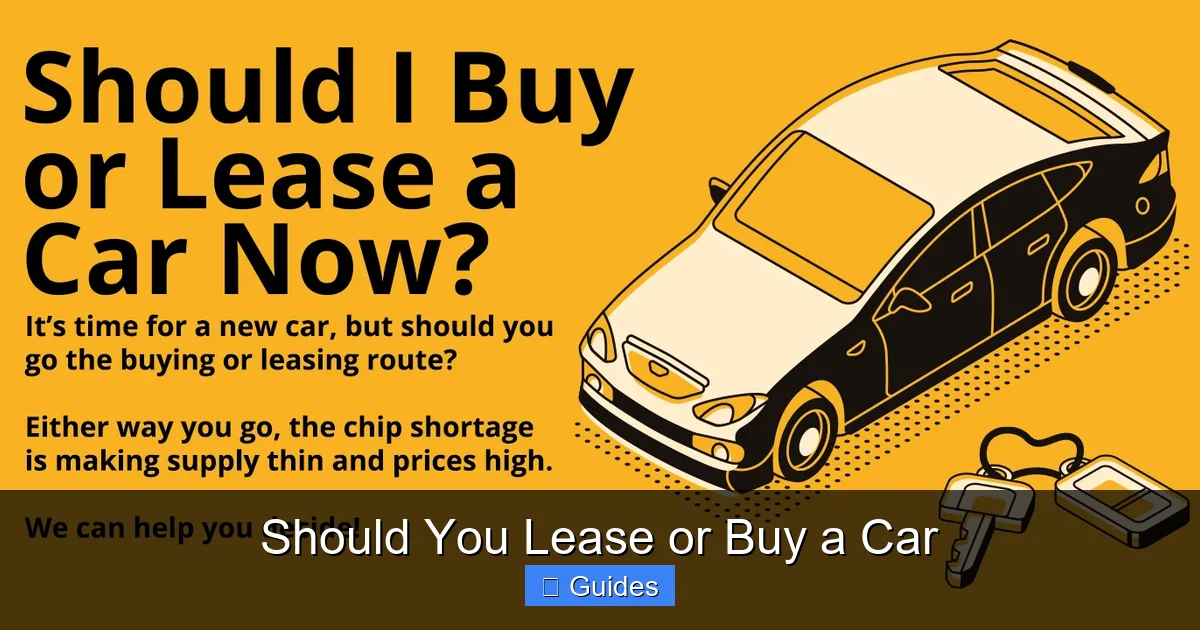
Leasing a car offers lower monthly payments and the chance to drive newer models every few years, but you don’t build equity. Buying a car means higher upfront costs but long-term savings and ownership—ideal if you plan to keep it for many years.
In This Article
- 1 Key Takeaways
- 2 📑 Table of Contents
- 3 Should You Lease or Buy a Car? A Complete Guide to Making the Right Choice
- 4 Understanding Car Leasing: What It Is and How It Works
- 5 Understanding Car Buying: Ownership, Equity, and Long-Term Value
- 6 Cost Comparison: Leasing vs. Buying Over Time
- 7 Lifestyle and Practical Considerations
- 8 Tips for Making the Best Decision
- 9 Final Thoughts: Which Is Right for You?
- 10 Frequently Asked Questions
Key Takeaways
- Leasing is best for short-term use: If you like driving new cars every 2–4 years and want lower monthly payments, leasing might be the better choice.
- Buying builds equity: When you buy, you own the car outright after the loan is paid off, and it becomes an asset you can sell or trade in.
- Mileage limits matter in leasing: Most leases come with annual mileage caps (usually 10,000–15,000 miles), and exceeding them can result in hefty fees.
- Maintenance costs differ: Leased cars are typically under warranty, so repairs are often covered, while owned cars may require out-of-pocket maintenance as they age.
- Down payments and fees vary: Leases often require less money down but include acquisition fees and other charges; buying may need a larger down payment but fewer recurring fees.
- Customization is limited with leasing: You can’t modify a leased vehicle without risking penalties, whereas owned cars can be personalized freely.
- Long-term cost favors buying: Over time, owning a car is usually cheaper than continuously leasing new ones, especially if you keep the vehicle beyond its loan term.
📑 Table of Contents
- Should You Lease or Buy a Car? A Complete Guide to Making the Right Choice
- Understanding Car Leasing: What It Is and How It Works
- Understanding Car Buying: Ownership, Equity, and Long-Term Value
- Cost Comparison: Leasing vs. Buying Over Time
- Lifestyle and Practical Considerations
- Tips for Making the Best Decision
- Final Thoughts: Which Is Right for You?
Should You Lease or Buy a Car? A Complete Guide to Making the Right Choice
So, you’re in the market for a new car. You’ve done your research, narrowed down your options, and now you’re staring at two big decisions: should you lease or buy? It’s a question that trips up even the most seasoned car shoppers. The truth is, there’s no one-size-fits-all answer—it all depends on your lifestyle, budget, driving habits, and long-term goals.
At first glance, leasing might seem like the more affordable option. Lower monthly payments, minimal down payments, and the thrill of driving a brand-new vehicle every few years can be tempting. But dig a little deeper, and you’ll find that leasing comes with strings attached—mileage limits, wear-and-tear fees, and no ownership at the end of the term. On the flip side, buying a car means higher monthly payments and more responsibility, but it also means you’ll eventually own something valuable. Once the loan is paid off, you’re driving for free (well, almost—gas, insurance, and maintenance still apply).
This guide will walk you through everything you need to know about leasing versus buying a car. We’ll break down the pros and cons, compare costs, explore real-life scenarios, and help you figure out which path aligns best with your needs. Whether you’re a first-time buyer, a commuter logging 20,000 miles a year, or someone who just loves the latest tech in a shiny new ride, we’ve got you covered.
Understanding Car Leasing: What It Is and How It Works
Leasing a car is essentially renting it for a fixed period—typically 24 to 36 months, though 48-month leases are becoming more common. Instead of paying for the entire value of the vehicle, you’re only paying for its depreciation during the lease term, plus interest and fees. Think of it like renting an apartment: you get to use it, but you don’t own it, and you have to follow certain rules.
Visual guide about Should You Lease or Buy a Car
Image source: treads.app
How Leasing Payments Are Calculated
Your monthly lease payment is based on three main factors: the car’s capitalized cost (what you agree to pay for it), the residual value (how much it’s expected to be worth at the end of the lease), and the money factor (the lease’s interest rate). For example, if you lease a $30,000 car with a 60% residual value after three years, you’re essentially financing $12,000—the amount it depreciates. Add in interest and fees, and that’s your monthly payment.
Pros of Leasing a Car
- Lower monthly payments: Because you’re only covering depreciation, not the full cost of the car, lease payments are typically 20–30% lower than loan payments for the same vehicle.
- Drive a new car more often: Most people lease for 2–4 years, meaning you can upgrade to the latest model with updated safety features, tech, and styling.
- Warranty coverage: Leased cars are usually under the manufacturer’s warranty for the entire lease term, so major repairs are often covered.
- Less sales tax in some states: In many states, you only pay sales tax on the monthly lease payments, not the full value of the car—saving you money upfront.
Cons of Leasing a Car
- No ownership: At the end of the lease, you return the car and walk away—no equity, no asset.
- Mileage restrictions: Most leases limit you to 10,000–15,000 miles per year. Go over, and you’ll pay 15–25 cents per extra mile.
- Wear and tear fees: Excessive damage (beyond “normal wear”) can result in charges when you return the car.
- Early termination penalties: Ending a lease early can be expensive, often costing thousands in fees.
- No customization: You can’t modify the car (like adding a spoiler or changing the interior) without risking penalties.
Who Should Consider Leasing?
Leasing makes the most sense for people who:
- Drive fewer than 12,000 miles per year
- Want lower monthly payments and minimal down payment
- Enjoy having the latest technology and safety features
- Don’t mind not owning the car long-term
- Can afford to keep leasing indefinitely (since you’ll always have a car payment)
For example, Sarah, a marketing executive in Chicago, leases a luxury sedan every three years. She drives about 10,000 miles annually, loves the latest infotainment systems, and doesn’t want the hassle of selling a used car. For her, leasing is a perfect fit.
Understanding Car Buying: Ownership, Equity, and Long-Term Value
Buying a car—whether with cash or a loan—means you’re purchasing the vehicle outright. Once the loan is paid off (usually in 3–7 years), you own the car free and clear. Unlike leasing, buying gives you full control: you can drive as much as you want, modify it, sell it, or keep it for decades.
Visual guide about Should You Lease or Buy a Car
Image source: quizondo.com
How Buying Payments Are Calculated
When you buy a car with a loan, your monthly payment depends on the purchase price, down payment, loan term, and interest rate. For example, a $30,000 car with a $5,000 down payment and a 5-year loan at 4% interest would result in monthly payments of around $460. Once the loan is paid off, those payments stop—except for insurance, gas, and maintenance.
Pros of Buying a Car
- Ownership and equity: After the loan is paid off, the car is yours. You can sell it, trade it in, or keep driving it for years.
- No mileage limits: Drive as much as you want without worrying about overage fees.
- Freedom to customize: Want to install a new stereo, paint job, or performance parts? Go for it—it’s your car.
- Long-term savings: Once the loan is paid off, you’re only paying for operating costs. Over 10+ years, this can save you tens of thousands compared to leasing.
- No wear-and-tear penalties: Normal dings and scratches won’t cost you extra when you sell or trade in the car.
Cons of Buying a Car
- Higher monthly payments: Loan payments are typically higher than lease payments because you’re paying for the full value of the car.
- Larger down payment: Most lenders require 10–20% down, which can be a hurdle for some buyers.
- Depreciation hits hard: New cars lose 20–30% of their value in the first year and about 50% after three years.
- Maintenance costs rise over time: As the car ages, repairs and upkeep become more frequent and expensive.
- Risk of being “upside-down”: If the car depreciates faster than you pay down the loan, you could owe more than it’s worth—a problem if you need to sell or trade it early.
Who Should Consider Buying?
Buying is ideal for people who:
- Plan to keep the car for 5+ years
- Drive more than 15,000 miles per year
- Want to avoid ongoing car payments in the long run
- Prefer to build equity and eventually own an asset
- Want the freedom to modify or personalize their vehicle
Take Mike, a delivery driver in Austin. He drives over 25,000 miles a year and needs a reliable, no-frills vehicle. He bought a used pickup truck with a 5-year loan. After paying it off, he plans to drive it for another 10 years. For Mike, buying was the clear winner.
Cost Comparison: Leasing vs. Buying Over Time
One of the biggest factors in deciding whether to lease or buy a car is cost. But it’s not just about monthly payments—it’s about total cost of ownership over time. Let’s break it down with a real-world example.
Visual guide about Should You Lease or Buy a Car
Image source: financialmentor.com
Scenario: $35,000 Car, 5-Year Timeline
Let’s compare leasing a $35,000 car for 36 months versus buying it with a 60-month loan.
Leasing Option:
- Capitalized cost: $35,000
- Residual value (60% after 3 years): $21,000
- Depreciation: $14,000
- Interest and fees: ~$3,000
- Total lease cost over 3 years: ~$17,000
- Monthly payment: ~$470
- At the end: Return the car, start a new lease
Buying Option:
- Purchase price: $35,000
- Down payment: $7,000
- Loan amount: $28,000
- Interest (5-year loan at 4%): ~$2,900
- Total cost over 5 years: ~$37,900
- Monthly payment: ~$515
- At the end: Own the car outright (worth ~$14,000 after 5 years)
Long-Term Financial Impact
Over 10 years, the difference becomes stark. If you lease continuously, you’ll pay about $56,400 (three 3-year leases at $470/month). If you buy and keep the car for 10 years, your total cost drops to around $37,900 (loan + maintenance), and you still own a car worth several thousand dollars.
This doesn’t mean leasing is always more expensive—some luxury brands depreciate slowly, and lease deals can be very competitive. But for most mainstream vehicles, buying wins in the long run.
Hidden Costs to Consider
Both leasing and buying come with hidden costs:
- Leasing: Acquisition fees ($500–$1,000), disposition fees ($300–$500 at lease end), excess mileage charges, wear-and-tear repairs.
- Buying: Sales tax (on full purchase price), higher insurance (especially for new cars), registration fees, and rising maintenance costs.
Always read the fine print and ask for a full breakdown of all fees before signing.
Lifestyle and Practical Considerations
Beyond numbers, your lifestyle plays a huge role in whether you should lease or buy a car. Ask yourself these questions:
How Many Miles Do You Drive?
If you’re a commuter, road-trip enthusiast, or gig worker (like Uber or DoorDash), you likely drive more than 15,000 miles a year. Leasing could cost you hundreds or even thousands in overage fees. Buying gives you the freedom to drive without limits.
Do You Like New Cars?
If you love having the latest tech—like adaptive cruise control, wireless Apple CarPlay, or a premium sound system—leasing lets you upgrade every few years. But if you’re happy with a reliable, slightly older model, buying used can save you a bundle.
Can You Handle Maintenance?
Leased cars are usually under warranty, so major repairs are covered. But once you own a car, especially after the warranty expires, you’re on the hook for everything—from oil changes to transmission replacements. If you’re not prepared for that responsibility, leasing might feel safer.
What’s Your Financial Situation?
Leasing requires less cash upfront, which can be great if you’re tight on savings. But buying builds equity and can improve your net worth over time. Also, if you have a low credit score, lease terms might be less favorable than loan terms.
Do You Plan to Move or Change Jobs?
Leasing offers flexibility—return the car and walk away. But if you’re planning a big life change (like moving across the country or switching careers), ending a lease early can be costly. Buying gives you more control, but selling a car quickly can be a hassle.
Tips for Making the Best Decision
Still unsure? Here are some practical tips to help you decide:
1. Run the Numbers
Use online calculators to compare total costs over 3, 5, and 10 years. Include insurance, fuel, maintenance, and resale value. Don’t forget to factor in your expected mileage.
2. Test Drive Both Options
Talk to dealers about lease and loan offers for the same car. Compare monthly payments, down payments, and terms. Sometimes, incentives make one option significantly better.
3. Consider Certified Pre-Owned (CPO)
CPO cars offer a middle ground: lower price than new, extended warranty, and often better loan rates. You get most of the benefits of a new car without the steep depreciation.
4. Negotiate Like a Pro
Whether leasing or buying, negotiate the capitalized cost (for leases) or purchase price (for loans). Dealers often inflate these to increase profits. Know the invoice price and use it as leverage.
5. Read the Fine Print
Lease agreements are full of clauses about mileage, wear, and early termination. Loan contracts include prepayment penalties and interest structures. Don’t skip the details.
6. Think Long-Term
Ask yourself: “Where will I be in 5 years?” If you see yourself in a different city, job, or life stage, your car needs might change. Choose the option that gives you the most flexibility.
Final Thoughts: Which Is Right for You?
So, should you lease or buy a car? The answer depends on your priorities. If you value lower payments, new technology, and hassle-free driving with minimal long-term commitment, leasing might be the way to go. But if you’re looking to save money over time, build equity, and enjoy the freedom of ownership, buying is likely the better choice.
There’s no shame in either path. Some people lease for a few years while saving up to buy their dream car. Others buy a reliable used vehicle and keep it for a decade. The key is to make an informed decision based on your budget, lifestyle, and goals—not just what the dealer is pushing.
Remember, a car is a tool, not a status symbol. Whether you lease or buy, the best choice is the one that fits your life—not the one that looks best on paper. Take your time, do your research, and drive away with confidence.
Frequently Asked Questions
Is it better to lease or buy a car for long-term savings?
Buying a car is generally better for long-term savings. Once your loan is paid off, you own the vehicle and only pay for operating costs, while leasing requires ongoing payments with no equity buildup.
Can you negotiate a car lease?
Yes, you can negotiate the capitalized cost, money factor, and other terms of a lease—just like when buying. Knowing the car’s invoice price and market value gives you leverage.
What happens at the end of a car lease?
At the end of a lease, you return the car to the dealership. You may be charged for excess mileage or wear and tear, but you can also choose to buy the car at its residual value.
Do you pay sales tax when leasing a car?
Yes, but in most states, you only pay sales tax on the monthly lease payments, not the full value of the car—which can result in lower overall tax compared to buying.
Can you lease a used car?
Some dealerships offer lease programs for certified pre-owned vehicles, but they’re less common. Most leases are for new cars with full warranties.
Is leasing a car a waste of money?
Not necessarily. Leasing can be a smart financial move if you drive low miles, want lower payments, and prefer driving new cars every few years—just don’t expect to build equity.

At CarLegit, we believe information should be clear, factual, and genuinely helpful. That’s why every guide, review, and update on our website is created with care, research, and a strong focus on user experience.