
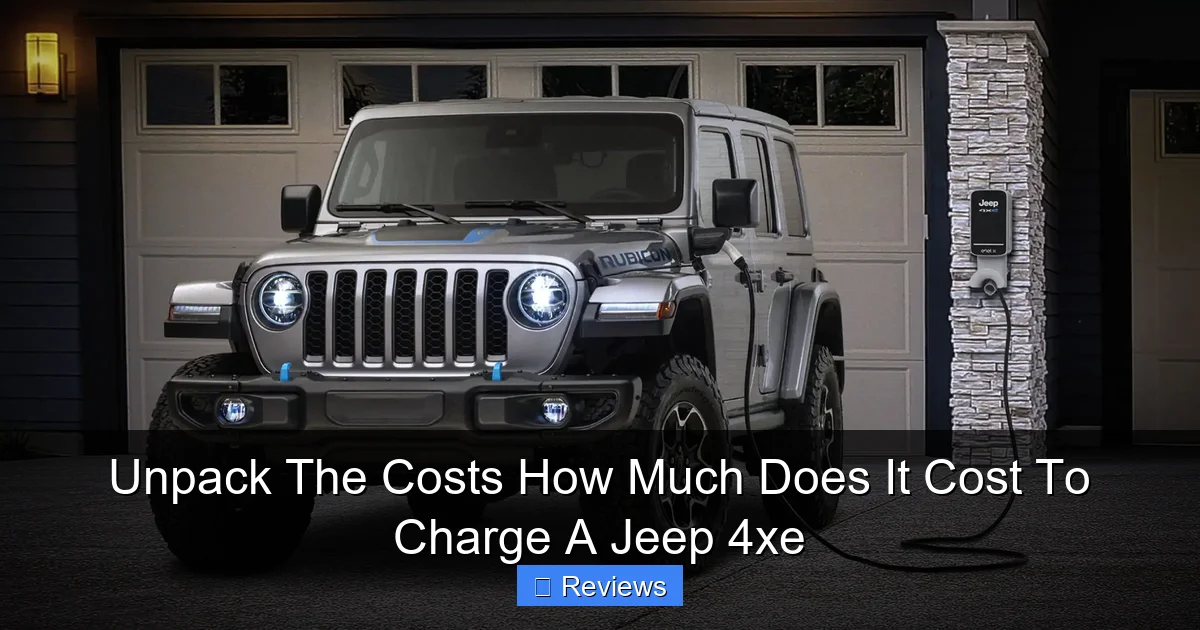
Featured image for how much does it cost to charge a jeep 4xe
Image source: storage.googleapis.com
The cost to charge a Jeep 4xe varies significantly, primarily dictated by local electricity rates and chosen charging method. While home charging can be highly economical, often just a few dollars for a full tank equivalent, public fast chargers are typically more expensive but offer greater convenience. Ultimately, understanding these variables allows owners to optimize their charging habits for maximum savings and a compelling blend of efficiency and capability.
The roar of an engine has long been synonymous with the spirit of adventure, especially when it comes to the iconic Jeep brand. Yet, a new, quieter revolution is transforming the trail – the advent of the Jeep 4xe. These innovative plug-in hybrid electric vehicles (PHEVs) like the Wrangler 4xe and Grand Cherokee 4xe seamlessly blend legendary off-road capability with the efficiency and eco-consciousness of electric power. As more enthusiasts embrace this exciting evolution, a common and critical question arises: How much does it truly cost to charge a Jeep 4xe?
For many prospective and current Jeep 4xe owners, understanding the financial implications of charging is paramount. Unlike traditional gasoline vehicles where the cost per gallon is a straightforward calculation, electric charging introduces a new set of variables. From electricity rates that fluctuate by region and time of day to the different types of charging available and the initial investment in home charging infrastructure, deciphering the true cost can feel like navigating a complex off-road trail without a map. But fear not, future and current trailblazers, because understanding these costs is simpler than it seems.
This comprehensive guide aims to demystify the cost of charging your Jeep 4xe. We’ll unpack every factor, from the basics of how these advanced hybrids work to the intricacies of different charging methods, public network pricing, and practical tips for maximizing your savings. By the end, you’ll have a clear understanding of what it takes to power your electrified adventure machine, empowering you to make informed decisions and enjoy your Jeep 4xe to its fullest, most economical potential.
In This Article
- 1 Key Takeaways
- 2 The Basics of Charging Your Jeep 4xe: Understanding PHEV Power
- 3 Level 1 Charging: The Everyday Wall Outlet Cost
- 4 Level 2 Charging: The Home and Public Charging Sweet Spot
- 4.1 What is Level 2 Charging and How it Benefits Your Jeep 4xe?
- 4.2 Faster Charging Speeds and Time to Full Charge
- 4.3 Home Level 2 Charging: EVSE and Installation Costs
- 4.4 Calculating Home Level 2 Charging Costs
- 4.5 Public Level 2 Charging: Pricing Models and Examples
- 4.6 Pros and Cons of Level 2 Charging for Your Jeep 4xe
- 5 Exploring Public Charging Networks and Their Pricing Models
- 6 Factors Influencing Your True Charging Costs
- 7 Data Table: Comparative Charging Costs for a Jeep 4xe
- 8 Maximizing Savings and Efficiency for Your Jeep 4xe
- 9 Conclusion: Powering Your Jeep 4xe Adventure Smartly
- 10 Frequently Asked Questions
- 10.1 What is the average cost to charge a Jeep 4xe?
- 10.2 How much does it cost to charge a Jeep 4xe at home?
- 10.3 What’s the typical cost for public charging a Jeep 4xe?
- 10.4 Is charging a Jeep 4xe cheaper than fueling a gasoline-powered Jeep?
- 10.5 What factors influence the cost to charge my Jeep 4xe?
- 10.6 How much does a full electric charge on a Jeep 4xe cost, and what range does it provide?
Key Takeaways
- Electricity rates vary: Your cost depends on local utility prices.
- Home charging is cheapest: Utilize your residential electricity rates.
- Public charging costs more: Convenience comes with a higher price per kWh.
- Full charge around $5-$15: Expect this range for a complete refill.
- Charge off-peak hours: Save significantly with time-of-use discounts.
- Battery size matters: Larger batteries mean higher per-charge costs.
The Basics of Charging Your Jeep 4xe: Understanding PHEV Power
Before diving into dollars and cents, it’s essential to grasp the fundamental mechanics of your Jeep 4xe‘s power system and how charging integrates into its operation. The “4xe” designation signifies Jeep’s commitment to four-wheel-drive electrified performance, offering a powerful blend of a turbocharged gasoline engine and two electric motors.
What Makes a Jeep 4xe a PHEV?
A Plug-in Hybrid Electric Vehicle (PHEV) like the Jeep 4xe offers the best of both worlds. It possesses a larger battery pack than a traditional hybrid, allowing it to travel a significant distance on electricity alone. Once the electric range is depleted, the gasoline engine seamlessly takes over, eliminating range anxiety that some all-electric vehicle owners might experience. This versatility means you can handle most daily commutes and errands solely on electric power, reserving the gasoline engine for longer journeys or when you need maximum power for challenging terrain. Understanding this dual-power system is crucial to appreciating the charging costs, as you’re offsetting gasoline consumption with electricity.
Jeep 4xe Battery Capacity and Electric Range
The core of your Jeep 4xe‘s electric capability lies in its battery. Both the Wrangler 4xe and the Grand Cherokee 4xe typically come equipped with a 17.3 kWh (kilowatt-hour) lithium-ion battery pack. This capacity dictates how much energy your vehicle can store and, subsequently, how far it can travel on electric power and how long it takes to charge. The electric range for the Wrangler 4xe is generally around 21 miles, while the Grand Cherokee 4xe offers a slightly higher range, often around 25 miles, depending on the model year, trim, and driving conditions. When calculating charging costs, this 17.3 kWh figure will be our baseline for a full charge, representing the total energy required to replenish the battery from empty.
Introduction to Charging Levels
Charging your Jeep 4xe isn’t a one-size-fits-all process. There are different “levels” of charging, each offering varying speeds and convenience, which directly impacts their cost-effectiveness and practicality for your lifestyle:
- Level 1 Charging (120V AC): This is the simplest and slowest method, using a standard household outlet (like the one you plug your phone into). Your Jeep 4xe comes with a charging cable for this.
- Level 2 Charging (240V AC): Significantly faster, Level 2 charging uses a dedicated charging station (often called an EVSE – Electric Vehicle Supply Equipment) installed at home or found in public locations. This requires a 240V outlet, similar to those for clothes dryers.
- Level 3 Charging (DC Fast Charging): While primarily for all-electric vehicles, some PHEVs can utilize Level 3 charging, though it’s less common for a Jeep 4xe due to its smaller battery and design. These are extremely fast but also the most expensive option, typically found at public charging hubs. We’ll focus mostly on Level 1 and Level 2 for the Jeep 4xe, as they are the primary charging methods.
Understanding these levels is the first step in comprehending the diverse cost landscape of powering your Jeep 4xe.
Level 1 Charging: The Everyday Wall Outlet Cost
Level 1 charging is the most accessible and often the most overlooked method for charging a Jeep 4xe. It leverages existing infrastructure – your home’s standard 120-volt wall outlet – making it incredibly convenient, especially for those who park their vehicle overnight. While it’s the slowest, it can be perfectly adequate for a PHEV with a relatively small battery like the Jeep 4xe.
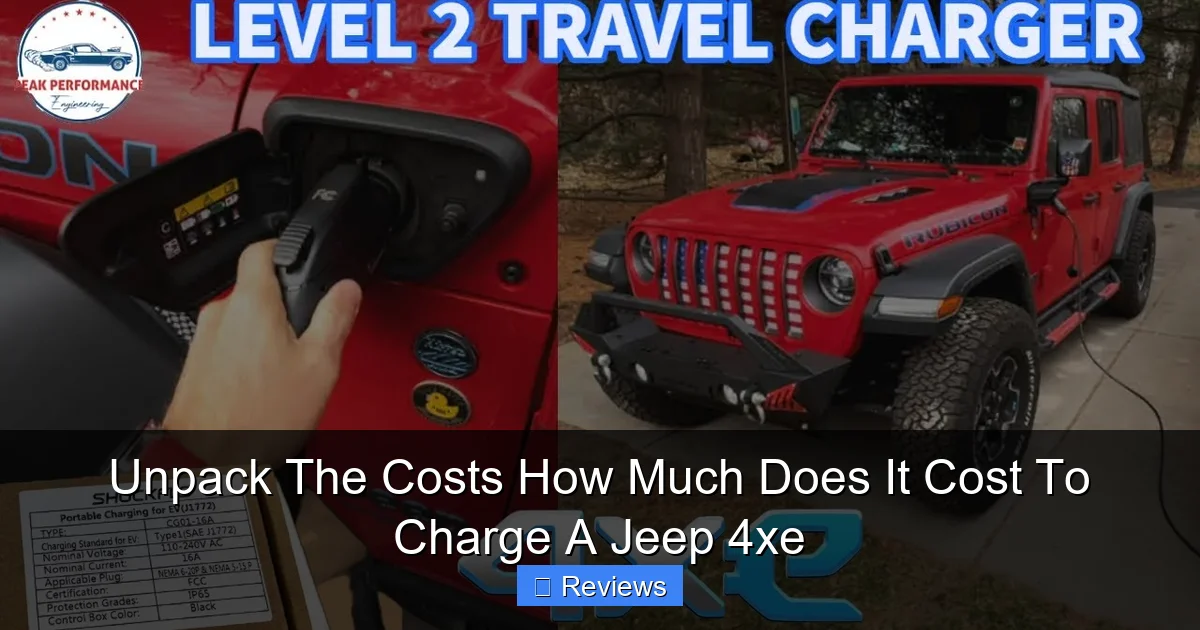
Visual guide about how much does it cost to charge a jeep 4xe
Image source: i.ytimg.com
How Level 1 Charging Works for Your Jeep 4xe
When you purchase a Jeep 4xe, it typically includes a Level 1 charging cord. This cord has a standard three-prong plug on one end and a J1772 connector on the other, which plugs into your vehicle’s charging port. Simply plug it into any standard 120V (15-amp) household outlet, and your Jeep 4xe will begin drawing power. The charging rate is slow, typically delivering around 1.4 to 1.9 kilowatts (kW) per hour. This translates to adding roughly 2 to 5 miles of range per hour of charging.
Charging Speed and Time to Full Charge
Given the 17.3 kWh battery capacity of the Jeep 4xe, Level 1 charging can take a considerable amount of time to achieve a full charge from empty. At an average rate of 1.4-1.9 kW, it would take approximately 10-14 hours to fully replenish the battery. While this might seem long, remember that most Jeep 4xe owners don’t fully drain their battery every day. If you only drive your electric range partially, or if you charge overnight for 8-10 hours, Level 1 can still add a significant amount of range, often enough to cover your typical daily commute. For instance, an overnight charge might add 15-20 miles of electric range, making it a viable option for many.
Calculating the Cost of Level 1 Charging
Calculating the cost of Level 1 charging for your Jeep 4xe is straightforward. You simply need to know your electricity rate (per kWh) and the battery capacity.
Formula: Battery Capacity (kWh) x Electricity Rate ($/kWh) = Cost per Full Charge
Let’s use an example:
- Jeep 4xe Battery Capacity: 17.3 kWh
- Average U.S. Residential Electricity Rate (as of late 2023/early 2024): $0.16 per kWh (this varies significantly by state and utility provider, so check your bill!)
- Cost: 17.3 kWh * $0.16/kWh = $2.77 per full charge
This is the cost to add a full 21-25 miles of electric range to your Jeep 4xe. Compared to the cost of gasoline for the same distance, it’s typically a significant saving. For example, if a gasoline-powered Jeep gets 20 MPG, and gas costs $3.50/gallon, 25 miles would cost approximately $4.38 ($3.50 / 20 MPG * 25 miles).
Pros and Cons of Level 1 Charging for Your Jeep 4xe
- Pros:
- No Installation Cost: Uses existing outlets, making it free to set up.
- Convenient: Charge anywhere there’s a standard outlet.
- Gentle on Battery: Slower charging can contribute to longer battery health (though modern batteries are robust).
- Low Operating Cost: Utilizes your residential electricity rates, which are often the cheapest.
- Cons:
- Slow: Takes a long time for a full charge, potentially limiting electric-only driving if you have longer daily commutes without overnight charging.
- Limited Range Added: May not fully replenish the battery for those with very long commutes or multiple trips in a day.
- Outlet Availability: Requires an outdoor or garage outlet accessible to your Jeep 4xe.
Level 1 charging is an excellent baseline for Jeep 4xe owners who primarily use their electric range for shorter daily trips and can charge overnight at home. It’s the most cost-effective per kilowatt-hour, as it avoids any additional infrastructure costs.
Level 2 Charging: The Home and Public Charging Sweet Spot
For many Jeep 4xe owners, Level 2 charging strikes the perfect balance between speed, convenience, and cost-effectiveness. It’s significantly faster than Level 1, making it ideal for daily use, whether at home or at public charging stations.
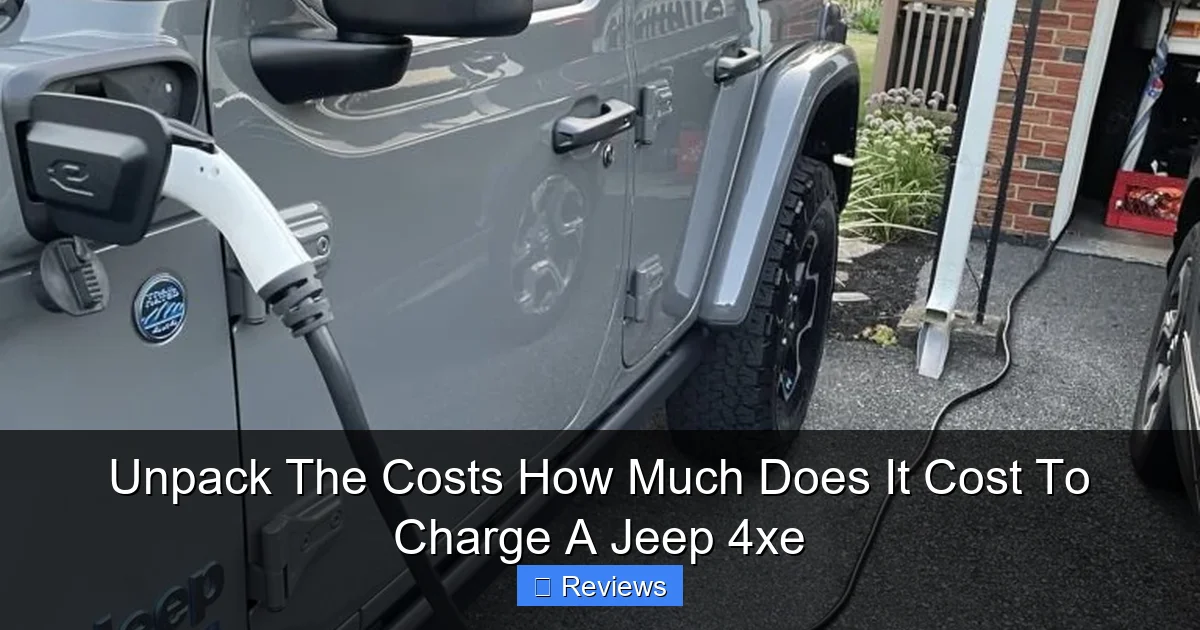
Visual guide about how much does it cost to charge a jeep 4xe
Image source: jeepfan.com
What is Level 2 Charging and How it Benefits Your Jeep 4xe?
Level 2 charging utilizes a 240-volt circuit, similar to what powers large appliances like electric dryers or ovens. This higher voltage allows for a much faster charging rate, typically delivering between 3.3 kW and 11 kW, depending on the charger and your Jeep 4xe‘s onboard charger capacity. For the Jeep 4xe, which usually has a 7.2 kW onboard charger, you’ll be able to charge at that maximum rate with a compatible Level 2 EVSE.
Faster Charging Speeds and Time to Full Charge
With a 7.2 kW Level 2 charger, your Jeep 4xe can be fully charged from empty in approximately 2.5 to 3 hours (17.3 kWh battery / 7.2 kW charging rate = ~2.4 hours). This dramatically reduced charging time is a game-changer. It means you can fully recharge your Jeep 4xe during a dinner break, a few hours at work, or simply overnight without needing to leave it plugged in for 10+ hours. This speed allows for more frequent use of the electric range, maximizing fuel savings and reducing emissions from your Jeep 4xe.
Home Level 2 Charging: EVSE and Installation Costs
While the operating cost of home Level 2 charging is similar to Level 1, there’s an initial investment:
- EVSE Cost: A Level 2 charging station (EVSE) typically costs between $300 and $700. Many smart chargers offer features like Wi-Fi connectivity, scheduling, and energy monitoring.
- Installation Cost: This is the variable part. If you already have a 240V outlet in your garage (e.g., for a dryer), installation might be as simple as mounting the charger and plugging it in, costing perhaps $100-$300 for an electrician to verify safety or move an outlet. However, if you need new wiring, a dedicated circuit, or a panel upgrade, costs can range from $500 to over $2,000. It’s crucial to get multiple quotes from licensed electricians.
Despite these upfront costs, many regions offer incentives or tax credits for EVSE purchases and installation, which can significantly offset the initial expense, making home Level 2 charging for your Jeep 4xe more appealing.
Calculating Home Level 2 Charging Costs
The per-charge cost calculation for Level 2 at home is identical to Level 1, as you’re still paying your residential electricity rate. Using our previous example:
- Jeep 4xe Battery Capacity: 17.3 kWh
- Average U.S. Residential Electricity Rate: $0.16 per kWh
- Cost: 17.3 kWh * $0.16/kWh = $2.77 per full charge
The difference lies in the convenience and speed, not the direct energy cost. However, some utilities offer “Time-of-Use” (TOU) plans, where electricity is cheaper during off-peak hours (e.g., overnight). If you charge your Jeep 4xe on a TOU plan during these cheaper hours, your actual cost per charge could be significantly lower, perhaps $0.10/kWh, dropping the cost to around $1.73 per charge.
Public Level 2 Charging: Pricing Models and Examples
Public Level 2 charging offers flexibility when you’re away from home. However, pricing can be more complex:
- Per kWh: The most common and fairest method. You pay for the actual energy consumed. Rates can vary widely, from $0.20 to $0.40 per kWh. Some destinations (e.g., hotels, workplaces) might offer free charging as an amenity.
- Per Minute: Less common for Level 2 but still seen. If the station charges $0.10-$0.20 per minute, and your Jeep 4xe charges at 7.2 kW (meaning it takes ~2.4 hours or 144 minutes for a full charge), the cost could be $14.40 – $28.80. This can be more expensive if your vehicle isn’t charging at its maximum rate.
- Session Fee: Some stations charge a flat fee per charging session, regardless of energy or time. This could be $2-$5 per session. This is great for a full charge but less economical if you only need a quick top-off for your Jeep 4xe.
Example Public Level 2 Cost:
If you find a public Level 2 charger at $0.30/kWh:
Cost: 17.3 kWh * $0.30/kWh = $5.19 per full charge
This is generally more expensive than home charging but offers the convenience of charging on the go.
Pros and Cons of Level 2 Charging for Your Jeep 4xe
- Pros:
- Fast: Fully recharges your Jeep 4xe in a few hours.
- Convenient: Ideal for daily use at home, work, or while running errands.
- Maximizes Electric Driving: Enables more consistent use of your Jeep 4xe‘s electric range.
- Smart Features: Many home EVSEs offer scheduling, monitoring, and app control.
- Cons:
- Upfront Cost: Requires investment in an EVSE and potentially installation.
- Public Variability: Public Level 2 pricing can vary, and availability isn’t always guaranteed.
For most Jeep 4xe owners looking to maximize their electric driving and save on fuel, home Level 2 charging is an invaluable investment that quickly pays for itself in convenience and fuel cost savings. Public Level 2 charging serves as a useful backup or supplementary option.
Exploring Public Charging Networks and Their Pricing Models
While home charging will likely be the primary method for your Jeep 4xe, public charging networks play a crucial role for longer trips, when you can’t charge at home, or when you simply need a top-off. Understanding their diverse pricing structures is key to managing your costs effectively.
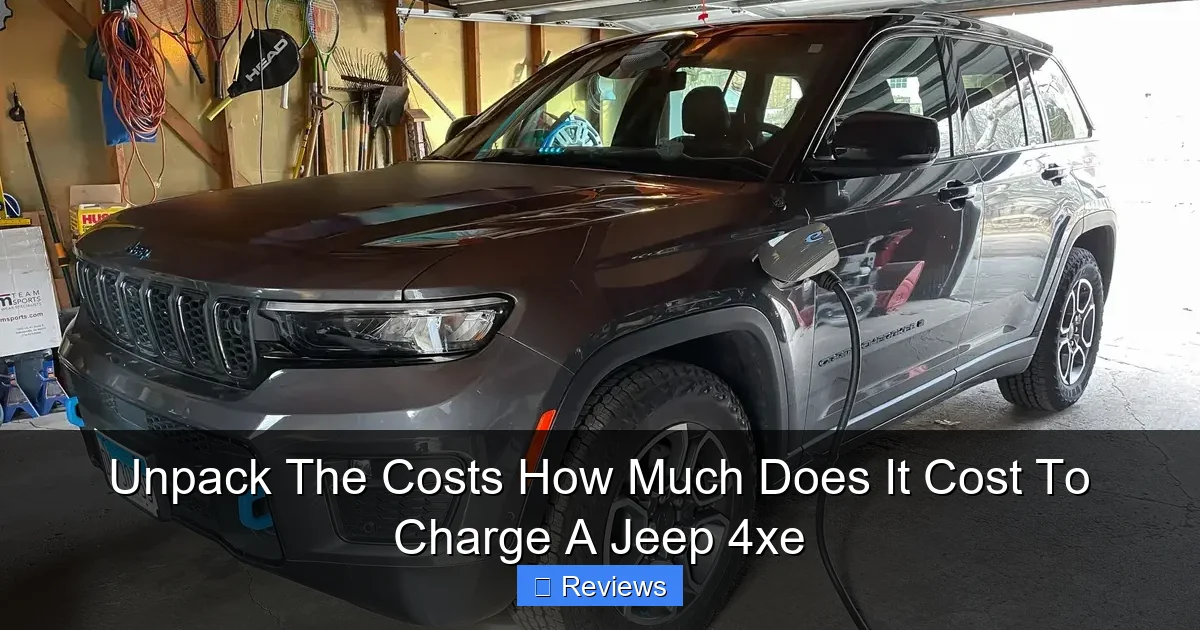
Visual guide about how much does it cost to charge a jeep 4xe
Image source: images.cars.com
Major Public Charging Networks
The public charging landscape is populated by several key players, each with its own network, app, and pricing strategy. For Jeep 4xe owners, these networks typically offer Level 2 charging, and in some rare cases, slower Level 3 (DC fast charging) which isn’t optimal for the Jeep 4xe‘s battery size but could theoretically work. Major networks include:
- ChargePoint: One of the largest networks, offering both Level 2 and DC fast chargers.
- EVgo: Primarily known for DC fast charging but also has Level 2 options.
- Electrify America: A rapidly expanding network, mostly focused on DC fast charging, but some locations have Level 2.
- FLO: Popular in Canada and expanding in the U.S., offering robust Level 2 chargers.
- Shell Recharge (formerly Greenlots): A growing network with both Level 2 and DC fast options.
- Local Utilities and Independent Stations: Many utilities and smaller businesses also offer charging, sometimes free or at very low rates.
Each network typically requires you to download their app to initiate and pay for charging, or you can use an RFID card.
Detailed Breakdown of Pricing Structures
Public charging networks employ various pricing models, which can make comparing costs challenging. For your Jeep 4xe, you’ll mainly encounter these:
- Per kWh (Kilowatt-hour):
- Explanation: You pay for the actual amount of electricity your Jeep 4xe consumes. This is generally considered the fairest pricing model, as you only pay for what you use.
- Typical Range: For Level 2, expect rates between $0.20 and $0.45 per kWh. DC fast charging can be $0.40 to $0.60+ per kWh.
- Example for Jeep 4xe: If you charge your 17.3 kWh battery at a station costing $0.35/kWh, the cost would be 17.3 kWh * $0.35/kWh = $6.06.
- Per Minute:
- Explanation: You pay for the duration your Jeep 4xe is plugged in and charging. This model can be tricky because your charging speed might fluctuate, or it might be slower than the station’s maximum capability. It can penalize you if your vehicle’s charging rate is not optimal.
- Typical Range: $0.10 to $0.30 per minute.
- Example for Jeep 4xe: If a Level 2 station charges $0.15/minute, and it takes 2.5 hours (150 minutes) to charge your Jeep 4xe from empty, the cost would be 150 minutes * $0.15/minute = $22.50. As you can see, this can quickly become significantly more expensive than per kWh pricing for the same amount of energy.
- Session Fees:
- Explanation: A flat fee charged per charging session, regardless of the energy delivered or the duration.
- Typical Range: $1.00 to $5.00 per session.
- Best Use for Jeep 4xe: This is often most economical if you are doing a full charge of your Jeep 4xe‘s battery. If you only need a quick 5 kWh top-off, a $3 session fee might make the cost per kWh very high.
- Idle Fees:
- Explanation: To encourage drivers to move their vehicles once charging is complete, many networks impose idle fees. These typically kick in after a grace period once your Jeep 4xe is fully charged.
- Typical Range: $0.20 to $0.50 per minute. These can add up very quickly if you leave your Jeep 4xe plugged in long after it’s done charging.
Membership Benefits vs. Guest Rates
Many charging networks offer membership programs that can provide discounted rates. For frequent users of public charging with their Jeep 4xe, these memberships are often worthwhile:
- Membership Tiers: Some networks have monthly subscription fees that unlock lower per-kWh or per-minute rates.
- Loyalty Programs: Accumulated points or spending can lead to discounts.
- Automaker Partnerships: Occasionally, purchasing a Jeep 4xe might come with promotional charging credits or discounted rates on specific networks. Always check with your dealer.
Guest rates, while convenient for occasional use, are almost always higher. So, if you foresee regularly relying on public charging for your Jeep 4xe, enrolling in memberships can lead to significant long-term savings.
The “Cost of Convenience” for Public Charging
It’s important to remember that public charging often carries a premium compared to home charging. This premium is the “cost of convenience” – you’re paying for the ability to charge when and where you need it, often in prime locations like shopping centers, restaurants, or workplaces. While it helps extend your electric range and reduce gasoline consumption for your Jeep 4xe, it’s rarely as cheap as charging at home, especially during off-peak hours.
Tips for Finding Cost-Effective Public Charging for Your Jeep 4xe
- Use Charging Apps: Apps like PlugShare, ChargePoint, Electrify America, and others allow you to locate stations, see real-time availability, and crucially, view pricing information before you plug in your Jeep 4xe.
- Prioritize Free Chargers: Many workplaces, hotels, and retail establishments offer free Level 2 charging as an amenity. These are goldmines for Jeep 4xe owners.
- Look for Per-kWh Pricing: Whenever possible, opt for stations that charge per kilowatt-hour, as this is the most transparent and generally fairest way to pay for energy.
- Mind the Idle Fees: Always move your Jeep 4xe promptly once charging is complete to avoid hefty idle fees.
- Consider Memberships: If you use a particular network frequently, a membership might pay for itself quickly.
Public charging for your Jeep 4xe is a valuable tool, but being an informed consumer by understanding the various pricing models and using available resources will help you keep costs down.
Factors Influencing Your True Charging Costs
The cost to charge your Jeep 4xe isn’t just about the rate per kilowatt-hour. Several other factors play a significant role in determining your overall expenditure. Understanding these nuances will help you optimize your charging habits and achieve the lowest possible operating costs for your plug-in hybrid.
Electricity Rates: Regional, Utility, and Time-of-Use Variability
This is arguably the most impactful factor. Electricity rates can vary wildly:
- Geographic Location: Rates differ significantly by state, city, and even neighborhood. For example, electricity in Washington state is generally cheaper than in California or Hawaii.
- Utility Provider: Different electric companies within the same state might have varying rate structures.
- Tiered Rates: Some utilities charge more per kWh once you exceed a certain monthly usage threshold.
- Time-of-Use (TOU) Rates: Many utilities offer TOU plans that charge different rates based on the time of day. “Off-peak” hours (typically overnight and during the day outside of peak evening demand) are significantly cheaper than “on-peak” hours. Charging your Jeep 4xe during off-peak times can drastically reduce your costs. If your electricity costs $0.25/kWh during peak and $0.10/kWh off-peak, consistently charging your Jeep 4xe during off-peak hours could save you over 60% per charge.
Always check your utility bill or website to understand your specific electricity rates and whether TOU plans are available and beneficial for your Jeep 4xe charging habits.
Driving Habits: Electric vs. Gasoline Utilization
The Jeep 4xe is a hybrid, meaning it can run on both electricity and gasoline. Your driving habits directly influence how much you spend on fuel versus electricity:
- Maximizing Electric Range: The more often you drive within your Jeep 4xe‘s electric range (21-25 miles) and recharge, the more you save on gasoline. If your daily commute falls within this range and you charge regularly, you could go weeks or even months without needing to buy gasoline.
- Longer Trips: For longer journeys beyond the electric range, your Jeep 4xe will switch to hybrid mode, using both the engine and electric motors, or primarily gasoline. In these scenarios, gasoline costs will factor into your overall fuel expenses.
- Regenerative Braking: Utilizing regenerative braking effectively (found in the Jeep 4xe) helps recapture energy during deceleration, slightly extending your electric range and reducing the need for charging.
The true cost of operating your Jeep 4xe is the sum of your electricity and gasoline expenses. By prioritizing electric driving, you maximize the benefit of cheaper electricity over gasoline.
Charging Efficiency Losses
It’s important to note that charging is not 100% efficient. Some energy is lost during the conversion from AC to DC power within the charger and the vehicle, as well as due to heat. Typically, charging efficiency ranges from 80% to 90%. This means if your Jeep 4xe battery needs 17.3 kWh, you might draw closer to 19-21 kWh from the wall to account for these losses. This slight increase in energy drawn will marginally increase your per-charge cost but is a normal part of the process.
Initial Installation Costs for Home Chargers
As discussed, setting up a Level 2 home charger for your Jeep 4xe involves an upfront cost for the EVSE unit and professional installation. While this isn’t a recurring charging cost, it’s a significant initial investment that impacts your overall cost of ownership. However, this is a one-time expense that pays for itself over time through convenience and fuel savings. Many government and utility incentives are available to offset these costs, making the transition to faster home charging more accessible.
Government Incentives and Rebates
Speaking of incentives, various federal, state, and local programs can significantly reduce the cost of owning and charging a Jeep 4xe:
- Federal Tax Credits: The Jeep 4xe models have historically been eligible for federal tax credits, reducing the purchase price.
- State/Local Rebates: Many states offer additional rebates or tax credits for PHEV purchases.
- EVSE Incentives: Some states and local utilities offer rebates or tax credits specifically for the purchase and installation of home charging equipment.
- Reduced Registration Fees or HOV Lane Access: Some areas provide benefits like lower annual registration fees or access to High-Occupancy Vehicle (HOV) lanes for PHEV owners.
These incentives can dramatically lower your effective purchase and charging infrastructure costs for your Jeep 4xe, making the overall economics even more attractive. Always research what’s available in your specific area.
By considering these factors alongside the basic per-kWh rates, Jeep 4xe owners can gain a much clearer picture of their true charging expenses and identify opportunities for further savings.
Data Table: Comparative Charging Costs for a Jeep 4xe
To help visualize the costs discussed, here’s a comparative data table showing estimated costs to fully charge a Jeep 4xe‘s 17.3 kWh battery under various scenarios. These figures are illustrative and your actual costs will vary based on local electricity rates, charging efficiency, and specific public network pricing.
(Assumptions: Jeep 4xe battery capacity: 17.3 kWh; charging efficiency: 88%)
| Charging Method/Scenario | Approximate Rate | Energy Drawn (accounting for 88% efficiency) | Estimated Cost Per Full Charge | Time to Full Charge | Notes |
|---|---|---|---|---|---|
| Home Level 1 (Standard Rate) | $0.16/kWh | 19.66 kWh | $3.15 | 10-14 hours | Most common, no installation cost for charger |
| Home Level 1 (Off-Peak TOU Rate) | $0.10/kWh | 19.66 kWh | $1.97 | 10-14 hours | Leverages cheaper overnight rates |
| Home Level 2 (Standard Rate) | $0.16/kWh | 19.66 kWh | $3.15 | 2.5-3 hours | Fast and convenient, requires EVSE & installation |
| Home Level 2 (Off-Peak TOU Rate) | $0.10/kWh | 19.66 kWh | $1.97 | 2.5-3 hours | Best balance of speed and cost savings for Jeep 4xe |
| Public Level 2 (Low End) | $0.25/kWh | 19.66 kWh | $4.92 | 3-4 hours (variable) | More expensive than home, good for occasional use |
| Public Level 2 (High End) | $0.45/kWh | 19.66 kWh | $8.85 | 3-4 hours (variable) | Higher cost of convenience, check app for best rates |
| Public Level 2 (Per Minute @ $0.15/min for 150 mins) | N/A | N/A | $22.50 | 2.5 hours | Can be very expensive if not carefully monitored; not recommended for Jeep 4xe if kWh option is available |
| Public Free Charging | $0.00/kWh | 0 kWh | $0.00 | Variable | The ultimate saving! Look for these at workplaces or stores. |
This table clearly illustrates that home charging, particularly on off-peak Time-of-Use rates, offers the most economical way to power your Jeep 4xe. Public charging provides flexibility but often comes at a higher price point. By understanding these differences, Jeep 4xe owners can strategically choose their charging methods to minimize expenses.
Maximizing Savings and Efficiency for Your Jeep 4xe
Owning a Jeep 4xe is an investment in capability and efficiency. To truly unlock the full economic benefits of your plug-in hybrid, it’s essential to adopt smart charging and driving habits. Here are actionable tips to maximize your savings and efficiency, ensuring you get the most out of every electron and every drop of fuel in your Jeep 4xe.
Leveraging Off-Peak Charging Strategies
As highlighted, Time-of-Use (TOU) electricity rates can dramatically impact your charging costs. Most utilities designate “off-peak” hours, usually overnight, when electricity demand is lowest and rates are significantly cheaper. Here’s how to capitalize on this for your Jeep 4xe:
- Enroll in TOU Plans: Contact your utility provider to see if they offer a TOU plan suitable for EV owners.
- Schedule Charging: Most Level 2 home chargers (EVSEs) and even your Jeep 4xe itself (via its infotainment system or Uconnect app) allow you to schedule charging sessions. Set your Jeep 4xe to begin charging during the cheapest off-peak hours, typically starting around 9 PM or 10 PM and ending early in the morning.
- Monitor Peak Hours: Be mindful of “peak” hours when electricity is most expensive. Avoid charging your Jeep 4xe during these times unless absolutely necessary.
This single strategy can be the most impactful way to reduce your recurring Jeep 4xe charging costs.
Monitoring Electricity Usage and Costs
Knowledge is power, especially when it comes to energy consumption. Keep a close eye on how much electricity your Jeep 4xe is using and what it’s costing you:
- Smart Charger Features: If you have a smart Level 2 charger, utilize its app for real-time monitoring of energy consumption, charging schedules, and estimated costs. Many can even integrate with your utility provider for accurate cost tracking.
- Utility Bill Analysis: Regularly review your electricity bills. Some utilities provide detailed breakdowns of consumption by time of day or even specific appliance if you have smart meters.
- Vehicle Telematics: The Uconnect app for your Jeep 4xe may offer insights into your electric driving, charge history, and efficiency metrics, helping you understand your usage patterns.
By actively monitoring, you can identify trends and adjust your habits to further optimize spending on your Jeep 4xe.
Pre-Conditioning the Cabin While Plugged In
Your Jeep 4xe has a feature that allows you to “pre-condition” the cabin – heating or cooling it to your desired temperature – while it’s still plugged into the charger. This is a significant energy-saving tip:
- Use Grid Power: When pre-conditioning, your Jeep 4xe draws power directly from the grid instead of using its battery. This saves valuable battery energy for driving range.
- Maintain Electric Range: By pre-conditioning before you depart, you ensure your full electric range is available for propulsion, maximizing the time you spend driving without gasoline. This is particularly useful in extreme hot or cold weather conditions that otherwise heavily tax the battery.
Utilizing Regenerative Braking Effectively
The Jeep 4xe, like other EVs and PHEVs, features regenerative braking. This technology captures kinetic energy normally lost as heat during braking and deceleration, converting it back into electricity to recharge the battery. To maximize its benefit:
- Smooth Driving: Practice smooth acceleration and gradual deceleration. Aggressive braking wastes more energy.
- Anticipate Stops: Look ahead in traffic and let off the accelerator earlier, allowing the regenerative braking system to recover more energy before you need to apply the friction brakes.
- Max Regen Button (if available): Some Jeep 4xe models may have a “Max Regen” button, which increases the aggressiveness of regenerative braking, effectively creating a “one-pedal” driving feel and maximizing energy capture. Experiment with this to see if it suits your driving style.
Every bit of recaptured energy means less power you need to draw from the grid, extending your Jeep 4xe‘s electric range and saving you money.
Bundling Charging with Errands and Finding Free Options
Beyond home charging, strategic use of public charging can minimize costs:
- Charge While You Shop/Dine: Look for free or low-cost Level 2 chargers at grocery stores, malls, restaurants, hotels, or workplaces. These allow you to charge your Jeep 4xe while you’re already doing something else, making the “cost” negligible.
- Leverage Destination Chargers: Many hotels offer free or discounted charging for guests. If you’re planning an overnight stay, prioritize places with charging facilities for your Jeep 4xe.
- Workplace Charging: If your employer offers charging, take full advantage. It’s often free or heavily subsidized, providing a significant boost to your electric driving and savings.
Consider Solar Power Integration
For the ultimate in cost savings and environmental friendliness, consider integrating solar panels into your home energy system. Charging your Jeep 4xe with self-generated solar power can drastically reduce, or even eliminate, your electricity costs for charging. While the initial investment in solar is substantial, it can provide long-term benefits, not just for your Jeep 4xe but for your entire household’s energy consumption. Many governments offer incentives for solar installation, making it more attainable.
By implementing these strategies, Jeep 4xe owners can significantly lower their overall operating costs, enhancing the value and enjoyment of their electrified adventure vehicle. It’s about being smart, proactive, and taking advantage of the unique benefits that a PHEV offers.
Conclusion: Powering Your Jeep 4xe Adventure Smartly
The Jeep 4xe represents a thrilling evolution, offering the legendary capability and adventurous spirit of a Jeep fused with the modern efficiency of electric power. As we’ve unpacked throughout this comprehensive guide, understanding the cost to charge your Jeep 4xe is not just about a single price point, but a dynamic interplay of factors, from your local electricity rates to your charging habits and infrastructure choices. The good news is that with a little knowledge and strategic planning, powering your Jeep 4xe can be remarkably cost-effective, often significantly cheaper than fueling a comparable gasoline-only vehicle.
Whether you opt for the slow but free-to-install Level 1 charging, the fast and convenient Level 2 home setup, or strategically utilize public networks, each method presents its own cost and benefit profile. The clear takeaway is that home charging, particularly when optimized with Time-of-Use rates, offers the lowest per-charge cost, making a Level 2 home charger a worthwhile investment for most Jeep 4xe owners. Public charging, while more expensive, provides invaluable flexibility and extends your electric range on the go, allowing you to maximize the electric-only driving of your Jeep 4xe.
Ultimately, the true cost of operating your Jeep 4xe is a blend of electricity and minimal gasoline usage, allowing for substantial savings on fuel. By embracing smart charging strategies – leveraging off-peak hours, utilizing regenerative braking, taking advantage of free public charging, and pre-conditioning your cabin – you’re not just saving money; you’re also maximizing the eco-friendly potential and the sheer enjoyment of your plug-in hybrid. So, go forth with confidence, charge smartly, and let your Jeep 4xe lead the way on countless efficient, electrified adventures.
Frequently Asked Questions
What is the average cost to charge a Jeep 4xe?
The cost to charge your Jeep 4xe can vary significantly, typically ranging from $2 to $7 for a full electric charge, depending on your location and charging method. This estimate considers factors like residential electricity rates and whether you’re charging at home or a public station.
How much does it cost to charge a Jeep 4xe at home?
Charging your Jeep 4xe at home is generally the most cost-effective option. The exact price depends on your local electricity rates, but it often falls between $2.50 to $4.50 for a full electric charge, making it very economical for daily use.
What’s the typical cost for public charging a Jeep 4xe?
Public charging for your Jeep 4xe can be more expensive than home charging, with costs varying widely by network, location, and charging speed. You might pay anywhere from $0.25 to $0.60 per kWh, or sometimes a session fee, resulting in a full charge potentially costing $5 to $10 or even more for DC fast charging.
Is charging a Jeep 4xe cheaper than fueling a gasoline-powered Jeep?
Yes, charging a Jeep 4xe is almost always significantly cheaper than filling up a comparable gasoline-powered Jeep. You can save hundreds of dollars annually, especially if you primarily use home charging for your daily electric-only commutes.
What factors influence the cost to charge my Jeep 4xe?
Several key factors influence the cost to charge your Jeep 4xe, including your local electricity rates, whether you’re using home or public charging, and the time of day you charge (if your utility offers time-of-use rates). The type of charger (Level 1, 2, or 3) also plays a role in public charging costs.
How much does a full electric charge on a Jeep 4xe cost, and what range does it provide?
A full electric charge for a Jeep 4xe typically costs between $2.50 and $7, depending on your charging method and electricity rates. This charge provides an all-electric range of approximately 21-25 miles, after which the hybrid system seamlessly switches to gasoline power.

At CarLegit, we believe information should be clear, factual, and genuinely helpful. That’s why every guide, review, and update on our website is created with care, research, and a strong focus on user experience.