
A TPMS failure in a 2008 Maserati Quattroporte means the Tire Pressure Monitoring System isn’t working properly, often due to dead sensors, wiring issues, or software glitches. Ignoring it can lead to unsafe driving conditions, poor fuel economy, and premature tire wear—so early detection and repair are crucial.
In This Article
- 1 Key Takeaways
- 2 📑 Table of Contents
- 3 Understanding the 2008 Maserati Quattroporte TPMS System
- 4 Common Signs of a TPMS Failure in the 2008 Quattroporte
- 5 Common Causes of TPMS Failure in the 2008 Quattroporte
- 6 How to Diagnose a TPMS Failure
- 7 Repairing and Replacing TPMS Components
- 8 Preventing Future TPMS Failures
- 9 Conclusion
- 10 Frequently Asked Questions
- 10.1 What does a flashing TPMS light mean on a 2008 Maserati Quattroporte?
- 10.2 Can I drive with a TPMS failure?
- 10.3 How much does it cost to replace a TPMS sensor on a 2008 Quattroporte?
- 10.4 Do I need a special tool to reset the TPMS on a 2008 Quattroporte?
- 10.5 Can a dead car battery cause TPMS failure?
- 10.6 Are aftermarket TPMS sensors compatible with the 2008 Quattroporte?
Key Takeaways
- TPMS monitors tire pressure: The system alerts you when tire pressure is too low, helping maintain safety and performance.
- Common failure causes include dead batteries, sensor damage, or corrosion: These issues often arise from age, weather, or road debris.
- The 2008 Quattroporte uses direct TPMS sensors: Each wheel has a sensor that sends real-time pressure data to the car’s computer.
- Warning lights may flash or stay on: A flashing TPMS light often indicates a system malfunction, not just low pressure.
- DIY checks can help diagnose issues: Use a TPMS scan tool or manual pressure gauge to verify readings.
- Professional diagnosis is recommended: Specialized tools and software are often needed to reset or reprogram sensors.
- Replacement sensors can be costly: Genuine Maserati parts are expensive, but aftermarket options may offer savings.
📑 Table of Contents
Understanding the 2008 Maserati Quattroporte TPMS System
The 2008 Maserati Quattroporte is a luxury sedan that blends Italian craftsmanship with high-performance engineering. Among its many advanced features is the Tire Pressure Monitoring System (TPMS), a critical safety component designed to keep drivers informed about their tire conditions. But what happens when this system fails? And how do you know if your Quattroporte’s TPMS is malfunctioning?
TPMS stands for Tire Pressure Monitoring System. It’s a technology mandated in all vehicles sold in the U.S. since 2008, and the Quattroporte was one of the first luxury cars to include it as standard. The system continuously monitors the air pressure in each tire and alerts the driver if pressure drops below a safe threshold—typically 25% below the recommended level. This helps prevent blowouts, improves fuel efficiency, and extends tire life.
In the 2008 Quattroporte, the TPMS uses a direct monitoring approach. That means each wheel is equipped with a small sensor mounted inside the tire, usually attached to the valve stem or wheel rim. These sensors measure pressure and temperature in real time and transmit data wirelessly to the car’s onboard computer. If a problem is detected, a warning light—usually shaped like a horseshoe with an exclamation point—appears on the dashboard.
But like any electronic system, TPMS isn’t immune to failure. Over time, sensors can wear out, batteries die, or signals get disrupted. When that happens, the system may stop working correctly, leaving you unaware of potentially dangerous tire conditions. Understanding how the system works—and what can go wrong—is the first step in diagnosing and fixing a TPMS failure.
How the TPMS Works in the 2008 Quattroporte
The 2008 Maserati Quattroporte’s TPMS relies on four individual sensors—one in each wheel. These sensors are battery-powered and typically last between 5 to 10 years, depending on usage and environmental conditions. Each sensor sends a unique radio frequency (RF) signal to the car’s TPMS control module, which processes the data and displays it on the instrument cluster.
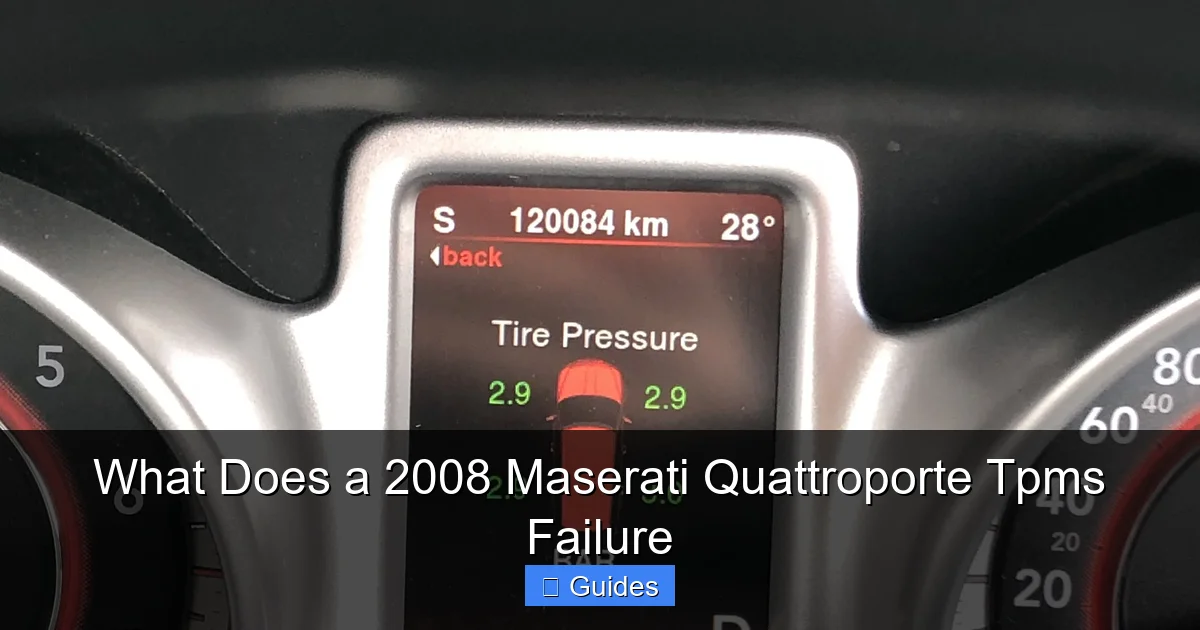
When you start the car, the system performs a brief self-check. If all sensors are functioning and pressures are normal, the TPMS light will turn on briefly and then go off. If a sensor is missing, damaged, or not transmitting, the light may stay on or flash repeatedly. In some cases, the system may display a message like “Check Tire Pressure” or “TPMS Fault” on the dashboard.
One important detail about the Quattroporte’s TPMS is that it doesn’t provide exact pressure readings like some newer models. Instead, it gives a general warning when pressure is too low. This means you still need to manually check tire pressure with a gauge, especially if the light comes on.
The system also includes a relearn procedure. Whenever tires are rotated, replaced, or sensors are changed, the car must “relearn” which sensor is in which position. This is typically done using a TPMS scan tool or through a specific sequence of ignition and brake pedal actions. Without this step, the system may misidentify which tire has low pressure or fail to recognize new sensors altogether.
Why TPMS Matters for Safety and Performance
You might wonder: Is TPMS really that important? The short answer is yes. Underinflated tires are a leading cause of tire failure, especially at high speeds. According to the National Highway Traffic Safety Administration (NHTSA), underinflated tires increase the risk of blowouts, reduce vehicle handling, and decrease fuel efficiency by up to 3%.
For a high-performance car like the 2008 Quattroporte, proper tire pressure is even more critical. The car’s handling, braking, and suspension are finely tuned for optimal performance. When tire pressure is off, even slightly, it can affect cornering stability, increase stopping distance, and cause uneven tire wear.
Additionally, the Quattroporte’s wide, low-profile tires are more sensitive to pressure changes. A drop of just a few PSI can significantly alter the tire’s contact patch with the road, leading to reduced grip and increased risk of hydroplaning in wet conditions.
Beyond safety, TPMS helps maintain fuel economy. Properly inflated tires reduce rolling resistance, which means the engine doesn’t have to work as hard. Over time, this can save you money at the pump—especially important for a luxury sedan that may not be the most fuel-efficient vehicle on the road.
Finally, TPMS contributes to tire longevity. Tires that are consistently underinflated wear out faster, particularly on the edges. By alerting you early, the system helps you catch problems before they lead to costly replacements.
Common Signs of a TPMS Failure in the 2008 Quattroporte
Visual guide about What Does a 2008 Maserati Quattroporte Tpms Failure
Image source: sensor.wiki
Recognizing a TPMS failure early can save you from bigger problems down the road. While the most obvious sign is the TPMS warning light on your dashboard, there are several other indicators that something might be wrong with the system.
One of the first things to notice is the behavior of the warning light itself. If the light comes on and stays on, it usually means one or more tires are underinflated. But if the light flashes for about a minute and then stays on, that’s a strong sign of a system malfunction—like a dead sensor or communication error.
Another clue is inconsistent or inaccurate warnings. For example, the light might come on even though all tires are properly inflated. Or it might fail to illuminate when a tire is clearly low. This suggests the sensors aren’t transmitting data correctly, or the control module isn’t receiving it.
You might also notice that the TPMS light behaves differently after tire rotations or replacements. If the light stays on or flashes after a service, it could mean the system hasn’t been properly reset or the new sensors aren’t compatible.
In some cases, the dashboard may display error messages like “TPM System Fault” or “Check Tire Pressure Sensor.” These messages are more specific and often point to a hardware or software issue within the TPMS.
Dashboard Warning Lights and What They Mean
The TPMS warning light in the 2008 Quattroporte is usually located in the instrument cluster, near the speedometer. It looks like a yellow or orange horseshoe with an exclamation point in the center. Here’s what different behaviors mean:
– **Light turns on briefly at startup and then goes off:** This is normal. It indicates the system is performing a self-check and all sensors are functioning.
– **Light stays on solid:** One or more tires are underinflated. Check tire pressure with a gauge and inflate as needed.
– **Light flashes for 60–90 seconds, then stays on:** This indicates a TPMS malfunction. The system has detected a problem with one or more sensors or the control module.
– **Light comes on intermittently:** Could be due to temperature changes, sensor battery weakness, or signal interference.
It’s important not to ignore a flashing TPMS light. While it doesn’t necessarily mean your tires are unsafe, it does mean the system can’t reliably monitor them. This leaves you vulnerable to undetected pressure loss, especially on long drives or in extreme weather.
Real-World Examples of TPMS Failures
Let’s look at a few real-world scenarios where Quattroporte owners experienced TPMS issues.
One owner reported that the TPMS light came on during a winter drive. He checked the tires and found they were all properly inflated. The light continued to flash, so he took the car to a mechanic. Diagnosis revealed that the sensor in the front left wheel had a dead battery. After replacing the sensor and performing a relearn procedure, the light went off and stayed off.
Another case involved a Quattroporte that had just had its tires rotated at a local shop. The TPMS light came on immediately after and wouldn’t turn off. The shop claimed they had reset the system, but the owner suspected otherwise. Using an aftermarket TPMS scan tool, he discovered that the sensors hadn’t been properly reprogrammed to match the new wheel positions. After a correct relearn procedure, the issue was resolved.
A third example involved a car that had been sitting in a garage for several months. When the owner started driving again, the TPMS light flashed continuously. All sensors were tested and found to be functional, but the control module had lost its programming due to a weak battery. A jump-start and system reset fixed the problem.
These examples show that TPMS failures can stem from a variety of causes—some simple, some more complex. The key is to diagnose the issue accurately and address it promptly.
Common Causes of TPMS Failure in the 2008 Quattroporte
Visual guide about What Does a 2008 Maserati Quattroporte Tpms Failure
Image source: dodgejourneyforum.com
Now that you know how the system works and what signs to look for, let’s dive into the most common reasons why the TPMS might fail in your 2008 Maserati Quattroporte.
Dead or Weak Sensor Batteries
The most frequent cause of TPMS failure is a dead or dying battery inside the sensor. These batteries are not rechargeable and typically last 5 to 10 years. Since the 2008 Quattroporte is now over 15 years old, it’s very likely that one or more sensors have reached the end of their life.
When a sensor battery dies, it can no longer transmit pressure data. The car’s computer detects the missing signal and triggers the TPMS warning light. In some cases, the sensor may still send intermittent signals, causing the light to flash or behave erratically.
Replacing a sensor battery isn’t possible—the entire sensor must be replaced. This can be costly, especially if you use genuine Maserati parts. However, aftermarket sensors are available and often work just as well, though they may require additional programming.
Sensor Damage from Road Debris or Installation
TPMS sensors are mounted inside the wheel, making them vulnerable to damage from potholes, curbs, or tire mounting equipment. A hard impact can crack the sensor housing or break internal components, causing it to fail.
Improper tire installation is another common cause. If a tire shop uses excessive force or the wrong tools, they can damage the sensor during mounting or dismounting. This is especially true for the Quattroporte’s low-profile tires, which require careful handling.
Signs of physical damage include visible cracks, corrosion around the valve stem, or a sensor that’s loose or misaligned. If you suspect damage, have the sensor inspected by a professional.
Corrosion and Moisture Intrusion
Over time, moisture can seep into the sensor or valve stem, leading to corrosion. This is more common in humid climates or areas with heavy road salt use. Corrosion can disrupt electrical connections or damage the sensor’s internal circuitry.
You might notice green or white buildup around the valve stem, or the sensor may appear rusted. In severe cases, the valve stem itself may leak air, compounding the problem.
Regular inspection and cleaning can help prevent corrosion. Some owners apply dielectric grease to the valve stem threads to create a moisture-resistant seal.
Signal Interference or Antenna Issues
TPMS sensors communicate with the car’s control module via radio frequency (RF) signals. These signals can be disrupted by interference from other electronic devices, such as cell phones, GPS units, or even nearby vehicles with active TPMS systems.
In rare cases, the antenna or receiver in the Quattroporte’s TPMS module may fail, preventing it from receiving signals altogether. This can cause the system to report false faults or fail to detect actual pressure issues.
Signal interference is usually temporary and resolves on its own. But if the problem persists, a diagnostic scan can help determine if the issue is with the sensors or the receiver.
Software Glitches or Control Module Failure
Like any computer system, the TPMS control module can experience software glitches. These may cause the system to freeze, reset unexpectedly, or fail to recognize sensors.
In some cases, the entire control module may fail due to age, heat, or electrical issues. This is less common but can happen, especially in older vehicles.
A professional diagnostic tool is needed to check the module’s software and hardware. Updates or replacements may be required.
How to Diagnose a TPMS Failure
Visual guide about What Does a 2008 Maserati Quattroporte Tpms Failure
Image source: wheelbasegarage.com
Diagnosing a TPMS failure in your 2008 Quattroporte doesn’t have to be complicated. With the right tools and a bit of know-how, you can often pinpoint the issue yourself.
Step 1: Check Tire Pressure Manually
Before assuming the TPMS is faulty, verify that your tires are properly inflated. Use a reliable digital or analog tire pressure gauge to check each tire. Compare the readings to the recommended pressure listed on the driver’s side door jamb or in the owner’s manual.
If one or more tires are low, inflate them to the correct pressure and see if the TPMS light turns off after driving for a few minutes. Sometimes, the system just needs time to recognize the change.
Step 2: Observe the Warning Light Behavior
Pay close attention to how the TPMS light behaves. A solid light usually means low pressure. A flashing light suggests a system malfunction. If the light comes on and off randomly, it could indicate a weak sensor battery or signal interference.
Keep a log of when the light appears and under what conditions (e.g., after driving over bumps, in cold weather, etc.). This can help your mechanic diagnose the issue faster.
Step 3: Use a TPMS Scan Tool
A TPMS scan tool is a handheld device that can read data from your car’s sensors. Many modern tools can also reset the system and perform relearn procedures.
To use one, simply plug it into the OBD-II port (usually under the dashboard) and follow the on-screen instructions. The tool will display the status of each sensor, including battery level, signal strength, and pressure readings.
If a sensor shows “No Signal” or “Low Battery,” it’s likely the culprit. Some tools can even tell you which wheel the faulty sensor is in.
Step 4: Inspect Sensors and Valve Stems
Visually inspect each sensor and valve stem for signs of damage or corrosion. Look for cracks, rust, or loose fittings. If you see any issues, the sensor may need to be replaced.
You can also remove the valve core and check for air leaks. A hissing sound indicates a leak, which could be due to a damaged sensor or faulty valve.
Step 5: Consult a Professional
If you’re unable to diagnose the issue yourself, take your Quattroporte to a qualified mechanic or Maserati dealership. They have specialized tools and software to perform a full TPMS diagnostic.
They can also check the control module, wiring, and antenna for faults. In some cases, a software update may be needed to fix glitches.
Repairing and Replacing TPMS Components
Once you’ve identified the problem, it’s time to fix it. The approach will depend on the cause of the failure.
Replacing a Faulty Sensor
If a sensor is dead or damaged, it must be replaced. This involves removing the tire, extracting the old sensor, and installing a new one. The process requires a tire machine and specialized tools.
You can choose between genuine Maserati sensors or aftermarket alternatives. Genuine parts are more expensive but guaranteed to work. Aftermarket sensors are cheaper but may require additional programming.
After installation, the system must be reset using a TPMS scan tool or the car’s built-in relearn procedure.
Performing a TPMS Relearn Procedure
The relearn procedure tells the car which sensor is in which wheel. This is essential after tire rotations, replacements, or sensor changes.
On the 2008 Quattroporte, the procedure typically involves:
1. Turning the ignition to “On” (engine off).
2. Pressing and holding the TPMS reset button (usually under the dashboard).
3. Waiting for the horn to chirp or the light to flash.
4. Driving the car for a few minutes to allow the system to recognize the sensors.
Some models may require a scan tool for a full reset. Consult your owner’s manual or a repair guide for exact steps.
Upgrading to Newer Sensors
If your sensors are old, consider upgrading to newer, longer-lasting models. Some aftermarket sensors have improved battery life and better signal strength.
You can also install a TPMS display unit that shows real-time pressure readings for each tire. This gives you more detailed information than the factory system.
Preventing Future TPMS Failures
Prevention is always better than repair. Here are some tips to keep your TPMS working smoothly:
– Check tire pressure monthly, especially before long trips.
– Inspect sensors and valve stems during routine maintenance.
– Avoid driving over potholes or curbs at high speed.
– Use dielectric grease to protect against corrosion.
– Replace sensors proactively if they’re over 7 years old.
Conclusion
A TPMS failure in your 2008 Maserati Quattroporte isn’t just an inconvenience—it’s a safety concern. By understanding how the system works, recognizing the warning signs, and knowing how to diagnose and fix issues, you can keep your car running safely and efficiently. Whether it’s a dead sensor, a software glitch, or a simple pressure check, staying proactive is the best way to avoid problems. With the right care, your Quattroporte’s TPMS can continue to protect you and your tires for years to come.
Frequently Asked Questions
What does a flashing TPMS light mean on a 2008 Maserati Quattroporte?
A flashing TPMS light usually indicates a system malfunction, such as a dead sensor, signal loss, or control module error. It’s different from a solid light, which typically means low tire pressure. Have the system diagnosed promptly.
Can I drive with a TPMS failure?
Yes, you can drive, but it’s not recommended. Without functional TPMS, you won’t be alerted to low tire pressure, which can lead to blowouts or poor handling. Check tire pressure manually and repair the system as soon as possible.
How much does it cost to replace a TPMS sensor on a 2008 Quattroporte?
Replacement costs vary. Genuine Maserati sensors can cost $150–$300 each, plus labor. Aftermarket sensors may cost $50–$150. Total repair cost typically ranges from $200 to $600 per sensor, depending on the shop.
Do I need a special tool to reset the TPMS on a 2008 Quattroporte?
Yes, a TPMS scan tool is recommended for accurate diagnosis and reset. Some procedures can be done manually, but a tool ensures proper sensor recognition and system calibration.
Can a dead car battery cause TPMS failure?
Yes, a weak or dead car battery can cause the TPMS control module to lose power or reset, leading to false warnings or system errors. Recharging or replacing the battery and performing a system reset often fixes the issue.
Are aftermarket TPMS sensors compatible with the 2008 Quattroporte?
Many aftermarket sensors are compatible, but they may require programming with a scan tool. Always verify compatibility before purchasing. Some brands offer pre-programmed sensors for specific models.

At CarLegit, we believe information should be clear, factual, and genuinely helpful. That’s why every guide, review, and update on our website is created with care, research, and a strong focus on user experience.