
The “DS” mode on a Nissan Altima stands for “Drive Sport” and enhances throttle response and gear shifting for a more dynamic driving experience. It’s ideal for winding roads, highway merging, or when you want a sportier feel—without compromising fuel efficiency during normal driving.
If you’ve ever driven a Nissan Altima and noticed a “DS” position on the gear shifter, you might have wondered—what does that even mean? Is it some kind of secret driving hack? A performance booster? Or just another confusing acronym in the world of modern cars?
Well, you’re not alone. Many Altima owners glance at the gear selector, see “P, R, N, D, DS,” and assume “DS” is just another gear. But it’s not. In fact, **DS stands for “Drive Sport,”** and it’s a feature designed to give you more control, responsiveness, and a touch of excitement behind the wheel. Whether you’re cruising down the highway, navigating twisty backroads, or just want a more engaging drive, DS mode can make a noticeable difference.
Unlike high-performance sports cars with multiple driving modes (Eco, Sport+, Track), the Nissan Altima keeps things simple. It doesn’t have a full suite of customizable settings, but the DS mode is a smart, accessible way to enhance your driving experience without overcomplicating things. It’s especially useful for drivers who want a little extra pep without switching to a manual transmission or buying a performance vehicle.
In this guide, we’ll break down exactly what DS means on a Nissan Altima, how it works, when to use it, and why it might just become your favorite driving feature. Whether you’re a daily commuter, a weekend road-tripper, or someone who just loves understanding how their car works, this article will give you everything you need to know.
In This Article
- 1 Key Takeaways
- 2 📑 Table of Contents
- 3 What Does DS Stand For on a Nissan Altima?
- 4 How Does DS Mode Work in the Nissan Altima?
- 5 When Should You Use DS Mode?
- 6 Does DS Mode Affect Fuel Economy?
- 7 Common Misconceptions About DS Mode
- 8 How to Use DS Mode: A Step-by-Step Guide
- 9 Conclusion: Is DS Mode Worth Using?
- 10 Frequently Asked Questions
Key Takeaways
- DS stands for Drive Sport: It activates a sportier driving mode that adjusts transmission behavior for quicker acceleration and sharper responsiveness.
- Improved Throttle Response: The engine reacts faster to pedal input, making overtaking and merging safer and more confident.
- Optimized Gear Shifting: The transmission holds gears longer, delivering more power when needed and enhancing engine braking on descents.
- Easy to Activate: Simply move the gear shifter to the DS position—no buttons or screens required—making it accessible for all drivers.
- Fuel Efficiency Considerations: While DS improves performance, it may reduce fuel economy during aggressive driving, so use it wisely.
- Not a Full Sport Mode: DS focuses on transmission tuning, not suspension or steering changes, so it’s a mild performance boost.
- Great for Varied Driving Conditions: Use DS on mountain roads, highways, or when towing for better control and responsiveness.
📑 Table of Contents
What Does DS Stand For on a Nissan Altima?
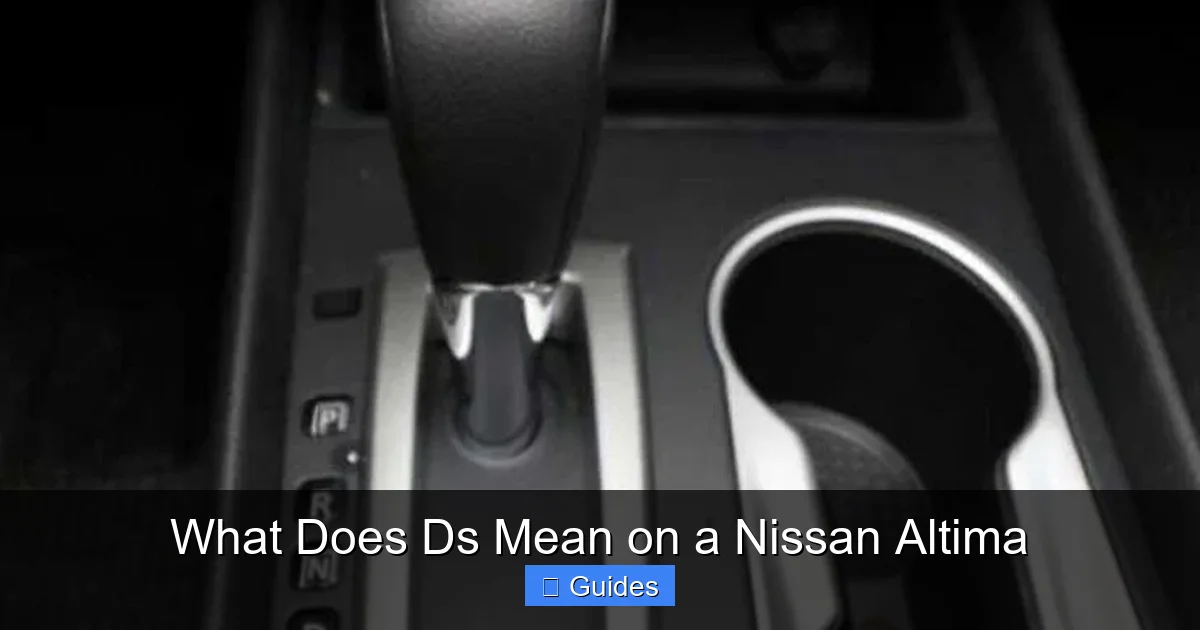
Let’s start with the basics: **DS stands for “Drive Sport.”** It’s a driving mode available on most Nissan Altima models equipped with an automatic transmission. You’ll find it right next to the standard “D” (Drive) position on the gear shifter—usually marked clearly so you can’t miss it.
When you shift into DS, you’re telling the car’s transmission to behave differently. Instead of prioritizing smooth, fuel-efficient gear changes like it does in regular Drive mode, the transmission shifts gears at higher RPMs (revolutions per minute). This means the engine stays in its power band longer, delivering quicker acceleration and a more responsive feel.
Think of it like this: in normal Drive mode, your Altima is like a calm, efficient commuter—smooth, quiet, and focused on saving gas. But when you switch to DS, it’s like giving that same commuter a shot of espresso. It’s still the same car, but now it’s more alert, more eager, and ready to respond when you need it.
It’s important to note that DS is **not** the same as a manual mode. You don’t manually select individual gears like you would in a manual transmission or paddle-shift system. Instead, DS is an automatic mode with a sportier tuning. The car still handles all the shifting for you—it just does it in a way that favors performance over fuel economy.
This makes DS perfect for drivers who want a sportier feel without the complexity of manual gear changes. It’s especially helpful for people who aren’t familiar with manual driving but still want more control over their car’s behavior.
How Is DS Different from Regular Drive Mode?
So, what exactly changes when you switch from “D” to “DS”? Let’s break it down.
In regular Drive mode, the Altima’s transmission is programmed to shift gears as early as possible. This helps keep engine RPMs low, which reduces noise, wear, and fuel consumption. It’s great for city driving, stop-and-go traffic, and long highway cruises where efficiency is key.
But in DS mode, the transmission delays upshifts and holds onto lower gears longer. This keeps the engine spinning faster, which means more power is available when you press the accelerator. The result? Faster acceleration, quicker response, and a more engaging drive.
For example, imagine you’re merging onto a busy highway. In Drive mode, your Altima might take a second or two to downshift and build speed. But in DS mode, the car is already in a lower gear, so it can accelerate more quickly and smoothly—helping you merge with confidence.
Another key difference is engine braking. In DS mode, when you lift off the accelerator, the car slows down more aggressively because the engine is in a lower gear. This is especially useful when driving downhill or navigating winding roads, where you want more control without riding the brakes.
Is DS the Same as Sport Mode?
This is a common question—and an important one. While DS and Sport Mode both aim to improve performance, they’re not exactly the same.
On some vehicles, “Sport Mode” is a comprehensive setting that adjusts multiple systems: throttle response, transmission behavior, steering weight, and even suspension (in higher-end models). It’s a full-package upgrade to the driving experience.
But on the Nissan Altima, **DS is primarily a transmission mode.** It focuses on how the automatic transmission shifts gears. It doesn’t change the steering feel, suspension stiffness, or other systems. So while it gives you a sportier drive, it’s not as comprehensive as a full Sport Mode found in performance cars.
That said, for most everyday drivers, DS provides plenty of sportiness. It’s a simple, effective way to make your Altima feel more alive without needing a sports car.
How Does DS Mode Work in the Nissan Altima?
Visual guide about What Does Ds Mean on a Nissan Altima
Image source: motchecker.org
Now that we know what DS stands for and how it differs from regular Drive, let’s dive into the mechanics. How exactly does DS mode change the way your Altima drives?
The key lies in the **transmission control module (TCM)**—the brain that manages gear shifts in your automatic transmission. When you shift into DS, the TCM receives a signal to alter its shifting strategy.
Instead of shifting up at low RPMs to save fuel, the TCM delays upshifts. This keeps the engine in its optimal power range—usually between 3,000 and 5,000 RPM—where it produces the most torque and horsepower. The result is quicker acceleration and a more responsive feel when you press the gas.
For example, if you’re driving at 40 mph in regular Drive mode, the transmission might be in 6th gear with the engine humming along at 1,800 RPM. But in DS mode, it might stay in 5th gear at 2,500 RPM, ready to deliver more power the moment you need it.
Throttle Response and Acceleration
One of the most noticeable effects of DS mode is improved throttle response. In regular Drive, there’s often a slight delay between pressing the accelerator and feeling the car respond. This is by design—it helps smooth out shifts and improve fuel economy.
But in DS mode, that delay is reduced. The engine reacts more quickly to your input, making the car feel more agile and responsive. This is especially helpful when you need to accelerate quickly—like when passing another vehicle or merging into fast-moving traffic.
Imagine you’re driving on a two-lane road and want to overtake a slow-moving truck. In Drive mode, you might have to wait a moment for the transmission to downshift and build speed. But in DS mode, the car is already in a lower gear, so it can accelerate more quickly and safely complete the pass.
Gear Holding and Engine Braking
Another benefit of DS mode is that it holds gears longer—both on acceleration and deceleration. This has two important effects:
First, it keeps the engine in its power band, so you always have access to maximum performance. Second, it enhances engine braking, which helps slow the car down when you release the accelerator.
Engine braking is especially useful when driving downhill. Instead of riding the brakes and risking overheating or brake fade, you can use DS mode to let the engine help slow the car. This not only improves safety but also extends the life of your brake pads.
For example, if you’re driving through a mountainous area with steep descents, shifting into DS can help you maintain a safe, controlled speed without constantly pressing the brake pedal. It’s a simple trick that makes driving more comfortable and safer.
When Does the Transmission Shift in DS Mode?
The exact shift points in DS mode depend on your driving style and road conditions, but here’s a general idea:
– **Upshifts:** Occur at higher RPMs (typically 3,000–5,000 RPM) instead of the lower RPMs used in Drive mode.
– **Downshifts:** Happen more quickly and at higher speeds, especially when you press the accelerator firmly.
– **Kickdown:** The transmission responds faster to sudden acceleration, dropping multiple gears if needed.
This behavior mimics what a skilled manual driver would do—keeping the engine in the sweet spot for performance.
When Should You Use DS Mode?
Visual guide about What Does Ds Mean on a Nissan Altima
Image source: rusticaly.com
Now that you understand how DS mode works, the next question is: when should you actually use it?
The short answer: **whenever you want a more responsive, engaging drive.** But let’s break it down with some practical examples.
1. Highway Merging and Passing
One of the best times to use DS mode is when you’re on the highway and need to merge or pass another vehicle. In regular Drive mode, the transmission might hesitate before downshifting, causing a delay in acceleration. But in DS mode, the car is already in a lower gear, so it can accelerate quickly and safely.
For instance, if you’re entering a highway from an on-ramp, shifting to DS can help you match the speed of traffic more smoothly. Similarly, if you’re driving behind a slow truck and want to pass, DS mode gives you the extra power you need to complete the maneuver confidently.
2. Driving on Winding or Mountain Roads
If you enjoy driving on scenic backroads or mountain passes, DS mode can make the experience more enjoyable and safer. The improved throttle response and engine braking help you navigate curves and descents with greater control.
Imagine you’re driving through a hilly area with sharp turns. In Drive mode, you might have to brake frequently to slow down for corners. But in DS mode, you can use engine braking to help slow the car, reducing wear on your brakes and keeping your speed more consistent.
Plus, the quicker acceleration out of corners makes the drive feel more dynamic and fun.
3. Towing or Carrying Heavy Loads
If you’re towing a trailer or carrying a heavy load—like luggage, gear, or passengers—DS mode can help your Altima handle the extra weight more effectively.
The transmission will stay in lower gears longer, providing more torque and reducing strain on the engine. This is especially helpful when climbing hills or accelerating from a stop with a heavy load.
For example, if you’re driving up a steep hill with a full car and a rooftop cargo box, DS mode can prevent the transmission from “hunting” between gears and keep the engine in its optimal power range.
4. Sporty Driving or Weekend Adventures
Even if you’re not towing or merging, DS mode can simply make your drive more enjoyable. If you’re in the mood for a little fun—maybe on a Sunday drive or a road trip—shifting into DS can give your Altima a sportier feel.
It’s not a race car mode, but it does make the car feel more alive and responsive. And because it’s so easy to activate, you can switch in and out of DS mode as needed.
When NOT to Use DS Mode
While DS mode is great for performance, it’s not always the best choice. Here are a few situations where you might want to stick with regular Drive mode:
– **City driving with stop-and-go traffic:** Frequent acceleration and braking in DS mode can reduce fuel efficiency and increase engine wear.
– **Long highway cruises at steady speeds:** In these conditions, DS mode offers little benefit and may lower fuel economy.
– **Cold engine starts:** It’s best to let the engine warm up in Drive mode before using DS, especially in cold weather.
In general, use DS when you need performance, and switch back to Drive when you’re focused on comfort and efficiency.
Does DS Mode Affect Fuel Economy?
Visual guide about What Does Ds Mean on a Nissan Altima
Image source: trucksauthority.com
This is a big question for many drivers: **Does using DS mode hurt your gas mileage?**
The short answer is: **Yes, but only if you drive aggressively.**
In DS mode, the engine runs at higher RPMs and shifts less frequently, which can increase fuel consumption—especially if you’re accelerating hard or driving at high speeds. However, if you use DS mode wisely—like for short bursts during merging or passing—the impact on fuel economy is minimal.
For example, if you use DS mode for 10 minutes during a 2-hour drive, your overall fuel efficiency won’t drop significantly. But if you drive in DS mode all the time and accelerate aggressively, you could see a noticeable decrease in miles per gallon.
That said, many drivers find that the improved responsiveness and control are worth the slight trade-off in fuel economy. And because DS mode is so easy to switch in and out of, you can always return to Drive mode when you’re cruising or trying to save gas.
Tips for Minimizing Fuel Impact
If you want to enjoy DS mode without hurting your fuel economy, here are a few tips:
– Use DS only when needed—like for merging, passing, or driving on hills.
– Avoid aggressive acceleration; smooth, gradual inputs are more efficient.
– Switch back to Drive mode when you’re at cruising speed.
– Combine DS with other fuel-saving habits, like maintaining steady speeds and avoiding rapid stops.
With smart use, you can enjoy the benefits of DS mode without sacrificing too much efficiency.
Common Misconceptions About DS Mode
Despite its simplicity, DS mode is often misunderstood. Let’s clear up a few common myths.
Myth 1: DS Mode Is Only for Racing
Some people think DS mode is only for performance driving or track use. But that’s not true. While it does enhance performance, DS mode is perfectly safe and useful for everyday driving—especially in situations that require quick acceleration or better control.
You don’t need to be a race car driver to benefit from DS mode. In fact, many family drivers use it for safer highway merging or driving in hilly areas.
Myth 2: DS Mode Damages the Engine or Transmission
Another concern is that running in DS mode could harm the engine or transmission. But modern Nissan Altimas are designed to handle DS mode safely. The transmission and engine are built to operate at higher RPMs, and the cooling systems are more than capable of handling the extra heat.
As long as you’re not redlining the engine or driving aggressively for long periods, DS mode won’t cause damage.
Myth 3: DS Mode Is the Same as Manual Mode
Some drivers confuse DS mode with manual shifting. But remember: DS is still an automatic mode. You don’t manually select gears. The car handles all the shifting—it just does it in a sportier way.
If your Altima has paddle shifters (available on some trims), those are for manual control. DS mode is different—it’s automatic with a performance tune.
Myth 4: You Should Always Drive in DS Mode
While DS mode is fun and useful, it’s not meant for constant use. Driving in DS mode all the time can reduce fuel economy and increase engine wear over time. It’s best used selectively, when you need the extra performance.
Think of it like a tool—use it when it’s helpful, not all the time.
How to Use DS Mode: A Step-by-Step Guide
Using DS mode is incredibly simple. Here’s how to do it:
1. **Start your car** and ensure it’s in Park (P).
2. **Press the brake pedal** and shift into Drive (D).
3. **Move the gear shifter to the DS position.** This is usually to the side or below the D position, depending on your Altima model.
4. **Drive normally.** The car will now shift gears at higher RPMs and respond more quickly to the accelerator.
5. **To exit DS mode,** simply move the shifter back to D.
That’s it! No buttons, no screens, no complicated settings. Just a simple shift, and you’re in sport mode.
Tips for First-Time Users
If you’ve never used DS mode before, here are a few tips to get started:
– Start in a safe, open area—like an empty parking lot or quiet road—to get a feel for the difference.
– Notice how the car accelerates more quickly and holds gears longer.
– Practice using DS for merging and passing on the highway.
– Pay attention to fuel economy over time to see how it affects your driving.
With a little practice, you’ll quickly learn when and how to use DS mode to your advantage.
Conclusion: Is DS Mode Worth Using?
So, what’s the final verdict? **Is DS mode worth using in your Nissan Altima?**
Absolutely—especially if you value responsiveness, control, and a more engaging driving experience. DS mode isn’t just a gimmick; it’s a practical feature that can make your daily drives safer and more enjoyable.
Whether you’re merging onto a busy highway, driving through the mountains, or just want a little extra pep, DS mode gives you the tools to drive with confidence. It’s easy to use, safe, and doesn’t require any special skills.
And while it may slightly reduce fuel economy during aggressive driving, the trade-off is minimal when used wisely. For most drivers, the benefits far outweigh the costs.
So the next time you’re behind the wheel of your Altima, don’t ignore that “DS” position. Give it a try. You might just discover your new favorite driving mode.
Frequently Asked Questions
What does DS mean on a Nissan Altima?
DS stands for “Drive Sport” and is a driving mode that enhances throttle response and gear shifting for a more dynamic and responsive driving experience. It’s designed to make the Altima feel sportier without requiring manual gear changes.
Is it safe to drive in DS mode all the time?
While DS mode is safe for occasional use, driving in it constantly can reduce fuel efficiency and increase engine wear over time. It’s best used selectively—like for merging, passing, or driving on hills—rather than for everyday cruising.
Does DS mode improve fuel economy?
No, DS mode typically reduces fuel economy because the engine runs at higher RPMs and shifts less frequently. However, the impact is minimal if used only when needed, such as for short bursts of acceleration.
Can I use DS mode in snow or icy conditions?
It’s not recommended. DS mode increases throttle sensitivity, which can lead to wheel spin on slippery surfaces. In snow or ice, it’s safer to use regular Drive mode for smoother, more controlled acceleration.
Does DS mode work in all Nissan Altima models?
Most Nissan Altima models with an automatic transmission include DS mode, but it may not be available on base trims or older models. Check your owner’s manual or gear shifter to confirm.
Is DS mode the same as manual mode?
No, DS mode is not manual mode. It’s an automatic transmission mode with sportier shifting. You don’t manually select gears—the car handles shifting automatically, just at higher RPMs for better performance.

At CarLegit, we believe information should be clear, factual, and genuinely helpful. That’s why every guide, review, and update on our website is created with care, research, and a strong focus on user experience.