
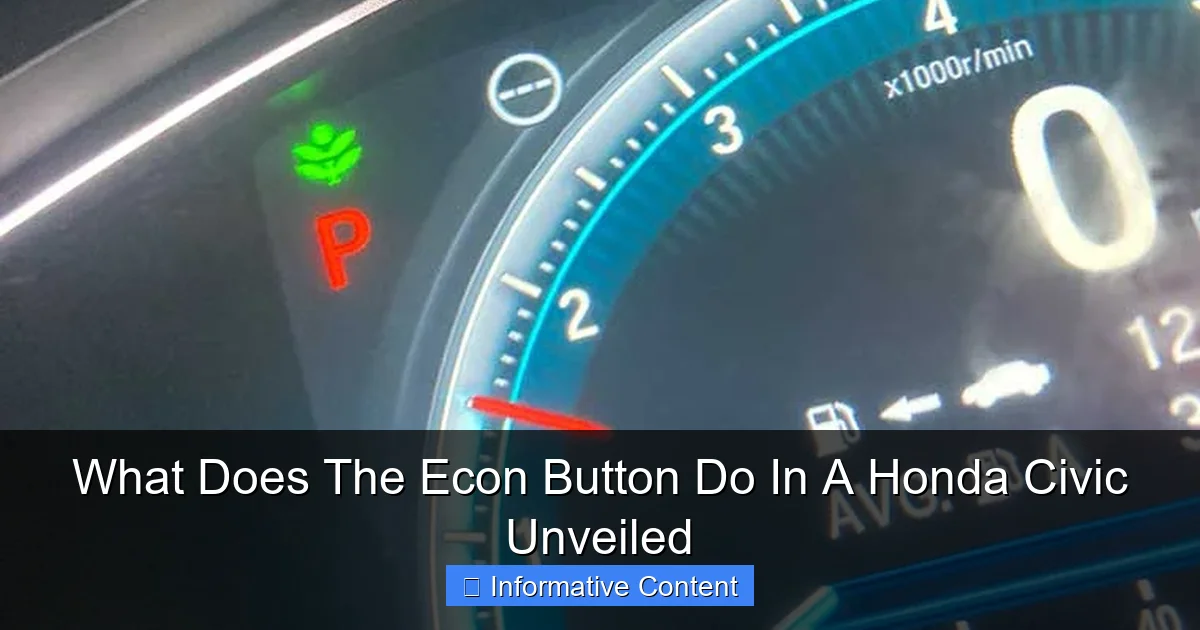
The Econ button in a Honda Civic activates an economy mode that prioritizes fuel efficiency by moderating throttle response and adjusting climate control. This optimization delivers noticeable gas savings for a more efficient, though slightly less responsive, driving experience.
In This Article
- 1 Key Takeaways
- 2 📑 Table of Contents
- 3 That Mysterious Green Button: Your Gateway to Smarter Driving
- 4 The Heart of the Matter: How the Econ Button Works
- 5 When to Press It: The Ideal Scenarios for Econ Mode
- 6 When to Turn It Off: Times You Need Full Power
- 7 What to Really Expect: Fuel Economy and Performance Impact
- 8 Comparing the Modes: A Data Perspective
- 9 Pro Tips and Common Myths Debunked
- 10 Your Drive, Your Choice: Mastering the Econ Button
- 11 Frequently Asked Questions
- 11.1 What is the Econ button in a Honda Civic?
- 11.2 How does the Econ button improve fuel efficiency?
- 11.3 When should I use the Econ button in my Honda Civic?
- 11.4 Does pressing the Econ button affect driving performance?
- 11.5 Can I leave the Econ button on all the time in my Honda Civic?
- 11.6 What specific changes occur when I press the Econ button in a Honda Civic?
Key Takeaways
- Engages a fuel-saving mode: Press the button once to activate the ECON system.
- Adjusts throttle and transmission: Creates smoother, more fuel-efficient acceleration.
- Optimizes HVAC operation: Reduces air conditioning power to save significant energy.
- Prioritizes efficiency over power: Expect a more relaxed, less responsive drive.
- Ideal for steady highway driving: Maximizes fuel savings during consistent cruising.
- Disable for quick acceleration: Turn it off before merging or passing.
📑 Table of Contents
- That Mysterious Green Button: Your Gateway to Smarter Driving
- The Heart of the Matter: How the Econ Button Works
- When to Press It: The Ideal Scenarios for Econ Mode
- When to Turn It Off: Times You Need Full Power
- What to Really Expect: Fuel Economy and Performance Impact
- Comparing the Modes: A Data Perspective
- Pro Tips and Common Myths Debunked
- Your Drive, Your Choice: Mastering the Econ Button
That Mysterious Green Button: Your Gateway to Smarter Driving
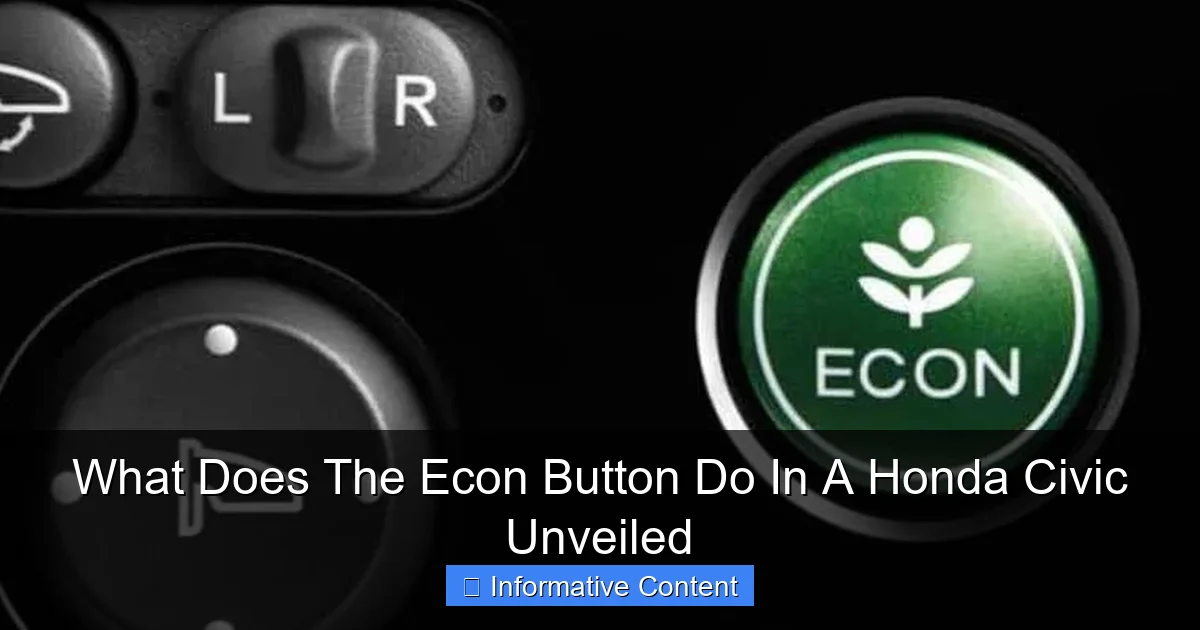
Have you ever been driving your Honda Civic, cruising down the highway, and your finger hovers over that button marked “ECON”? You know it’s supposed to be good—it’s green, after all, the universal color for “go” and “good.” But what does pressing it actually do? Does it magically turn your Civic into a hyper-efficient hybrid? Or does it just make the car feel, well, a bit sleepy?
I remember the first time I drove a Civic with this feature. I was on a long road trip, watching the gas gauge a little too closely. I finally mustered the courage and pressed the Econ button. The dashboard lit up with a soothing green glow, and I immediately braced for a dramatic change. What followed wasn’t a jolt of electric power or a loud proclamation of fuel savings. It was subtler. The car just felt… more relaxed. It got me thinking. What exactly is happening under the hood when that little light comes on?
This post is here to demystify that button for you. We’re going to peel back the layers and explain, in plain English, exactly what the Econ button does in your Honda Civic. Whether you’re a daily commuter, a weekend adventurer, or just someone who likes to know every feature of their car, you’re in the right place. Let’s turn that mystery into knowledge.
The Heart of the Matter: How the Econ Button Works
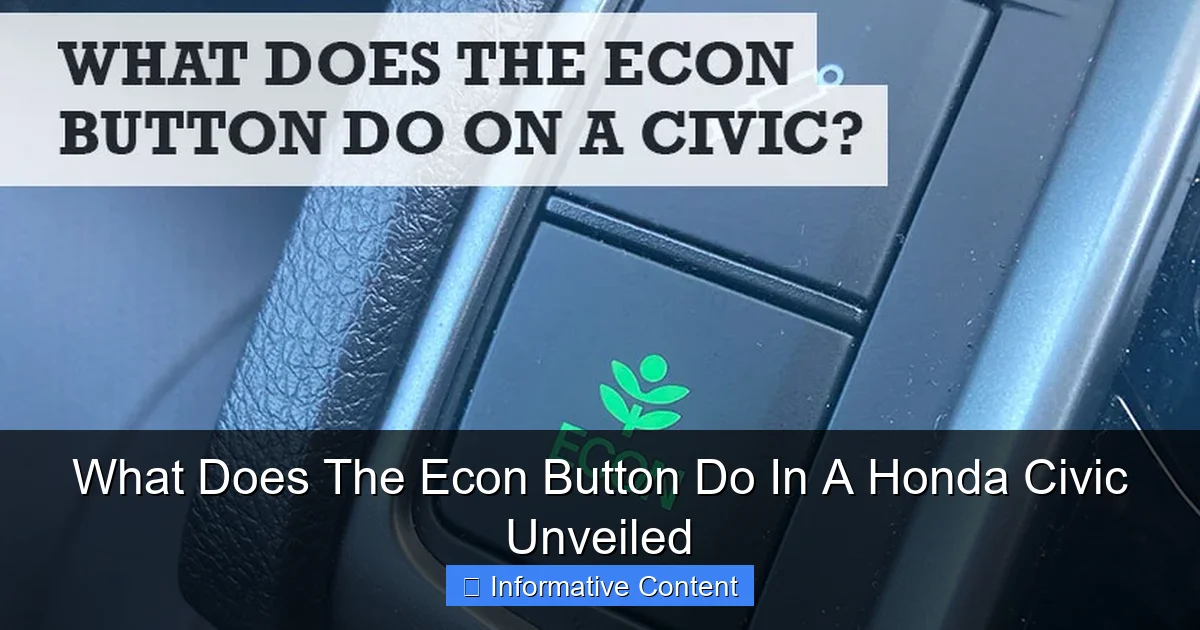
At its core, the Econ button is a master switch for your Honda Civic’s efficiency. It doesn’t add new hardware or create energy from nothing. Instead, it’s a clever software system that coordinates several of your car’s key functions to prioritize fuel economy over spirited performance. Think of it as an orchestra conductor, carefully tuning each section to play a symphony of savings.
Visual guide about What Does The Econ Button Do In A Honda Civic
Image source: simplecarguides.com
When you press the Econ button, you’re telling your car’s computer, “My main goal today is to use as little fuel as possible.” The computer then takes that command and adjusts several systems to work in harmony toward that single goal. It’s a holistic approach, not just one single tweak.
The Three Pillars of Econ Mode
The magic of the Econ system rests on three main adjustments: how the engine responds, how the transmission behaves, and how your comfort systems operate. Let’s break down each one.
Engine and Throttle Response
This is the change you’ll feel most immediately. The Econ mode remaps your throttle pedal’s sensitivity. In normal mode, when you press the accelerator 25%, the engine might give you 25% of its power. In Econ mode, that same 25% press might only request 15-20% power. It makes the accelerator feel less “jumpy” and more linear. The engine computer also adjusts ignition timing and other parameters to optimize for efficiency at the expense of quick acceleration. It’s not that the car can’t accelerate; it just does so more gently and deliberately.
Transmission Behavior (CVT Models)
If your Honda Civic has a Continuously Variable Transmission (CVT), the Econ button has a profound effect here. The CVT is designed to keep the engine in its most efficient speed (RPM) for any given driving situation. Econ mode makes this programming even more aggressive. It will allow the engine to run at lower RPMs more often and will be quicker to “upshift” (simulate a higher gear) to reduce engine speed. You might notice the engine doesn’t rev as high when you’re accelerating onto a freeway.
Climate Control and Electrical Systems
This is a fascinating and often overlooked part of the system. Your air conditioner is a huge drain on engine power. In Econ mode, the climate control system is adjusted to reduce its workload. The compressor may cycle on and off more frequently, and fan speeds might be managed more conservatively to save energy. Some models also reduce the power to heated seats or adjust the alternator’s charging output to lessen the engine’s load. It’s all about reducing parasitic losses.
When to Press It: The Ideal Scenarios for Econ Mode
Now that you know what it does, the big question is: when should you use it? The Econ button isn’t an “always on” kind of feature for most people. It’s a tool for specific situations. Using it wisely is the key to unlocking its benefits.

Visual guide about What Does The Econ Button Do In A Honda Civic
Image source: simplecarguides.com
Long Highway Cruises
This is the Econ mode’s sweet spot. Once you’re at a steady speed on the interstate, the system excels. The engine and transmission can settle into their most efficient operating zones without the constant need for acceleration and deceleration. The reduced throttle sensitivity is also less of a bother when you’re just maintaining speed. You’ll likely see the best fuel economy gains here.
City Commuting in Steady Traffic
If your daily drive involves predictable, steady-speed traffic (not stop-and-go), Econ can help. The smoother throttle response can actually make for a less jerky ride in congestion, as it discourages aggressive speeding up and slowing down. The trick is to anticipate traffic flow and use gentle pedal inputs.
When Every Drop Counts
We’ve all been there—running low on fuel and trying to stretch the last quarter tank to the next gas station. This is a perfect time to engage Econ mode. By minimizing the load from the A/C and optimizing drivetrain efficiency, you give yourself the best possible chance to make it to the pump.
When to Turn It Off: Times You Need Full Power
Just as important as knowing when to use Econ mode is knowing when to turn it off. There are times when you need your Honda Civic’s full, unbridled responsiveness, and Econ mode will be a hindrance.
Visual guide about What Does The Econ Button Do In A Honda Civic
Image source: simplecarguides.com
Merging onto Fast Highways or Overtaking
When you need a burst of speed to safely merge into fast-moving traffic or pass a slower vehicle, you want immediate power. The dulled throttle response in Econ mode can make this maneuver feel sluggish and less confident. For safety’s sake, tap the button to turn it off before attempting a strong acceleration.
Driving in Hilly or Mountainous Terrain
Climbing steep grades requires power. In Econ mode, your Civic might struggle to find the right “gear” with its CVT, causing the engine to feel like it’s laboring or “hunting” for the right ratio. This can actually be less efficient and is certainly less pleasant. Turn it off for mountain drives.
When Maximum Cabin Comfort is a Priority
On a blistering hot day, you might find the Econ mode’s toned-down air conditioning insufficient. If you and your passengers are uncomfortable, the minor fuel savings aren’t worth it. Feel free to disengage Econ for a stronger, cooler blast of air.
What to Really Expect: Fuel Economy and Performance Impact
Let’s talk numbers and feelings. Managing your expectations is crucial to being happy with the Econ button.
Real-World Fuel Savings
Honda is careful not to promise a specific percentage gain because it varies wildly with driving conditions. In ideal scenarios (steady highway driving), you might see a 1-3 MPG improvement. In mixed city/highway driving, it might be more like 0.5-2 MPG. It’s not a miracle worker, but over a year of driving, those small savings can add up to several free gallons of gas. The biggest benefit often comes from the driving habit change it encourages—smoother, more gradual acceleration.
The Performance Trade-Off
The trade-off is very real. Your Honda Civic will feel noticeably less peppy. Acceleration from a stop will be slower, and passing power will be reduced. For some drivers, this “sluggish” feeling is annoying. For others, it’s a welcome calmness. It’s a personal preference. Remember, you can toggle it on and off at any time while driving, so you have full control over this trade-off.
Comparing the Modes: A Data Perspective
To visualize the differences, let’s look at how the Econ button influences your Honda Civic’s behavior compared to normal driving mode. This table summarizes the key adjustments.
| System | Normal Mode | Econ Mode | Driver Feeling |
|---|---|---|---|
| Throttle Response | Direct, responsive. Pedal input closely matches power request. | Muted, linear. Requires more pedal for the same power. | Car feels peppier and more alert in Normal. Feels calm and relaxed in Econ. |
| Transmission (CVT) | Seeks a balance of responsiveness and efficiency. Allows higher RPMs for acceleration. | Prioritizes low RPMs. Quicker to simulate “upshifts” to drop engine speed. | More immediate acceleration in Normal. Engine revs lower and more quietly in Econ. |
| Climate Control | Full power available for maximum cooling/heating as requested. | System runs more conservatively to reduce engine load. | A/C may blow slightly less cold, fans may be less forceful in Econ. |
| Overall Goal | Balance of performance, comfort, and efficiency. | Maximum fuel economy, even at the cost of performance and comfort. | A versatile daily driver vs. a focused efficiency machine. |
Pro Tips and Common Myths Debunked
Let’s wrap up the operational knowledge with some hands-on advice and clear up a few misconceptions about the Econ button.
Tips for Maximizing Econ Mode
- Pair it with Smooth Driving: Econ mode works best when you do. Anticipate stops, accelerate gently, and maintain a steady speed. The system is your partner, not a replacement for good habits.
- Use Cruise Control: On the highway, engaging cruise control while in Econ mode is a fantastic combo. It lets the computer manage steady-speed efficiency perfectly.
- Experiment: Try a week with it on during your regular commute and a week with it off. Track your fuel economy (using the car’s trip computer or an app) to see the real impact for your driving style.
Busting the Myths
- Myth: The Econ button damages the engine or transmission.
Truth: Absolutely not. It uses factory-programmed, conservative settings designed by Honda’s engineers. It’s perfectly safe for long-term use. - Myth: It’s only for hybrid models.
Truth: While Honda hybrids have a more complex Eco mode, the standard Econ button is a key feature on many non-hybrid gasoline Civics and works on the principles we’ve discussed. - Myth: You must always use it to get good gas mileage.
Truth: Your right foot is the biggest factor in fuel economy. You can achieve excellent mileage in Normal mode with a light, smooth driving style. The Econ button is an aid, not a requirement.
Your Drive, Your Choice: Mastering the Econ Button
So, what does the Econ button do in a Honda Civic? It transforms your car from a balanced daily driver into a consciously tuned efficiency partner. It gently reprograms how the engine, transmission, and accessories work together, with the singular goal of saving fuel. It encourages smoother driving and makes you more aware of your car’s energy consumption.
The beauty of this feature is its simplicity and flexibility. A quick press engages it; another press returns everything to normal. There’s no penalty for switching. This puts you, the driver, in complete control. You can choose efficiency for your long, boring highway slog and then choose full responsiveness for the winding backroad on the way home.
Don’t be afraid of that little green button. See it for what it is: a smart tool in your Honda Civic’s extensive toolkit. Experiment with it. Learn its nuances. Some days you’ll love the calm, money-saving vibe it creates. Other days, you’ll want the sportier feel of Normal mode. And that’s exactly the point. It’s your Civic, and now you know exactly how to make it suit your mood, your route, and your wallet. Happy driving!
Frequently Asked Questions
The Econ button, short for Economy, is a fuel-saving feature in your Honda Civic. When engaged, it optimizes various systems like engine performance and air conditioning to enhance efficiency and reduce fuel consumption.
The Econ button adjusts throttle response and transmission shift patterns to promote smoother, more economical driving. It also reduces the workload of the air conditioning system, which helps save gas during your commute.
Use the Econ button during steady-speed driving, such as on highways or in light traffic, to maximize fuel savings. It’s best to turn it off when you need rapid acceleration, like for passing or merging, to maintain full engine performance.
Yes, activating the Econ button can slightly reduce throttle sensitivity and engine power to prioritize fuel economy. This may make acceleration feel less responsive, but it’s ideal for routine trips where efficiency is key.
You can keep the Econ button on continuously for daily driving to consistently benefit from improved fuel economy. However, consider turning it off for demanding situations like steep climbs or loaded driving to ensure adequate power.
Pressing the Econ button modifies throttle mapping for gentler acceleration, adjusts transmission shift points for better efficiency, and scales back air conditioning output to reduce engine load. These tweaks work together to lower fuel usage without major compromises in comfort.

At CarLegit, we believe information should be clear, factual, and genuinely helpful. That’s why every guide, review, and update on our website is created with care, research, and a strong focus on user experience.