

Featured image for What Does The H And C Mean On A Car
Image source: topgear.com
The H and C on your car’s dashboard stand for Hot and Cold, marking the ends of your engine coolant temperature gauge. Keeping an eye on this gauge is crucial to prevent overheating and ensure your engine runs smoothly. Aim for the needle to stay in the middle range to avoid costly repairs and maintain peak performance.
In This Article
- 1 Key Takeaways
- 2 📑 Table of Contents
- 3 Uncover What The H And C Mean On Your Car
- 4 The Basics: Your Car’s Vital Sign Monitor
- 5 The Journey from C to H: What’s Normal and What’s Not
- 6 Understanding the Dangers: Why “H” is a Serious Warning
- 7 Modern Dashboards: From Gauges to Lights
- 8 A Quick Comparison: Gauge vs. Light Systems
- 9 Keeping Your Cool: Simple Maintenance Tips
- 10 Conclusion: Your Key to a Healthy Engine
- 11 Frequently Asked Questions
- 11.1 What do the H and C symbols mean on my car’s dashboard?
- 11.2 Why are there H and C indicators on my car?
- 11.3 What does the H and C mean on a car in terms of engine health?
- 11.4 What should I do if the H light comes on in my car?
- 11.5 Can ignoring the C symbol on my car cause issues?
- 11.6 How do I properly read the H and C gauge while driving?
Key Takeaways
- H means Hot: This setting activates the heater for warm air.
- C means Cold: This setting engages the air conditioner for cool air.
- Adjust for comfort: Use H in winter and C in summer for optimal temperature.
- Check system if unresponsive: If H or C doesn’t work, inspect your HVAC system.
- Understand your controls: Knowing H and C helps manage cabin temperature efficiently.
- Save fuel with care: Use C sparingly as AC increases engine load.
- Prioritize safety: Proper climate control reduces driver fatigue and improves focus.
📑 Table of Contents
- Uncover What The H And C Mean On Your Car
- The Basics: Your Car’s Vital Sign Monitor
- The Journey from C to H: What’s Normal and What’s Not
- Understanding the Dangers: Why “H” is a Serious Warning
- Modern Dashboards: From Gauges to Lights
- A Quick Comparison: Gauge vs. Light Systems
- Keeping Your Cool: Simple Maintenance Tips
- Conclusion: Your Key to a Healthy Engine
Uncover What The H And C Mean On Your Car
Have you ever been driving along, maybe on a long road trip or just running errands, and your eyes drift down to the dashboard? Among the speedometer and fuel gauge, there’s that one dial that seems simple but can spark a moment of quiet panic. You see a needle hovering somewhere between a big “C” and a big “H.”
For a split second, you wonder, “Is that where it’s supposed to be? What do these letters even mean?” If you’ve ever had that thought, you’re absolutely not alone. That little gauge is one of the most important, yet misunderstood, features in your car.
Today, we’re going to demystify it completely. Consider this a friendly chat where we uncover what the H and C mean on your car, why paying attention to them is crucial for your engine’s health, and what to do if that needle starts acting up. By the end, you’ll look at that dial with confidence, not confusion.
The Basics: Your Car’s Vital Sign Monitor
Think of your car’s engine like the human body. It has a perfect operating temperature, just like we do at 98.6°F (37°C). When you’re healthy, your temperature is steady. Your car’s engine is the same. It needs to be warm enough to run efficiently but not so hot that it damages itself.

Visual guide about What Does The H And C Mean On A Car
Image source: images.prismic.io
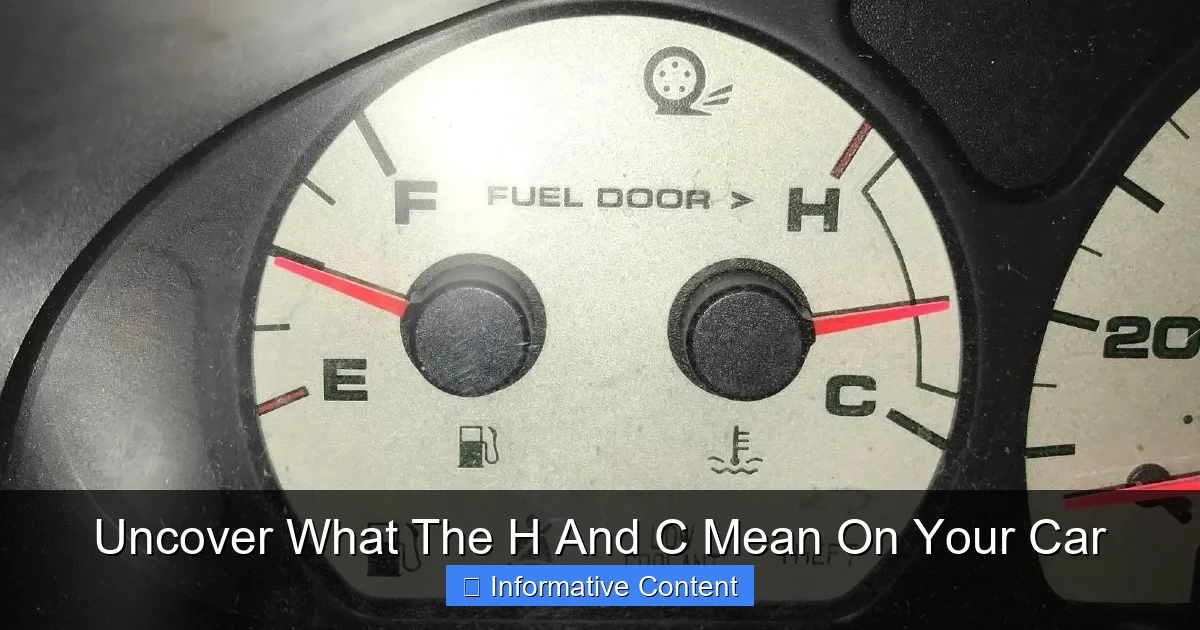
The gauge with the “H” and “C” is your engine’s thermometer. Its proper name is the coolant temperature gauge or engine temperature gauge. Its one job is to tell you the temperature of your engine’s coolant—the special liquid circulating through the engine block to absorb and carry away heat.
Breaking Down the Letters: C and H
- C stands for Cold: This indicates the coolant/engine is at a low temperature, usually when you first start the car on a chilly morning.
- H stands for Hot: This indicates the coolant/engine is at a high temperature, a warning that things are getting too warm.
The magic happens in the space between them. That’s where your engine wants to live.
The Journey from C to H: What’s Normal and What’s Not
When you turn the key in the ignition, you’ll almost always see the needle on or near “C.” This is completely normal. Your engine is cold and needs to warm up.
Visual guide about What Does The H And C Mean On A Car
Image source: motorbiscuit.com
As you start driving, the needle will gradually climb from “C” toward the middle of the gauge. This warming-up process is vital. Modern engines are designed to operate most efficiently at this optimal temperature, which is typically around 195°F to 220°F (90°C to 105°C). On your gauge, this is represented by the midpoint, often marked with a small symbol or just a blank space.
The Sweet Spot: Normal Operating Temperature
A healthy car will reach this middle point and stay there. Whether you’re idling in traffic or cruising on the highway, the cooling system (thermostat, radiator, fan, and water pump) works tirelessly to maintain this balance. The needle should be rock-steady in the middle. Seeing it parked steadily between C and H is a sign of a happy engine.
Red Flags: When the Needle Misbehaves
Problems arise when the needle doesn’t follow this normal pattern. Here are two common abnormal scenarios:
- The Needle Never Leaves “C”: If you’ve been driving for 15-20 minutes and the gauge is still at or very near “C,” your engine might be running too cool. This is often caused by a stuck-open thermostat. While less immediately dramatic than overheating, it reduces fuel efficiency, increases engine wear, and can lead to higher emissions.
- The Needle Creeps Toward “H”: This is the more urgent warning. If the needle climbs past the midpoint and keeps going toward “H,” especially in normal driving conditions, your engine is beginning to overheat. This requires immediate attention.
Understanding the Dangers: Why “H” is a Serious Warning
An engine running too hot isn’t just a minor inconvenience; it’s a crisis. Modern engines are marvels of precision engineering with tight tolerances between metal parts. Excessive heat causes metal to expand dramatically.
Visual guide about What Does The H And C Mean On A Car
Image source: i.ytimg.com
When the temperature soars past the normal range, several catastrophic things can happen:
- Warped Cylinder Heads: The cylinder head, a major engine component, can warp from the heat, breaking the seal with the engine block.
- Blown Head Gasket: This critical seal can fail, allowing coolant and oil to mix. Repairing this is one of the most expensive common fixes for an engine.
- Cracked Engine Block: In extreme cases, the main structure of the engine itself can crack from thermal stress. This often means the engine is totaled.
In short, the “H” is your car’s way of screaming for help before it inflicts serious, wallet-draining damage on itself.
What to Do If the Needle Hits H
If you see the temperature needle heading for or at “H,” stay calm but act quickly:
- Turn Off the A/C and Turn On the Heat: This sounds backwards, but it helps. Switch your climate control to full heat and fan at maximum. This pulls heat away from the engine and into the cabin, acting as a secondary radiator.
- Reduce Engine Load: If possible, ease off the gas, shift to a lower gear (in a manual), and avoid hard acceleration.
- Find a Safe Place to Stop: Do not immediately shut off the engine if the needle is at H. Pull over safely, let the engine idle for a minute to circulate coolant, then turn it off.
- Do Not Open the Radiator Cap: The system is under extreme pressure. Opening it will cause scalding coolant to erupt violently. Wait until the engine is completely cool (several hours) before attempting to check coolant levels.
Modern Dashboards: From Gauges to Lights
Not all cars have a full gauge with a needle. Many modern vehicles use a simplified set of warning lights. This doesn’t change what H and C mean; it just changes how the information is delivered.
- Blue or “C” Light: This illuminates when the engine is cold. It’s simply telling you the engine hasn’t reached its optimal temperature yet. It’s a cue to take it easy on the engine until it warms up.
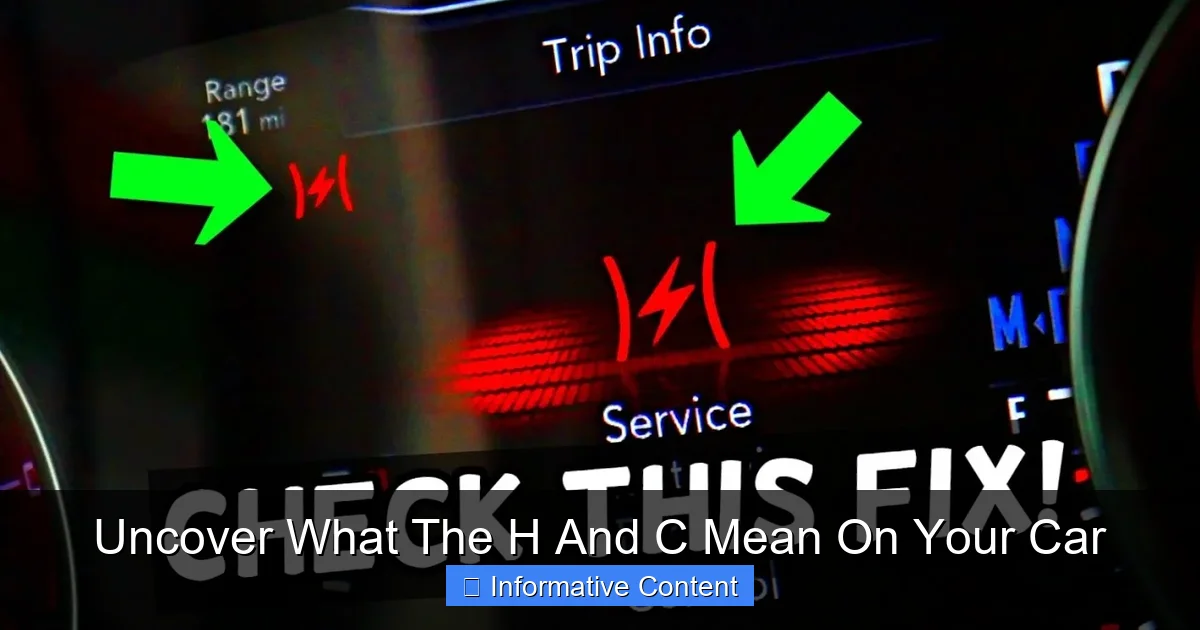
- Red or “H” Light (or a Red Temperature Symbol): This is the critical warning. If this red light comes on and stays on, it means the engine is overheating. Treat it with the same urgency as a needle in the “H” zone.
The principle remains identical: “C” means cold/caution, “H” means hot/help needed. The middle ground—normal operation—is indicated by no light being illuminated at all.
A Quick Comparison: Gauge vs. Light Systems
Here’s a simple breakdown of the two common types of temperature indicators:
| Feature | Traditional Needle Gauge | Idiot Light / Warning Light System |
|---|---|---|
| Information Detail | High. Shows exact temperature progression from cold to hot. | Low. Only shows “cold” or “overheating,” not the in-between. |
| Driver Awareness | Allows you to spot a slow creep toward “H” before it’s critical. | Only alerts you when a problem is already occurring. |
| Common In | Older cars, trucks, and many modern vehicles focused on driver information. | Many modern economy and mid-range cars as a cost-saving measure. |
| Best For | Drivers who prefer proactive monitoring of their vehicle’s health. | Drivers who prefer a simple “problem/no problem” alert. |
Keeping Your Cool: Simple Maintenance Tips
Preventing temperature problems is much easier and cheaper than fixing them. Here are a few friendly tips to keep that needle happy in the middle:
Regular Coolant Checks
Every month or so, when the engine is cold, check the coolant level in the overflow reservoir (the plastic tank under the hood, not the radiator itself). The fluid level should be between the “MIN” and “MAX” lines. If it’s consistently low, you might have a leak.
Follow Your Car’s Service Schedule
Coolant doesn’t last forever. Over time, it loses its anti-corrosion and lubricating properties. Your owner’s manual will specify how often to flush and replace the coolant—typically every 30,000 to 100,000 miles depending on the type.
Pay Attention to Other Signs
Your car gives other hints of cooling system trouble. Watch for:
- A sweet smell from the engine bay (leaking coolant).
- Puddles of green, orange, or pink fluid under your car.
- Your heater stops blowing hot air (low coolant level).
Conclusion: Your Key to a Healthy Engine
So, what does the H and C mean on your car? It’s the story of your engine’s health, told in the simplest alphabet. “C” is the starting point, a cold engine asking for a gentle warm-up. The wide space between C and H is where your engine thrives, working at its efficient best. And “H” is a bright red flag, a clear signal that something is wrong and needs your immediate attention.
Understanding this simple gauge empowers you as a driver. It moves you from being a passive passenger to an informed caretaker of your vehicle. No longer just mysterious letters, “C” and “H” become useful tools, helping you catch small problems before they become big, expensive ones. The next time you glance at your dashboard, you can smile, knowing exactly what your car is telling you.
Frequently Asked Questions
What do the H and C symbols mean on my car’s dashboard?
The H and C symbols on your car’s dashboard represent the temperature gauge for your engine. H stands for “Hot” and C stands for “Cold,” indicating the coolant temperature to help you monitor if the engine is running within a safe range.
Why are there H and C indicators on my car?
H and C indicators are part of your car’s vital temperature monitoring system. They alert you to potential overheating or excessive cooling of the engine, which is crucial for preventing damage and ensuring optimal performance during drives.
What does the H and C mean on a car in terms of engine health?
On a car, H and C directly relate to engine health by showing coolant temperature. Keeping the needle between these extremes indicates proper operation, while deviations can signal cooling system problems that need addressing.
What should I do if the H light comes on in my car?
If the H light illuminates, it means your engine is overheating. Immediately pull over safely, turn off the engine, and allow it to cool before checking coolant levels or contacting a mechanic to avoid serious engine damage.
Can ignoring the C symbol on my car cause issues?
Yes, ignoring the C symbol can lead to issues if the engine runs too cold consistently. This may cause poor fuel efficiency, increased wear, and higher emissions, so it’s wise to have the thermostat or cooling system inspected.
How do I properly read the H and C gauge while driving?
To read the H and C gauge correctly, observe that the needle should settle near the middle during normal operation. This indicates a safe temperature; regularly check for shifts toward H or C that might require maintenance.

At CarLegit, we believe information should be clear, factual, and genuinely helpful. That’s why every guide, review, and update on our website is created with care, research, and a strong focus on user experience.