
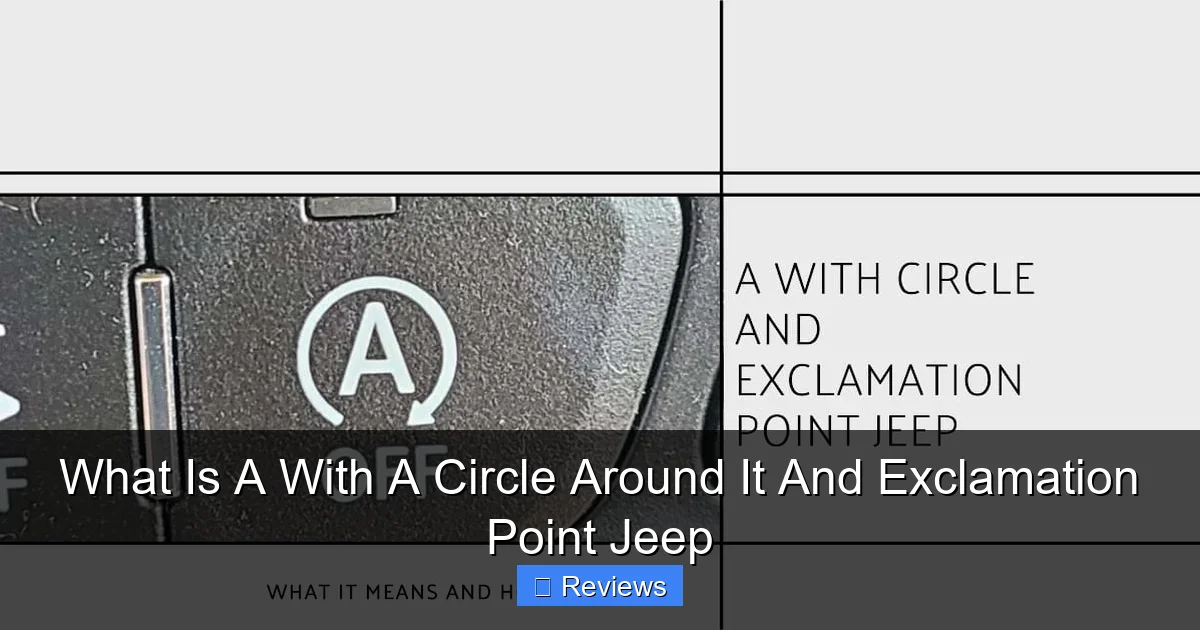
Featured image for a with a circle around it and exclamation point jeep
Image source: automadesimply.com
The “A with a circle and exclamation point” on your Jeep dashboard is a critical warning light, primarily signaling an issue with the vehicle’s Start/Stop system. While often related to the engine’s auto start/stop functionality, it can also indicate a more serious transmission or system fault, requiring immediate attention. Consult your owner’s manual or a certified technician promptly for diagnosis.
<h1>What Is A With A Circle Around It And Exclamation Point Jeep</h1>
<p>Imagine this common scenario: You’re cruising down the highway in your beloved Jeep, perhaps fresh off an exhilarating off-road adventure, or simply commuting through the urban jungle. Suddenly, a peculiar symbol illuminates on your dashboard – a distinct “A” encapsulated within a circle, accompanied by an exclamation point. For many Jeep owners, this sight can instantly trigger a mix of curiosity and concern. What does this cryptic <strong>A With A Circle Around It And Exclamation Point Jeep</strong> warning light signify? Is it a minor glitch, or a harbinger of a more serious underlying issue?</p>
<p>Dashboard warning lights are your vehicle’s primary means of communication, signaling everything from routine maintenance needs to critical system failures. While some symbols, like the low fuel indicator, are universally understood, others can be more ambiguous, leading to confusion and, sometimes, unwarranted panic. The unique description of <strong>A With A Circle Around It And Exclamation Point Jeep</strong> suggests a specific type of alert, one that demands immediate attention due to its potential implications for your vehicle’s safety and performance, especially in a rugged machine like a Jeep.</p>
<p>This comprehensive guide aims to demystify this particular Jeep dashboard symbol. We will delve into its most probable meanings, explore potential causes for its illumination, and equip you with the knowledge and practical steps necessary to respond effectively. Understanding the <strong>A With A Circle Around It And Exclamation Point Jeep</strong> light isn’t just about troubleshooting; it’s about ensuring your safety, preserving your vehicle’s longevity, and maintaining the peace of mind that comes with being a responsible Jeep owner. Let’s embark on this journey to decode one of your Jeep’s most vital messages.</p>
<h2>Decoding the Enigmatic “A With A Circle Around It And Exclamation Point” Symbol</h2>
<p>The sight of an unfamiliar warning light can be unsettling, especially when it involves such a unique description as <strong>A With A Circle Around It And Exclamation Point Jeep</strong>. While specific symbols can vary slightly across different Jeep models and years, the core message behind such a critical-looking indicator often points to a fundamental safety system. Let’s break down the most common interpretations and consider some less obvious possibilities.</p>
<h3>The Most Common Interpretation: The Brake System Warning Light</h3>
<p>When most drivers describe “a circle with an exclamation point” on their dashboard, they are almost invariably referring to the <em>Brake System Warning Light</em>. This symbol is a universal automotive standard, designed to alert the driver to issues within the vehicle’s braking system. Its appearance is a clear signal that something requires immediate attention to prevent potential safety hazards. For a <strong>Jeep</strong>, where robust braking is paramount for both on-road safety and challenging off-road conditions, this light is particularly critical.</p>
<ul>
<li><strong>Visual Representation:</strong> The standard symbol is a red circle enclosing an exclamation point (!). In some instances, it might be accompanied by the word “BRAKE” or a “P” for parking brake. The “A” in your description of <strong>A With A Circle Around It And Exclamation Point Jeep</strong> could be a specific variant, a misinterpretation, or an additional indicator related to advanced systems like an Anti-lock Braking System (ABS) or another specific alert within a sophisticated diagnostic display.</li>
<li><strong>Typical Significance:</strong> The brake system warning light commonly indicates one of three primary conditions:
<ul>
<li><em>Parking Brake Engaged:</em> This is the simplest and most frequent cause. If the parking brake (handbrake or foot pedal) is even partially engaged, the light will illuminate. Releasing it should turn the light off.</li>
<li><em>Low Brake Fluid Level:</em> The brake fluid reservoir has a sensor that detects when the fluid level drops below a safe threshold. This can happen due to normal wear of brake pads (which causes the calipers to extend further, drawing more fluid), or, more seriously, due to a leak in the brake lines, calipers, or master cylinder. Low fluid significantly compromises braking ability.</li>
<li><em>Brake System Malfunction:</em> This is the most serious interpretation. It could indicate a problem with the master cylinder, a pressure differential switch, a sensor failure, or another critical component of the hydraulic braking system. Some vehicles also use this light to signal an issue with the brake booster or the electronic brake-force distribution (EBD) system.</li>
</ul>
</li>
</ul>
<p>For a <strong>Jeep</strong> specifically, considering its robust design and expected use, any issue with the braking system needs to be addressed immediately. Whether it’s a casual drive or navigating treacherous trails, reliable brakes are non-negotiable.</p>
<h3>Exploring Rarer Interpretations or Misconceptions of the “A With A Circle Around It And Exclamation Point Jeep” Symbol</h3>
<p>While the brake system warning light is the primary candidate, the “A” in <strong>A With A Circle Around It And Exclamation Point Jeep</strong> adds a layer of specificity that warrants further consideration. It’s possible this is a less common, manufacturer-specific symbol, or perhaps a slight misinterpretation of a standard one.</p>
<ul>
<li><strong>Manufacturer-Specific Warning:</strong> While less common for fundamental safety systems, some manufacturers integrate unique symbols for specific features or advanced driver-assistance systems. An “A” could potentially stand for “Assistance,” “Alert,” or a proprietary system not universally recognized. However, for a core system like brakes, symbols are generally standardized for clarity. If this is the case, consulting your specific Jeep owner’s manual is the definitive step.</li>
<li><strong>Generalized Master Warning Light:</strong> Some modern vehicles feature a general “Master Warning Light” (often a triangle with an exclamation point, or similar) that illuminates when multiple less critical system alerts occur, or when a specific system experiences a fault that doesn’t have its own dedicated warning light. It’s plausible that the <strong>A With A Circle Around It And Exclamation Point Jeep</strong> could be a specific variant of such a master alert, which is then elaborated upon by text messages in the instrument cluster or requires deeper diagnostic scanning.</li>
<li><strong>ABS System Light Confusion:</strong> An ABS (Anti-lock Braking System) warning light typically shows the letters “ABS” within a circle or simply illuminates as “ABS.” It’s separate from the primary brake warning light. However, a significant ABS malfunction <em>could</em> trigger a general brake system warning. If the “A” is being confused with the “ABS” letters, or if the system uses an “A” to denote an “Active” or “Adaptive” braking component, this could be a related interpretation.</li>
</ul>
<p>Regardless of the exact interpretation, the presence of an exclamation point, especially within a circle, strongly suggests a condition that affects vehicle safety and demands immediate attention. It’s a call to action for every <strong>Jeep</strong> driver.</p>
<h2>Why This Light is Critical: Understanding Brake System Dynamics in a Jeep</h2>
<p>The significance of the <strong>A With A Circle Around It And Exclamation Point Jeep</strong> light cannot be overstated, primarily because it touches upon the very core of vehicle safety: the braking system. For a Jeep, known for its rugged capabilities and adventurous spirit, a compromised braking system isn’t just an inconvenience; it’s a direct threat to safety, performance, and the integrity of your vehicle, whether you’re on paved roads or tackling extreme terrain.</p>
<h3>The Intricacies of Jeep’s Braking Systems</h3>
<p>Modern Jeeps are equipped with sophisticated braking systems designed to provide optimal stopping power and control across a wide range of conditions. These systems go far beyond simple hydraulic calipers and rotors:</p>
<ul>
<li><strong>Traditional Hydraulic Brakes:</strong> At its heart, every Jeep relies on a hydraulic system where brake fluid transmits force from the pedal to the calipers, which then press brake pads against rotors (or shoes against drums) to create friction and slow the vehicle. This fundamental system must be intact and properly maintained.</li>
<li><strong>Anti-lock Braking System (ABS):</strong> Standard on all modern Jeeps, ABS prevents wheel lock-up during hard braking, allowing the driver to maintain steering control. It uses wheel speed sensors to detect when a wheel is about to lock and rapidly modulates brake pressure to that wheel. A fault in the ABS system can severely impact braking performance and control, especially on slippery surfaces.</li>
<li><strong>Electronic Stability Control (ESC) and Traction Control (TC):</strong> These systems work in conjunction with ABS, using many of the same sensors. ESC helps prevent skidding by selectively applying individual brakes and/or reducing engine power if it detects a loss of traction or control. TC prevents wheel spin during acceleration. Issues detected by the <strong>A With A Circle Around It And Exclamation Point Jeep</strong> light might indirectly point to related sensor or module failures affecting these integrated safety features.</li>
<li><strong>Brake Booster:</strong> Most Jeeps use a vacuum-assisted brake booster to amplify pedal pressure, making it easier to brake. A problem here can lead to a hard brake pedal and significantly reduced stopping power.</li<
<li><strong>Hill Descent Control and Off-Road ABS Calibration:</strong> For off-road oriented Jeeps (like the Wrangler Rubicon), specific braking enhancements like Hill Descent Control use the braking system to maintain a constant, slow speed down steep declines. Off-road ABS calibrations are also designed to perform optimally in loose terrain. A fault indicated by the <strong>A With A Circle Around It And Exclamation Point Jeep</strong> could compromise these specialized capabilities, diminishing your Jeep’s off-road prowess and safety.</li>
</ul>
<h3>Potential Dangers of Ignoring the Warning</h3>
<p>Ignoring the <strong>A With A Circle Around It And Exclamation Point Jeep</strong> light is akin to ignoring a smoke detector in your house – it’s an invitation to disaster. The consequences can range from inconvenient to catastrophic:</p>
<ul>
<li><strong>Reduced Braking Efficiency:</strong> If the light indicates low brake fluid or worn components, your Jeep will take longer to stop, increasing the risk of rear-end collisions. The brake pedal might feel “spongy” or require more force.</li>
<li><strong>Partial or Total Brake Failure:</strong> In severe cases, especially with significant fluid leaks or master cylinder failure, you could experience a complete loss of braking power, leading to uncontrollable situations and high-speed accidents.</li>
<li><strong>Loss of Control:</strong> If the issue affects ABS or ESC, your ability to steer away from obstacles during emergency braking or maintain stability on curves will be severely hampered, increasing the risk of skids or rollovers.</li>
<li><strong>Increased Wear and Tear:</strong> Driving with a malfunctioning brake system can accelerate wear on other components, leading to more expensive repairs down the line. For example, worn brake pads can damage rotors, and overheating brakes can damage seals and calipers.</li>
<li><strong>Compromised Off-Road Safety:</strong> Off-roading demands precise control and reliable braking. A faulty system, indicated by the <strong>A With A Circle Around It And Exclamation Point Jeep</strong> symbol, can turn a thrilling adventure into a dangerous predicament, especially on steep descents or uneven terrain where controlled braking is essential.</li>
</ul>
<p>Therefore, when the <strong>A With A Circle Around It And Exclamation Point Jeep</strong> light illuminates, it’s not a suggestion; it’s an imperative to investigate and resolve the issue without delay. Your safety, and the safety of your passengers and others on the road, depends on it.</p>
<h2>Common Causes Behind the Illumination of the “A With A Circle Around It And Exclamation Point”</h2>
<p>Understanding the potential reasons behind the <strong>A With A Circle Around It And Exclamation Point Jeep</strong> light is the first step towards effective troubleshooting. While the symbol itself might be generic, the underlying causes are usually specific and identifiable. Here, we delve into the most frequent culprits that trigger this critical brake system warning.</p>
<h3>Parking Brake Engagement</h3>
<p>This is, by far, the simplest and most common reason for the <strong>A With A Circle Around It And Exclamation Point Jeep</strong> light to illuminate. If your parking brake (also known as the emergency brake or handbrake) is even partially engaged, the sensor will trigger the warning light. Often, drivers forget to fully disengage it, especially if it’s a foot-pedal type or a manual lever that isn’t pushed all the way down.</p>
<ul>
<li><strong>Practical Tip:</strong> Before panicking, always check your parking brake. Fully engage and then fully disengage it. If the light disappears, you’ve found your answer! This applies universally across all <strong>Jeep</strong> models.</li>
</ul>
<h3>Low Brake Fluid Level</h3>
<p>The brake fluid reservoir has a float sensor that detects when the fluid level drops below a predetermined minimum. This is a crucial safety mechanism. If your <strong>A With A Circle Around It And Exclamation Point Jeep</strong> light comes on and the parking brake is disengaged, low brake fluid is the next most likely culprit.</p>
<ul>
<li><strong>Why Fluid Levels Drop:</strong>
<ul>
<li><em>Normal Wear:</em> As brake pads wear down, the calipers need more fluid to extend further and contact the rotors, causing a slight, gradual drop in the reservoir level.</li>
<li;><em>Leaks:</em> More seriously, there could be a leak in the brake lines, master cylinder, wheel cylinders (for drum brakes), or caliper seals. A leak can lead to a rapid and dangerous drop in fluid level.</li>
</ul>
</li>
<li><strong>Practical Tip:</strong> Locate your brake fluid reservoir (usually a plastic container under the hood, often near the firewall on the driver’s side). Check the fluid level against the “MIN” and “MAX” lines. If it’s low, you can temporarily top it up with the correct DOT-approved brake fluid (check your Jeep’s manual). <strong>However, a low fluid level is a symptom, not a fix.</strong> If you’ve topped it up, the light might go off, but you still need to find and repair the source of the fluid loss. <em>Do not ignore a persistent low fluid level.</em></li>
</ul>
<h3>Worn Brake Pads</h3>
<p>While not all <strong>Jeep</strong> models directly link worn brake pads to the main brake warning light, some advanced systems do. More commonly, severely worn pads lead to lower brake fluid levels as the calipers extend further, thereby indirectly triggering the light. Some luxury vehicles and specific performance packages in Jeeps might have electronic wear sensors on the brake pads that directly activate a warning when the pads are too thin.</p>
<ul>
<li><strong>Practical Tip:</strong> Listen for squealing or grinding noises when you brake, and note any reduced braking performance. Visually inspect your brake pads if you can safely do so (or have a professional check them). If the pads are worn thin, replacement is essential.</li>
</ul>
<h3>ABS or ESP System Malfunction</h3>
<p>Although ABS (Anti-lock Braking System) and ESP (Electronic Stability Program) usually have their own dedicated warning lights (often “ABS” and a car skidding icon, respectively), a severe fault in either of these systems can sometimes trigger the general brake system warning light, possibly the <strong>A With A Circle Around It And Exclamation Point Jeep</strong> symbol. This is especially true if the malfunction impacts the vehicle’s fundamental braking capabilities.</p>
<ul>
<li><strong>Common Issues:</strong> Faulty wheel speed sensors (which can get dirty, damaged, or disconnected during off-roading), a damaged ABS module, or wiring problems are common culprits. While your regular brakes might still work, you’ll lose the benefits of ABS and ESP, which is a significant safety concern for any <strong>Jeep</strong>, particularly when navigating challenging terrains.</li>
<li><strong>Practical Tip:</strong> If you notice your ABS or ESC lights also illuminating, or if your brakes feel unusual (e.g., pulsing even under light braking), a professional diagnostic scan is necessary to pinpoint the exact sensor or module failure.</li>
</ul>
<h3>Other Electrical or Sensor Issues</h3>
<p>Sometimes, the <strong>A With A Circle Around It And Exclamation Point Jeep</strong> light might illuminate due to an electrical gremlin rather than a direct mechanical problem with the brakes themselves. This could include:</p>
<ul>
<li><strong>Faulty Brake Pressure Switch:</strong> A sensor designed to monitor brake line pressure can malfunction, sending an incorrect signal to the ECU and triggering the light.</li>
<li><strong>Wiring Problems:</strong> Damaged, corroded, or loose wiring connecting to brake fluid level sensors, parking brake sensors, or other brake system components can cause intermittent or continuous illumination of the warning light.</li>
<li><strong>Master Cylinder Failure:</strong> Internal leaks in the master cylinder can lead to a soft brake pedal and, eventually, a drop in fluid level, triggering the light. While a mechanical failure, it often manifests initially through a sensor reading.</li>
</ul>
<p>In summary, while the <strong>A With A Circle Around It And Exclamation Point Jeep</strong> symbol is a universal call to action for brake system concerns, a systematic approach to troubleshooting, starting with the simplest checks, is the most effective way to address it.</p>
<h2>Immediate Actions and Troubleshooting Steps When the Light Appears</h2>
<p>When the <strong>A With A Circle Around It And Exclamation Point Jeep</strong> light flashes on, your immediate response can be critical. Panic is unhelpful; decisive and informed action is key. Here’s a step-by-step guide on what to do, and perhaps more importantly, what <em>not</em> to do.</p>
<h3>Safe Pullover and Initial Checks</h3>
<p>Your first priority is safety. If you are driving, especially at speed, you need to assess the situation calmly:</p>
<ul>
<li><strong>Find a Safe Location:</strong> Gradually and safely pull your <strong>Jeep</strong> over to the side of the road or into a parking lot. Avoid sudden braking, as your brake system might already be compromised. Engage your hazard lights.</li>
<li><strong>Check the Parking Brake:</strong> This is the absolute first thing to verify. Ensure the parking brake is fully disengaged. If the light immediately turns off, you’ve solved the mystery. Resume driving cautiously, but still monitor the dashboard for any recurrence.</li>
<li><strong>Visual Inspection Around Wheels:</strong> Once safely parked, step out and quickly scan around your Jeep. Look for any visible fluid leaks, especially reddish-brown or yellowish fluid near the wheels or under the engine compartment. Brake fluid leaks are a serious issue. Also, look for any obvious damage to brake lines or components.</li>
<li><strong>Check Brake Fluid Reservoir:</strong> Open the hood and locate the brake fluid reservoir. Check the fluid level. If it’s below the “MIN” line, this is a strong indicator of the problem. <em>Do not drive if the fluid is significantly low.</em> You may temporarily top it off with the correct DOT-rated fluid (refer to your Jeep’s owner manual), but understand this is a temporary measure. The underlying leak or issue still needs professional attention.</li>
<li><strong>Inspect Brake Pedal Feel:</strong> While parked, gently press the brake pedal. Does it feel normal, firm, and responsive? Or is it spongy, does it sink to the floor, or does it require excessive force to apply? Any deviation from normal indicates a serious problem.</li>
</ul>
<h3>What to Do (and Not Do) If Driving</h3>
<p>If the <strong>A With A Circle Around It And Exclamation Point Jeep</strong> light illuminates while you’re in motion, especially if accompanied by a change in brake pedal feel or unusual noises, exercise extreme caution:</p>
<ul>
<li><strong>Reduce Speed Immediately:</strong> Take your foot off the accelerator and allow the vehicle to slow down naturally. Use engine braking (downshifting) to help reduce speed without relying solely on the friction brakes.</li>
<li><strong>Avoid Sudden Stops:</strong> If you must brake, do so gently and progressively. Be prepared for reduced stopping power or uneven braking. Maintain a much larger following distance.</li>
<li><strong>Emergency Braking:</strong> In a true emergency (e.g., total brake failure), you may need to apply the parking brake gradually. <strong>Do NOT yank the parking brake lever at high speeds,</strong> as this can cause a skid. Apply it slowly to bring the vehicle to a controlled stop.</li>
<li><strong>DO NOT Continue Driving If:</strong>
<ul>
<li>The brake pedal feels unusually soft, spongy, or goes to the floor.</li>
<li>You hear grinding, screeching, or any severe metallic noises when braking.</li>
<li>There’s a significant fluid leak visible under your <strong>Jeep</strong>.</li>
<li>Braking performance is noticeably diminished.</li>
</ul>
</li>
</ul>
<h3>When Professional Help is Imperative</h3>
<p>For your <strong>Jeep</strong> and your safety, professional diagnosis and repair are often the only safe course of action:</p>
<ul>
<li><strong>Persistent Light:</strong> If the <strong>A With A Circle Around It And Exclamation Point Jeep</strong> light remains on after checking the parking brake and brake fluid (and topping it up if necessary), do not delay. This indicates a more serious underlying issue.</li>
<li><strong>Any Change in Brake Feel:</strong> Even if the light is intermittent, but your brake pedal feels different, get it checked immediately. This is a critical indicator of a failing component.</li>
<li><strong>Fluid Loss:</strong> If you had to add brake fluid, that fluid went somewhere. A mechanic needs to find and fix the leak. Driving with a leak is extremely dangerous.</li>
<li><strong>Accompanying Symptoms:</strong> If other warning lights (like ABS or ESP) are also on, or if you notice strange noises, pulling to one side when braking, or vibrating, it’s time for the shop.</li>
</ul>
<p>Contact a certified <strong>Jeep</strong> service center or a trusted independent mechanic. Describe the exact symbol, what actions you’ve taken, and any other symptoms. If driving your <strong>Jeep</strong> feels unsafe, arrange for a tow. Prioritizing safety over convenience here is non-negotiable.</p>
<h2>Preventative Maintenance and Long-Term Care for Your Jeep’s Braking System</h2>
<p>While knowing how to react to the <strong>A With A Circle Around It And Exclamation Point Jeep</strong> light is crucial, preventing its illumination in the first place is even better. Proactive maintenance is the cornerstone of a reliable and safe braking system, especially for a <strong>Jeep</strong> that often endures more demanding conditions than a typical passenger car.</p>
<h3>Regular Brake Inspections</h3>
<p>Scheduled inspections are your best defense against unexpected brake problems. Don’t wait until you hear grinding or see a warning light.</p>
<ul>
<li><strong>Frequency:</strong> Most manufacturers recommend brake inspections at least once a year or every 12,000-15,000 miles. However, if you frequently tow, drive aggressively, or engage in heavy off-roading with your <strong>Jeep</strong>, more frequent checks (e.g., every 6 months or 7,500 miles) are advisable.</li>
<li><strong>What to Check:</strong> A comprehensive inspection should include:
<ul>
<li><em>Brake Pad Thickness:</em> Ensuring pads have adequate material remaining.</li>
<li><em>Rotor Condition:</em> Checking for excessive wear, warping, or scoring.</li>
<li><em>Caliper Functionality:</em> Ensuring calipers move freely and aren’t seized.</li>
<li><em>Brake Fluid Level and Condition:</em> Checking for proper level and inspecting the fluid for contamination or excessive discoloration. Brake fluid absorbs moisture over time, which can lower its boiling point and corrode internal components.</li>
<li><em>Brake Lines and Hoses:</em> Inspecting for cracks, leaks, bulges, or corrosion.</li>
<li;><em>Wheel Bearings:</em> Loose or worn wheel bearings can affect braking performance and potentially damage other components.</li>
<li;><em>ABS/ESP Sensors:</em> Ensuring sensors are clean and properly connected, especially after off-roading where mud and debris can interfere.</li>
</ul>
</li>
<li><strong>Importance of Professional Inspections:</strong> While basic checks can be done at home, a professional mechanic has specialized tools and expertise to identify subtle issues before they become major problems. They can also flush and replace brake fluid as needed, a critical maintenance item often overlooked.</li>
</ul>
<h3>Understanding Your Jeep’s Manual</h3>
<p>Your <strong>Jeep</strong>’s owner’s manual is an invaluable resource. It contains specific information about your vehicle’s warning lights, including the exact meaning of symbols like the <strong>A With A Circle Around It And Exclamation Point Jeep</strong> (or its equivalent in your model year). It also provides recommended maintenance schedules, fluid specifications, and troubleshooting tips unique to your particular <strong>Jeep</strong> model.</p>
<ul>
<li><strong>Practical Tip:</strong> Keep your manual accessible, whether in your glove compartment or as a digital copy on your phone. Refer to it immediately if an unfamiliar light appears. Knowing your specific <strong>Jeep</strong> will help differentiate between generic advice and model-specific solutions.</li>
</ul>
<h3>Quality Parts and Fluids</h3>
<p>When performing brake service or replacing components on your <strong>Jeep</strong>, the quality of parts and fluids used makes a significant difference in performance and longevity.</p>
<ul>
<li><strong>OEM vs. Aftermarket:</strong> While quality aftermarket parts can be excellent, always ensure they meet or exceed OEM (Original Equipment Manufacturer) specifications. Cheap, substandard parts can compromise safety and lead to premature failure.</li>
<li><strong>Correct Fluid Types:</strong> Use only the brake fluid type specified in your <strong>Jeep</strong>’s manual (e.g., DOT 3, DOT 4, DOT 5.1). Mixing incompatible fluids or using the wrong type can cause serious damage to the braking system and lead to failure.</li>
</ul>
<h3>Driving Habits and Off-Road Considerations</h3>
<p>How you drive your <strong>Jeep</strong> directly impacts the lifespan of its braking system.</p>
<ul>
<li><strong>Moderate Braking:</strong> Avoid aggressive braking whenever possible. Smooth, progressive braking reduces wear on pads and rotors.</li>
<li><strong>Off-Road Demands:</strong> Off-roading places unique stresses on brakes.
<ul>
<li;><em>Mud and Water Crossings:</em> Mud, sand, and water can contaminate brake components, accelerating wear and causing corrosion. After deep water crossings, gently apply brakes a few times to dry them out.</li>
<li;><em>Steep Descents:</em> Use engine braking (low gears) to control speed on steep hills, reducing reliance on the friction brakes and preventing overheating.</li>
<li;><em>Debris:</em> Rocks, sticks, and other trail debris can damage brake lines or sensors. A post-trail inspection is a good habit.</li>
</ul>
</li>
</ul>
<p>By adhering to these preventative measures, you significantly reduce the likelihood of encountering the dreaded <strong>A With A Circle Around It And Exclamation Point Jeep</strong> light and ensure your <strong>Jeep</strong> remains a safe and capable companion for all your adventures.</p>
<h2>The Evolution of Jeep Warning Systems and Future Trends</h2>
<p>The <strong>A With A Circle Around It And Exclamation Point Jeep</strong> symbol, while critical, is a snapshot in the evolving landscape of automotive diagnostics. From simple bulbs to sophisticated digital displays, warning systems in Jeeps, like all modern vehicles, have undergone significant advancements, promising even greater precision and proactivity in the future.</p>
<h3>From Basic Warnings to Integrated Diagnostics</h3>
<p>Early vehicles featured very few warning lights, typically for oil pressure, battery charge, and maybe a basic brake light. These were simple on/off indicators, often directly wired to a sensor.</p<
<ul>
<li><strong>The Rise of the ECU and OBD-II:</strong> The introduction of Electronic Control Units (ECUs) and the mandated On-Board Diagnostics II (OBD-II) standard in the mid-1990s revolutionized warning systems. Now, multiple sensors feed data to the ECU, which can pinpoint more specific faults. When the <strong>A With A Circle Around It And Exclamation Point Jeep</strong> light illuminates today, it’s often accompanied by a Diagnostic Trouble Code (DTC) stored in the ECU, providing mechanics with valuable clues.</li>
<li><strong>CAN Bus Systems:</strong> Modern Jeeps utilize Controller Area Network (CAN bus) systems, allowing various modules (engine, transmission, ABS, body control) to communicate rapidly. This means a fault in one system can trigger warnings in others, creating a more comprehensive diagnostic picture. For example, a wheel speed sensor issue (part of ABS) might trigger both the ABS light and the main brake warning, such as the <strong>A With A Circle Around It And Exclamation Point Jeep</strong> symbol.</li>
<li><strong>Digital Instrument Clusters:</strong> Many newer Jeeps feature digital or reconfigurable instrument clusters. This allows for more detailed text messages alongside symbolic warnings, often providing more context to symbols like the <strong>A With A Circle Around It And Exclamation Point Jeep</strong> by indicating “Check Brake System” or “Low Brake Fluid.”</li>
</ul>
<h3>Predictive Maintenance and Telematics</h3>
<p>The future of vehicle diagnostics, including for your <strong>Jeep</strong>, is moving towards even greater intelligence and connectivity.</p>
<ul>
<li><strong>Proactive Alerts:</strong> Instead of waiting for a critical failure like the <strong>A With A Circle Around It And Exclamation Point Jeep</strong> symbol to illuminate, future systems will likely predict potential issues before they become urgent. For instance, sensors might detect subtle changes in brake pad thickness or fluid degradation and alert the driver to schedule maintenance <em>before</em> a warning light appears.</li>
<li><strong>Telematics and Connected Services:</strong> Many new Jeeps already offer connected services (e.g., Uconnect). These systems can transmit diagnostic data directly to the dealership or a personal device. If a serious warning like the <strong>A With A Circle Around It And Exclamation Point Jeep</strong> appears, the system could automatically alert roadside assistance, schedule a service appointment, and even pre-order necessary parts, all without driver intervention.</li>
<li><strong>Over-the-Air Updates:</strong> Software updates delivered wirelessly could fix glitches in diagnostic systems or enhance their accuracy, improving the reliability of warning lights and reducing false positives.</li>
<li><strong>AI and Machine Learning:</strong> Artificial intelligence could analyze driving patterns and sensor data to provide personalized maintenance recommendations, ensuring your <strong>Jeep</strong> is always in optimal condition for its specific use case, whether it’s daily commuting or extreme off-roading.</li>
</ul>
<p>While these future trends promise to make vehicles even smarter and safer, the fundamental principle remains: understanding and responding to your <strong>Jeep</strong>’s current warning lights, like the critical <strong>A With A Circle Around It And Exclamation Point Jeep</strong>, is an essential part of responsible vehicle ownership today.</p>
<h2>Understanding Common Brake-Related Warning Lights in Jeeps</h2<
<p>To further clarify the meaning of <strong>A With A Circle Around It And Exclamation Point Jeep</strong>, it’s helpful to see it in the context of other common brake-related warning lights that might appear on your Jeep’s dashboard. While visual symbols can have slight variations, their core meanings are generally standardized to ensure driver safety.</p>
<table>
<thead>
<tr>
<th>Symbol Description</th>
<th>Common Interpretation</th>
<th>What It Means</th>
<th>Immediate Action</th>
</tr>
</thead>
<tbody>
<tr>
<td>Circle with Exclamation Point (!) / “A” with Circle and Exclamation Point</td>
<td>Brake System Warning / Master Brake Warning for Jeep</td>
<td>Parking brake engaged, low brake fluid, brake system malfunction (e.g., pressure sensor), or a general system alert that includes the brake system. The “A” in <strong>A With A Circle Around It And Exclamation Point Jeep</strong> could be a specific manufacturer variant or part of a general alert unique to your <strong>Jeep</strong> model.</td>
<td>Safely pull over. Check parking brake. Check brake fluid level. If fluid is low or brake pedal feels off, do not drive. Call for professional inspection.</td>
</tr>
<tr>
<td>”ABS” light</td>
<td>Anti-lock Braking System Malfunction in Jeep</td>
<td>The ABS system is not functioning correctly. Regular brakes will still work, but ABS will not prevent wheel lock-up during hard braking. This could be due to a faulty sensor or module within your <strong>Jeep</strong>’s system.</td>
<td>Continue driving carefully, but get the system checked by a mechanic soon. Avoid hard braking. Your <strong>Jeep</strong>’s regular brakes are still operational.</td>
</tr>
<tr>
<td>”P” with Circle and Exclamation Point</td>
<td>Parking Brake Engaged in Jeep</td>
<td>The parking brake is currently applied. In some <strong>Jeep</strong> models, this might be integrated into the main brake warning light.</td>
<td>Release the parking brake fully. If the light remains on, there may be a sensor issue or a more serious brake system problem that needs attention from a <strong>Jeep</strong> specialist.</td>
</tr>
<tr>
<td>”BRAKE” text light</td>
<td>General Brake System Warning in Jeep</td>
<td>Similar to the exclamation point light, indicating a fault within the braking system or parking brake engaged. This is a clear indicator that your <strong>Jeep</strong>’s braking integrity is at risk.</td>
<td>Same as the exclamation point light: safely pull over, check fluid, seek professional help if sustained. <strong>Do not drive your Jeep</strong> if braking feels compromised.</td>
</tr>
<tr>
<td>Car skidding icon (often with “OFF” or “ESP” text)</td>
<td>Electronic Stability Control (ESC) / Traction Control (TC) Warning in Jeep</td>
<td>The ESC or TC system is either active (blinking) or has a malfunction (solid). A malfunction means your <strong>Jeep</strong> will not have the same level of electronic assistance for stability and traction control.</td>
<td>If blinking, it’s working; if solid, get it checked, especially if accompanied by the <strong>A With A Circle Around It And Exclamation Point Jeep</strong> light, as systems are often interconnected.</td>
</tr>
</tbody>
</table>
<h2>Conclusion</h2>
<p>The illumination of the <strong>A With A Circle Around It And Exclamation Point Jeep</strong> symbol on your dashboard is not merely a suggestion; it’s a critical safety alert that demands your immediate and informed attention. While often a simple reminder that the parking brake is engaged, this enigmatic light can also be a harbinger of more serious issues, such as dangerously low brake fluid or a malfunction within your <strong>Jeep</strong>’s intricate braking, ABS, or stability control systems.</p>
<p>As a <strong>Jeep</strong> owner, understanding the potential implications of this warning light is paramount. Your <strong>Jeep</strong> is engineered for robust performance and adventure, but its capabilities are only as reliable as its most critical safety systems. Ignoring a brake warning can lead to reduced stopping power, loss of vehicle control, or even complete brake failure, posing significant risks to yourself, your passengers, and others on the road, especially when tackling challenging off-road terrain.</p>
<p>By following the practical advice outlined in this guide – from conducting immediate, safe pullovers and checks to prioritizing professional diagnosis and adhering to a rigorous preventative maintenance schedule – you can effectively address the <strong>A With A Circle Around It And Exclamation Point Jeep</strong> light and prevent potential hazards. Always refer to your specific <strong>Jeep</strong> owner’s manual for model-specific information and do not hesitate to consult a certified mechanic when in doubt.</p>
<p>Ultimately, responsible ownership means being attuned to your <strong>Jeep</strong>’s messages. Heeding the call of the <strong>A With A Circle Around It And Exclamation Point Jeep</strong> light ensures that your vehicle remains safe, reliable, and ready for whatever adventure lies ahead, allowing you to drive with confidence and peace of mind.</p>
In This Article
- 1 Key Takeaways
- 2 Frequently Asked Questions
- 2.1 What is “A With A Circle Around It And Exclamation Point Jeep”?
- 2.2 What does the “A with a circle around it and exclamation point” symbol mean?
- 2.3 Which Jeep models are eligible for the “A with a circle around it and exclamation point” program?
- 2.4 What benefits are included with the “A with a circle around it and exclamation point” Jeep Wave program?
- 2.5 How long do the benefits last for an “A with a circle around it and exclamation point” Jeep?
- 2.6 Is the “A with a circle around it and exclamation point” symbol related to the Jeep Wave hand gesture?
Key Takeaways
- Understand the Symbol: The “A” with circle and exclamation is your Jeep’s Start/Stop indicator.
- Green Means Ready: A green “A” symbol means your Start/Stop system is active and ready.
- Amber Signals Fault: An amber “A” with an exclamation indicates a Start/Stop system fault or disablement.
- Consult Your Manual: Always refer to your Jeep owner’s manual for precise warning light meanings.
- Try Disabling System: You can often temporarily disable the Start/Stop system with a button.
- Battery Health Matters: Start/Stop system issues frequently relate to your vehicle’s battery condition.
- Seek Professional Help: Persistent amber lights warrant professional diagnosis at a certified Jeep service center.
Frequently Asked Questions
What is “A With A Circle Around It And Exclamation Point Jeep”?
This phrase refers to the distinctive logo for the Jeep Wave program, which typically features an “A” (representing Advantage or Access) enclosed in a circle with an exclamation point. When you see “A With A Circle Around It And Exclamation Point Jeep,” it signifies that the vehicle is part of Jeep’s premium customer loyalty and benefits program.
What does the “A with a circle around it and exclamation point” symbol mean?
The “A with a circle around it and exclamation point” symbol indicates that a Jeep is enrolled in the exclusive Jeep Wave program. This means the vehicle owner is entitled to a range of premium benefits and dedicated support directly from Jeep.
Which Jeep models are eligible for the “A with a circle around it and exclamation point” program?
Most new Jeep vehicles purchased or leased from October 1, 2021, are automatically enrolled in the Jeep Wave program, featuring the “A with a circle around it and exclamation point” distinction. Eligibility can vary by model year and trim level, so it’s always best to verify with your dealer or the official Jeep website.
What benefits are included with the “A with a circle around it and exclamation point” Jeep Wave program?
Owners of an “A with a circle around it and exclamation point” Jeep receive a comprehensive package of benefits. These typically include worry-free maintenance, trip interruption coverage, first-day rental, and 24/7 roadside assistance, along with access to a dedicated owner support line.
How long do the benefits last for an “A with a circle around it and exclamation point” Jeep?
For most new Jeep vehicles, the Jeep Wave membership, symbolized by the “A with a circle around it and exclamation point,” generally lasts for 36 months from the date of purchase or lease. It’s recommended to check your specific program details and terms on the official Jeep Wave portal for exact duration and renewal options.
While both use the term “Jeep Wave,” the “A with a circle around it and exclamation point” symbol specifically represents the official customer loyalty and benefits program. The Jeep Wave hand gesture is a separate, long-standing tradition among Jeep owners to acknowledge each other on the road, symbolizing community and camaraderie.

At CarLegit, we believe information should be clear, factual, and genuinely helpful. That’s why every guide, review, and update on our website is created with care, research, and a strong focus on user experience.