
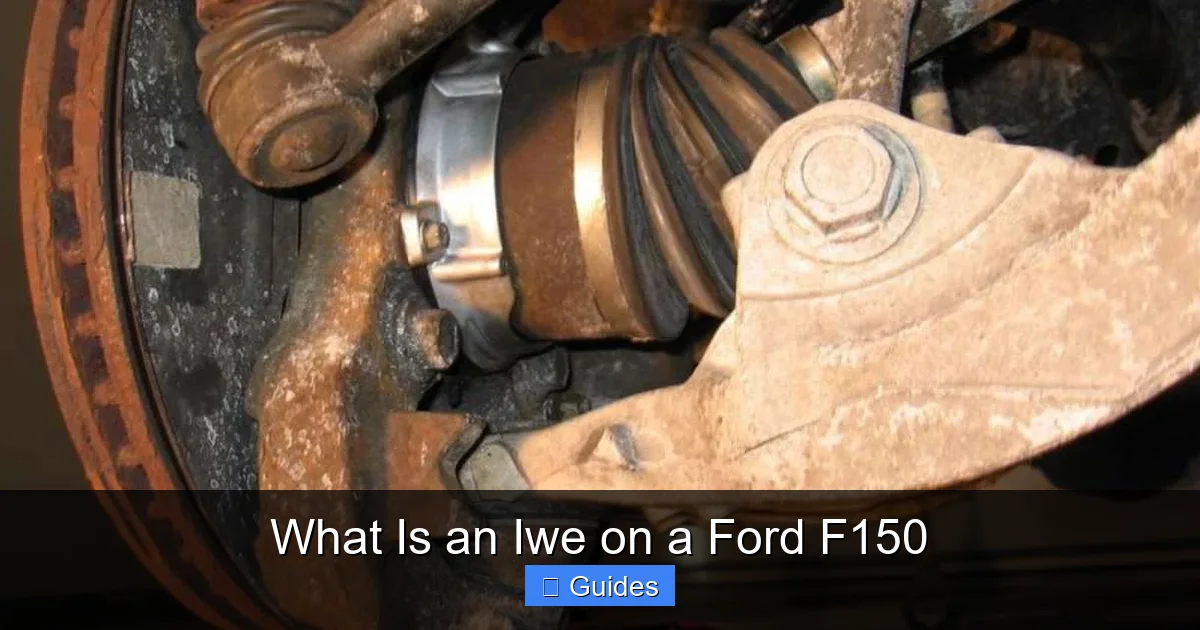
An IWE on a Ford F150—short for Integrated Wheel End—is a key part of the truck’s four-wheel-drive system. It helps engage and disengage the front wheels automatically when you switch between 2WD and 4WD, improving fuel efficiency and reducing wear. Understanding how it works can save you from costly repairs and keep your F150 performing at its best.
If you own a Ford F150—especially one made between 1997 and 2018—you’ve probably heard the term “IWE” thrown around in forums, repair shops, or even by fellow truck enthusiasts. But what exactly is an IWE, and why does it matter to your daily driving experience? Whether you’re hauling gear up a mountain trail, cruising down the highway, or just trying to figure out why your truck is making a weird noise when you shift into 4WD, understanding the Integrated Wheel End system is essential.
The IWE, or Integrated Wheel End, is one of those clever engineering solutions that Ford introduced to make the F150 more efficient without sacrificing capability. Unlike older trucks that required manual locking hubs—where you had to get out and twist each front hub by hand—the IWE system automates the process. It seamlessly switches your front wheels between being driven (in 4WD) and free-spinning (in 2WD), all without you lifting a finger. This not only makes driving more convenient but also helps improve gas mileage and reduces wear on your drivetrain when you’re not using four-wheel drive.
But like any mechanical system, the IWE isn’t perfect. Over time, it can develop issues that affect performance, cause strange noises, or even prevent you from engaging 4WD when you need it most—like during a snowstorm or off-road adventure. That’s why knowing how it works, what to look for, and how to maintain it can save you time, money, and frustration down the road.
In This Article
Key Takeaways
- What Is an IWE? The Integrated Wheel End (IWE) is a vacuum-operated hub system that disconnects the front axle from the wheels in 2WD mode, reducing drag and improving fuel economy.
- How It Works: When you shift into 4WD, vacuum pressure is released, allowing the IWE to lock and transfer power to the front wheels. In 2WD, vacuum keeps it disengaged.
- Common Problems: Vacuum leaks, cracked diaphragms, or faulty solenoids can cause grinding noises, 4WD failure, or difficulty shifting modes.
- Maintenance Tips: Regularly inspect vacuum lines, check for leaks, and test the 4WD system seasonally to catch issues early.
- DIY vs. Professional Help: Simple checks like listening for hissing sounds can be done at home, but complex repairs may require a mechanic with diagnostic tools.
- Replacement Cost: Expect to pay $150–$300 per side for parts, plus labor if done professionally. Aftermarket options may be cheaper but vary in quality.
- Why It Matters: A well-maintained IWE improves fuel efficiency, extends drivetrain life, and ensures reliable off-road or winter performance.
📑 Table of Contents
What Is an IWE on a Ford F150?
Let’s start with the basics: what exactly is an IWE? The acronym stands for Integrated Wheel End, and it’s a component found on many Ford F150 models equipped with part-time four-wheel drive (4WD). Specifically, it’s part of the front axle assembly and sits between the wheel hub and the axle shaft. Think of it as a smart clutch that decides whether power from the engine should reach your front wheels or not.
In simpler terms, the IWE is what allows your F150 to run in two-wheel drive (2WD) mode most of the time—saving fuel and reducing mechanical drag—while still giving you the option to instantly switch to 4WD when conditions demand it. Without the IWE, your front wheels would always be connected to the drivetrain, even when you’re driving on dry pavement. That would waste fuel, increase tire wear, and put unnecessary stress on components like the transfer case and differential.
The IWE system was first introduced in the late 1990s and became standard on most F150s through the 2010s. It’s especially common on trucks with electronic shift-on-the-fly 4WD systems, where you can switch between 2H (2WD high), 4H (4WD high), and 4L (4WD low) using a dial or button inside the cab. The IWE works hand-in-hand with this system to make those transitions smooth and automatic.
How the IWE System Works
So how does this little device actually do its job? The magic lies in vacuum pressure. The IWE uses a vacuum-operated diaphragm—a flexible membrane inside a sealed chamber—to control whether the front axle is engaged or disengaged.
When your truck is in 2WD mode, the engine creates vacuum through the intake manifold. This vacuum is routed via hoses to the IWE solenoids (usually located near the firewall), which then send it to the IWE units on each front wheel. The vacuum pulls the diaphragm inward, which disengages a set of splines or gears inside the IWE. This disconnects the axle shaft from the wheel hub, allowing the front wheels to spin freely without being driven by the engine.
Now, when you shift into 4WD—say, by turning the dial to 4H—the vacuum is cut off. A spring inside the IWE pushes the diaphragm back out, re-engaging the splines and locking the axle shaft to the wheel hub. Power now flows from the transfer case through the front differential, down the axle shafts, and into the front wheels. Voilà—you’re in four-wheel drive.
This entire process happens in seconds and is completely automatic. You don’t need to stop the truck or get out to lock hubs. It’s one of the reasons modern F150s are so user-friendly, especially for drivers who occasionally need extra traction but don’t want the hassle of manual systems.
Why Ford Uses the IWE System
Ford didn’t add the IWE just for fun—it solved several real-world problems. First and foremost, it improves fuel economy. When the front wheels aren’t being driven, there’s less rotational resistance in the drivetrain. That means the engine doesn’t have to work as hard, especially at highway speeds. For a full-size pickup like the F150, which already guzzles more gas than a sedan, every bit of efficiency counts.
Second, it reduces wear and tear. Constantly driving the front wheels—even when not needed—can cause premature wear on tires, axles, and differential components. By disconnecting the front axle in 2WD, the IWE helps extend the life of these parts.
Third, it enhances drivability. Manual locking hubs require the driver to stop, exit the vehicle, and physically twist each hub—a tedious process, especially in bad weather or on uneven terrain. The IWE eliminates that step, making 4WD engagement as easy as turning a knob.
Finally, it supports Ford’s marketing of the F150 as a versatile, everyday truck that can handle both city commutes and weekend adventures. The IWE system is a key part of that “have-your-cake-and-eat-it-too” appeal.
Common IWE Problems and Symptoms

Visual guide about What Is an Iwe on a Ford F150
Image source: blueovaltrucks.com
While the IWE system is clever, it’s not immune to failure. Over time, several issues can arise—many of which are related to the vacuum system that controls it. Recognizing the symptoms early can prevent bigger problems down the line.
One of the most common signs of an IWE problem is a grinding or whining noise coming from the front wheels, especially when accelerating or decelerating. This often happens when the IWE is partially engaged—meaning it’s not fully locked or fully unlocked. The splines inside are rubbing against each other, creating metal-on-metal contact. If left unchecked, this can damage the IWE, axle shaft, or even the differential.
Another red flag is difficulty shifting into or out of 4WD. You might turn the dial to 4H, but the truck doesn’t respond—or it engages with a loud clunk. Sometimes, the 4WD light on the dashboard flashes or stays off, indicating a fault in the system.
You might also notice a loss of fuel efficiency. If the IWE isn’t disengaging properly in 2WD, your front wheels are still being driven, increasing drag and reducing miles per gallon.
In cold weather, IWE issues can become more pronounced. Moisture inside the vacuum lines can freeze, blocking airflow and preventing proper engagement or disengagement. That’s why many F150 owners report 4WD problems during winter months.
Vacuum Leaks: The #1 Culprit
The vast majority of IWE failures stem from vacuum leaks. The system relies on airtight hoses and seals to maintain pressure. Over time, these components can crack, dry out, or become disconnected—especially in older trucks or those driven in harsh conditions.
Common leak points include:
– The vacuum hoses running from the engine to the solenoids
– The solenoids themselves (which can fail internally)
– The IWE diaphragms (which can tear or lose elasticity)
– The check valve that prevents vacuum from escaping
A simple way to check for leaks is to listen for a hissing sound near the front wheels or under the hood when the engine is running. You can also use a vacuum gauge or smoke machine (if you have access to one) to pinpoint the source.
Other Potential Issues
Beyond vacuum problems, other components can fail:
– **Faulty solenoids**: These control the flow of vacuum to the IWEs. If they stick open or closed, the system won’t work correctly.
– **Worn IWE units**: The internal splines or diaphragm can wear out, especially if the truck has high mileage or has been used heavily off-road.
– **Electrical issues**: While the IWE itself is mechanical, the system relies on sensors and wiring to communicate with the truck’s computer. A bad connection or blown fuse can disrupt the signal.
It’s also worth noting that some aftermarket modifications—like lift kits or oversized tires—can put extra strain on the IWE system, increasing the likelihood of failure.
How to Diagnose IWE Problems
Visual guide about What Is an Iwe on a Ford F150
Image source: trucksauthority.com
If you suspect your IWE is acting up, don’t panic. Many of the diagnostic steps can be done at home with basic tools and a little patience.
Start by checking the 4WD system. With the engine off, try shifting between 2H, 4H, and 4L. Listen for smooth transitions and watch the dashboard lights. If the system hesitates, makes noise, or doesn’t engage, there’s likely an issue.
Next, inspect the vacuum lines. Look for cracks, kinks, or loose connections, especially near the firewall and front wheels. You can gently squeeze the hoses—if they feel brittle or crumble, they need replacing.
You can also perform a simple vacuum test. With the engine running, disconnect the vacuum line at the IWE solenoid and see if you feel suction. If there’s no vacuum, the problem could be upstream—like a clogged line or faulty check valve.
For a more advanced test, some owners use a handheld vacuum pump to apply pressure directly to the IWE and see if it holds. If it leaks, the diaphragm may be damaged.
If you’re not comfortable doing these checks yourself, a trusted mechanic can run a full diagnostic using a scan tool. Modern F150s store trouble codes related to the 4WD system, which can help pinpoint the exact cause.
When to Seek Professional Help
While many IWE issues can be diagnosed at home, some repairs are best left to professionals. If you’re dealing with internal IWE damage, solenoid replacement, or complex electrical faults, it’s wise to consult a Ford specialist or certified technician. They have the tools and expertise to disassemble the axle, inspect components, and ensure everything is reassembled correctly.
Attempting a DIY repair without proper knowledge can lead to further damage—or even safety risks if the 4WD system fails while driving.
Maintaining Your IWE System

Visual guide about What Is an Iwe on a Ford F150
Image source: blueovaltrucks.com
The good news? A little maintenance can go a long way in preventing IWE problems.
Start by inspecting the vacuum lines annually—especially if you live in a cold or humid climate. Replace any that look cracked or worn. Use high-quality rubber or silicone hoses rated for automotive use.
Test your 4WD system regularly, even if you don’t use it often. Shift into 4H and 4L for a few minutes every few months to keep the components moving and prevent seals from drying out.
If you drive in snow or mud, consider installing a vacuum line heater or insulation to prevent freezing. Some owners also add inline check valves for extra protection.
Finally, avoid aggressive off-roading unless your truck is specifically built for it. Excessive strain can accelerate wear on the IWE and other drivetrain parts.
Replacing an IWE: What to Expect
If your IWE is beyond repair, replacement is usually straightforward—but labor-intensive. The process involves removing the wheel, brake caliper, hub assembly, and axle shaft to access the IWE unit.
Parts cost varies: OEM (original equipment manufacturer) IWEs from Ford typically run $250–$300 per side, while aftermarket options can be as low as $150. However, cheaper parts may not last as long or perform as well.
Labor costs depend on your location and shop rates, but expect to pay $200–$400 per side if done professionally. Some mechanics offer package deals for both sides.
If you’re handy with tools, you can save money by doing it yourself—but be prepared to spend several hours and have the right equipment (like a hub puller and torque wrench).
Conclusion
The Integrated Wheel End (IWE) on a Ford F150 is a smart, efficient system that makes four-wheel drive more convenient and fuel-efficient. While it’s not without its flaws, understanding how it works—and how to maintain it—can help you avoid common pitfalls and keep your truck running smoothly for years to come.
Whether you’re a weekend warrior, a daily commuter, or somewhere in between, taking care of your IWE ensures that your F150 is ready for whatever the road—or trail—throws at it.
Frequently Asked Questions
What does IWE stand for on a Ford F150?
IWE stands for Integrated Wheel End. It’s a vacuum-operated system that automatically engages and disengages the front wheels when switching between 2WD and 4WD modes.
Can I drive my F150 with a bad IWE?
You can drive in 2WD, but avoid using 4WD until it’s fixed. A faulty IWE can cause grinding noises, poor fuel economy, or damage to other drivetrain components.
How often should I test my 4WD system?
Test your 4WD system at least twice a year—once in fall and once in spring—to ensure the IWE and related components are working properly.
Are IWE problems covered under warranty?
It depends on your truck’s age and mileage. Most IWE issues fall outside standard powertrain warranties, but check your specific coverage or extended warranty terms.
Can I replace just one IWE, or do I need to do both?
You can replace just one side, but it’s often recommended to do both at the same time to ensure balanced performance and avoid future repairs.
Do newer Ford F150s still use the IWE system?
Starting around 2019, Ford began phasing out the vacuum-operated IWE in favor of electronically controlled systems. Newer models may use different hub designs, so check your owner’s manual.

At CarLegit, we believe information should be clear, factual, and genuinely helpful. That’s why every guide, review, and update on our website is created with care, research, and a strong focus on user experience.