
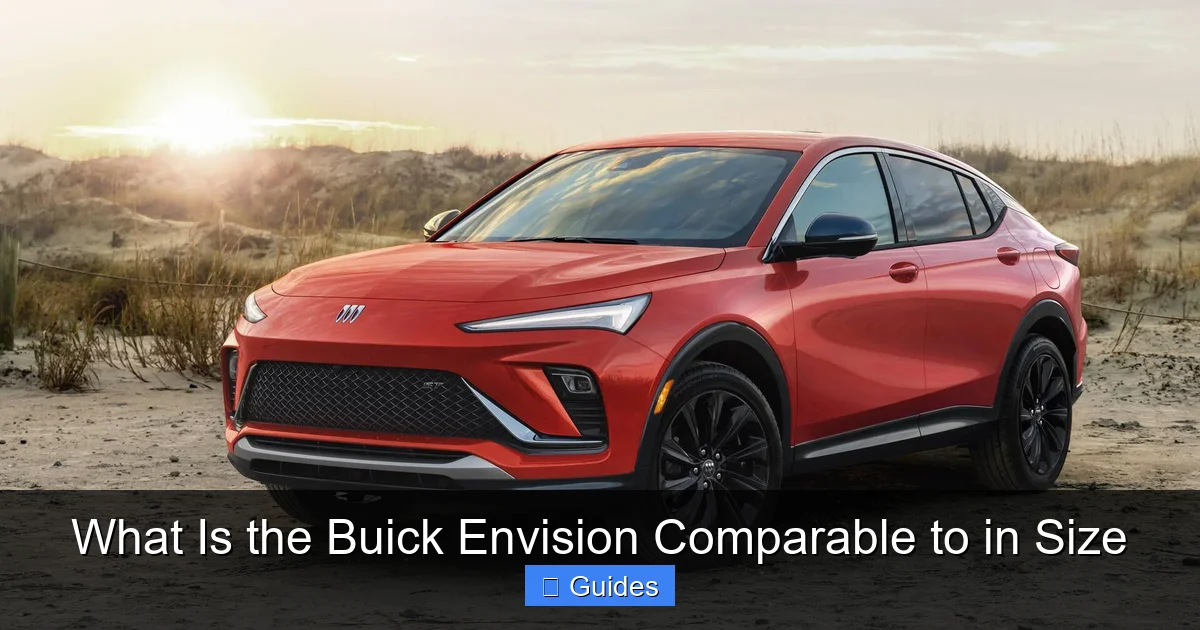
The Buick Envision is a midsize SUV that sits comfortably between compact and full-size models, offering a balanced blend of interior space, cargo capacity, and ride comfort. It’s most comparable in size to vehicles like the Honda Passport, Toyota Highlander, and Ford Edge, making it ideal for families and daily commuters alike.
When you’re shopping for a new SUV, size matters—but not in the way you might think. It’s not just about how big a vehicle looks on the lot. It’s about how that size translates into real-world usability: passenger comfort, cargo room, ease of parking, and overall driving feel. If you’re considering the Buick Envision, you’re likely wondering, “What is the Buick Envision comparable to in size?” You’re not alone. This is one of the most common questions buyers ask when comparing midsize SUVs.
The Buick Envision occupies a sweet spot in the SUV market. It’s not as small as a compact crossover like the Honda CR-V or Toyota RAV4, nor is it as large and bulky as a full-size SUV such as the Chevrolet Tahoe or Ford Expedition. Instead, it fits neatly into the midsize segment—specifically, the two-row midsize SUV category. This means it offers more interior space than smaller crossovers while remaining more agile and fuel-efficient than three-row giants. Think of it as the Goldilocks of SUVs: not too big, not too small, but just right for many drivers.
In this guide, we’ll break down exactly what the Buick Envision is comparable to in size, comparing it to key competitors in dimensions, passenger room, cargo capacity, and overall usability. Whether you’re a family of four, a weekend adventurer, or a professional who values comfort and style, understanding where the Envision stands in the size spectrum will help you make a smarter buying decision.
In This Article
- 1 Key Takeaways
- 2 📑 Table of Contents
- 3 Understanding the Buick Envision’s Size Category
- 4 Exterior Dimensions: How the Envision Stacks Up
- 5 Interior Space and Passenger Comfort
- 6 Comparing the Envision to Key Competitors
- 7 Practical Considerations: Who Is the Envision Right For?
- 8 Conclusion: The Envision’s Size Sweet Spot
- 9 Frequently Asked Questions
Key Takeaways
- Mid-tier SUV size: The Buick Envision falls into the midsize SUV category, offering more space than compact crossovers but less than full-size three-row SUVs.
- Two-row seating for five: With seating for up to five passengers, it’s ideal for small families or those who prefer a more intimate cabin without sacrificing legroom.
- Cargo space rivals competitors: Offering 26.9 cubic feet behind the rear seats and up to 57.7 cubic feet with seats folded, it matches or exceeds many rivals.
- Comparable to Honda Passport and Toyota Highlander: In overall dimensions and interior volume, the Envision is closely aligned with these popular midsize SUVs.
- Better maneuverability than larger SUVs: Its slightly shorter wheelbase and overall length make it easier to park and navigate city streets than bulkier three-row models.
- Premium feel in a practical package: Combines upscale materials and quiet cabin with everyday usability, setting it apart from more utilitarian competitors.
- Great for road trips and daily drives: Balanced size makes it versatile for both long-distance comfort and urban commuting.
📑 Table of Contents
Understanding the Buick Envision’s Size Category
Before diving into comparisons, it’s important to understand where the Buick Envision fits in the SUV hierarchy. SUVs are generally categorized by size: subcompact, compact, midsize, and full-size. The Envision falls squarely into the midsize category, but with a twist—it’s a two-row midsize SUV, unlike some of its three-row competitors.
Most midsize SUVs are designed to seat seven or eight passengers, offering a third row for extra capacity. Examples include the Toyota Highlander, Honda Pilot, and Ford Explorer. The Buick Envision, however, skips the third row and focuses on maximizing comfort and space for five passengers. This design choice gives it a unique position in the market: it’s larger than compact SUVs but more manageable than three-row models.
The Envision’s exterior dimensions reflect this balance. It measures approximately 187.5 inches in length, 74.1 inches in width, and 66.0 inches in height. Its wheelbase—the distance between the front and rear wheels—is 109.4 inches. These numbers place it right in the middle of the midsize pack. For context, the Honda CR-V (a compact SUV) is about 180 inches long, while the Chevrolet Traverse (a full-size three-row SUV) stretches over 200 inches.
This mid-tier size gives the Envision several advantages. It’s spacious enough to comfortably seat five adults, with ample legroom and headroom in both rows. Yet it’s still compact enough to maneuver through tight city streets and fit into standard parking spaces without hassle. It’s also lighter than larger SUVs, which can improve fuel efficiency and handling.
Why Size Matters in SUV Selection
Choosing the right SUV size isn’t just about how many people you need to carry. It affects everything from your daily driving experience to long-term ownership costs. A vehicle that’s too small may leave you cramped on road trips, while one that’s too large can be a pain to park, expensive to fuel, and overkill for everyday use.
The Buick Envision’s size makes it ideal for a wide range of drivers. Families with two or three kids will appreciate the extra legroom and cargo space compared to compact SUVs. Couples or empty nesters who occasionally host guests will find it more than adequate. And urban drivers will enjoy the ease of parking and navigating traffic that comes with a slightly smaller footprint.
Moreover, the Envision’s size contributes to its refined ride quality. Buick has tuned the suspension to absorb road imperfections, and the quieter cabin—thanks in part to active noise cancellation—makes long drives more pleasant. This focus on comfort is a hallmark of the brand, and the Envision’s dimensions play a key role in delivering that experience.
Exterior Dimensions: How the Envision Stacks Up
Visual guide about What Is the Buick Envision Comparable to in Size
Image source: whatissuv.com
When comparing SUVs, exterior dimensions are a good starting point. They give you a sense of how a vehicle will look and feel on the road, how it will handle in tight spaces, and how it compares to others in its class.
Let’s look at the Buick Envision’s key exterior measurements:
– **Length:** 187.5 inches
– **Width:** 74.1 inches (81.5 inches with mirrors)
– **Height:** 66.0 inches
– **Wheelbase:** 109.4 inches
– **Ground clearance:** 7.5 inches
Now, let’s compare these to some of its closest competitors.
The **Honda Passport**, a two-row midsize SUV, measures 190.5 inches in length, 76.2 inches in width, and 69.6 inches in height, with a 110.9-inch wheelbase. That makes the Passport slightly longer, wider, and taller than the Envision, but the differences are minor—just a few inches here and there.
The **Toyota Highlander**, a three-row midsize SUV, is significantly larger at 194.9 inches long, 76.0 inches wide, and 68.1 inches tall, with a 112.2-inch wheelbase. While the Highlander offers that third row, it comes at the cost of added bulk and reduced maneuverability.
The **Ford Edge**, another two-row midsize SUV, is very close in size to the Envision. It measures 190.7 inches long, 75.9 inches wide, and 68.2 inches tall, with a 112.2-inch wheelbase. Again, the Envision is a bit more compact, especially in length and wheelbase.
What does this mean in practical terms? The Envision is one of the more compact options in the midsize SUV segment. This gives it an edge in urban environments where parking space is limited and tight turns are common. It’s also easier to handle on winding roads, thanks to its shorter wheelbase and balanced weight distribution.
Real-World Implications of Exterior Size
So, how does the Envision’s size affect everyday use? Let’s say you’re pulling into a crowded grocery store parking lot. The Envision’s shorter length means you’re less likely to bump into adjacent cars or struggle to fit into tight spots. Its narrower width (without mirrors) also helps when navigating narrow driveways or alleyways.
On the highway, the Envision feels stable but not unwieldy. It doesn’t have the floaty sensation that some larger SUVs exhibit, thanks to its moderate wheelbase and well-tuned suspension. And while it doesn’t have the nimble feel of a compact SUV, it’s far more responsive than a full-size model.
For families, the size also means easier access to the rear seats. With only two rows, there’s no need to fold or remove a third-row seat to load gear or help kids into their car seats. The rear doors open wide, and the step-in height is reasonable for both children and older adults.
Interior Space and Passenger Comfort

Visual guide about What Is the Buick Envision Comparable to in Size
Image source: dealerinspire-image-library-prod.s3.us-east-1.amazonaws.com
While exterior dimensions are important, what really matters to most buyers is interior space—how much room there is for people and their stuff. The Buick Envision shines in this area, offering a well-designed cabin that maximizes comfort without sacrificing style.
Let’s break down the interior dimensions:
– **Front headroom:** 40.0 inches
– **Front legroom:** 40.4 inches
– **Rear headroom:** 39.0 inches
– **Rear legroom:** 39.0 inches
– **Shoulder room (front/rear):** 57.3 / 55.8 inches
– **Hip room (front/rear):** 55.1 / 53.4 inches
These numbers place the Envision among the most spacious two-row midsize SUVs. For comparison, the Honda Passport offers 40.1 inches of front headroom and 39.1 inches of rear legroom—very similar to the Envision. The Ford Edge provides 40.2 inches of front headroom and 38.3 inches of rear legroom, slightly less in the back.
The Toyota Highlander, despite its larger exterior, offers 40.1 inches of front headroom and 38.4 inches of rear legroom—again, comparable but not superior. This shows that the Envision holds its own in passenger comfort, even against bigger rivals.
Seating and Comfort Features
The Envision’s five-passenger seating is designed for comfort. The front seats are supportive and available with heating, ventilation, and massage functions in higher trims. The rear seats recline and offer ample legroom, making long trips more bearable for passengers.
One standout feature is the quiet cabin. Buick has gone to great lengths to reduce road and wind noise, using acoustic glass, sound-dampening materials, and active noise cancellation. This makes the Envision feel more like a luxury sedan than a rugged SUV—perfect for commuters and road trippers alike.
The dashboard layout is intuitive, with a user-friendly infotainment system and physical controls for key functions. Higher trims add premium materials like leather upholstery, wood trim, and ambient lighting, elevating the overall feel.
Cargo Capacity: More Than You Might Expect
Cargo space is another critical factor when evaluating SUV size. The Buick Envision offers 26.9 cubic feet of cargo volume behind the rear seats. Fold the 60/40-split rear seats flat, and that expands to 57.7 cubic feet.
How does that compare? The Honda Passport offers 26.9 cubic feet behind the rear seats and 57.5 cubic feet with seats folded—virtually identical. The Ford Edge provides 30.3 cubic feet behind the rear seats and 68.4 cubic feet with seats down, giving it a slight edge in maximum capacity.
The Toyota Highlander, with its third row folded, offers 16.0 cubic feet behind the third row, 48.4 cubic feet behind the second row, and 84.3 cubic feet with both rows down. While the Highlander wins in total volume, it requires folding more seats to access that space.
For most buyers, the Envision’s cargo numbers are more than sufficient. It can easily handle a week’s worth of groceries, a stroller, luggage for a family vacation, or even a few large boxes from the store. The low load floor and wide opening make loading and unloading a breeze.
Comparing the Envision to Key Competitors

Visual guide about What Is the Buick Envision Comparable to in Size
Image source: carsized.com
To truly understand what the Buick Envision is comparable to in size, let’s take a closer look at how it stacks up against three of its closest rivals: the Honda Passport, Toyota Highlander, and Ford Edge.
Buick Envision vs. Honda Passport
The Honda Passport is one of the Envision’s most direct competitors. Both are two-row midsize SUVs with similar exterior dimensions and interior space. The Passport is slightly longer and taller, but the differences are minimal.
In terms of cargo, both offer nearly identical volume: 26.9 cubic feet behind the rear seats and around 57.5 cubic feet with seats folded. Passenger room is also comparable, with the Passport having a slight edge in rear legroom (39.1 vs. 39.0 inches).
Where the Envision stands out is in refinement. The Buick offers a quieter cabin, more premium materials, and a smoother ride. The Passport, while reliable and practical, leans more toward rugged utility.
Buick Envision vs. Toyota Highlander
The Toyota Highlander is a three-row SUV, so it’s naturally larger. It offers more total cargo space and the ability to seat up to eight passengers. However, that comes with trade-offs: reduced fuel efficiency, a bulkier feel, and less agility.
For families who truly need a third row, the Highlander is a better choice. But for those who only occasionally need extra seating, the Envision’s two-row design offers more comfort and easier access. The Envision also has a more upscale interior and better noise insulation.
Buick Envision vs. Ford Edge
The Ford Edge is another two-row midsize SUV that’s very close in size to the Envision. It’s slightly longer and offers more cargo space (30.3 cubic feet behind the rear seats), but the Envision counters with a more refined ride and quieter cabin.
The Edge has a sportier tuning, which some drivers may prefer, but it can feel firmer on rough roads. The Envision prioritizes comfort, making it a better choice for long drives or daily commutes.
Practical Considerations: Who Is the Envision Right For?
Now that we’ve covered the numbers, let’s talk about real-world use. Who should consider the Buick Envision based on its size?
**Families with 2–3 kids:** The Envision offers plenty of space for car seats, strollers, and backpacks. The rear seats are easy to access, and the cargo area is large enough for weekend trips.
**Empty nesters or couples:** If you don’t need a third row but want more space than a compact SUV, the Envision is ideal. It’s comfortable for long drives and has enough room for guests or pets.
**Urban drivers:** The Envision’s compact footprint makes it easy to park and maneuver in cities. It’s not as nimble as a crossover, but it’s far more manageable than a full-size SUV.
**Luxury seekers:** With its quiet cabin, premium materials, and smooth ride, the Envision delivers a near-luxury experience at a more accessible price point.
Conclusion: The Envision’s Size Sweet Spot
So, what is the Buick Envision comparable to in size? In short, it’s most similar to other two-row midsize SUVs like the Honda Passport and Ford Edge, while offering a more refined experience than many competitors. It’s larger than compact crossovers but more agile than three-row models, striking a perfect balance for a wide range of drivers.
Its exterior dimensions make it easy to handle in daily driving, while its interior space ensures comfort for passengers and ample room for cargo. Whether you’re commuting to work, taking a road trip, or running errands around town, the Envision’s size makes it a versatile and practical choice.
If you’re shopping for an SUV that offers space without excess, the Buick Envision deserves a close look. It may not be the biggest or the smallest in its class, but it’s one of the most well-rounded—proving that sometimes, the best size is the one that fits just right.
Frequently Asked Questions
Is the Buick Envision a midsize SUV?
Yes, the Buick Envision is classified as a midsize SUV. It offers more interior space than compact crossovers but is smaller and more maneuverable than full-size three-row SUVs.
How many people can the Buick Envision seat?
The Buick Envision seats up to five passengers with two rows of seating. It does not have a third row, unlike some other midsize SUVs.
How much cargo space does the Buick Envision have?
The Envision offers 26.9 cubic feet of cargo space behind the rear seats and up to 57.7 cubic feet with the rear seats folded down.
Is the Buick Envision bigger than a Honda CR-V?
Yes, the Buick Envision is larger than the Honda CR-V. The Envision offers more passenger and cargo space, making it a better choice for those who need extra room.
Can the Buick Envision fit in a standard garage?
Yes, the Envision’s length of 187.5 inches allows it to fit comfortably in most standard garages, which are typically 20 feet long.
Is the Buick Envision easy to park?
Yes, thanks to its moderate size and available parking assist features, the Envision is relatively easy to park, even in tight urban spaces.

At CarLegit, we believe information should be clear, factual, and genuinely helpful. That’s why every guide, review, and update on our website is created with care, research, and a strong focus on user experience.