
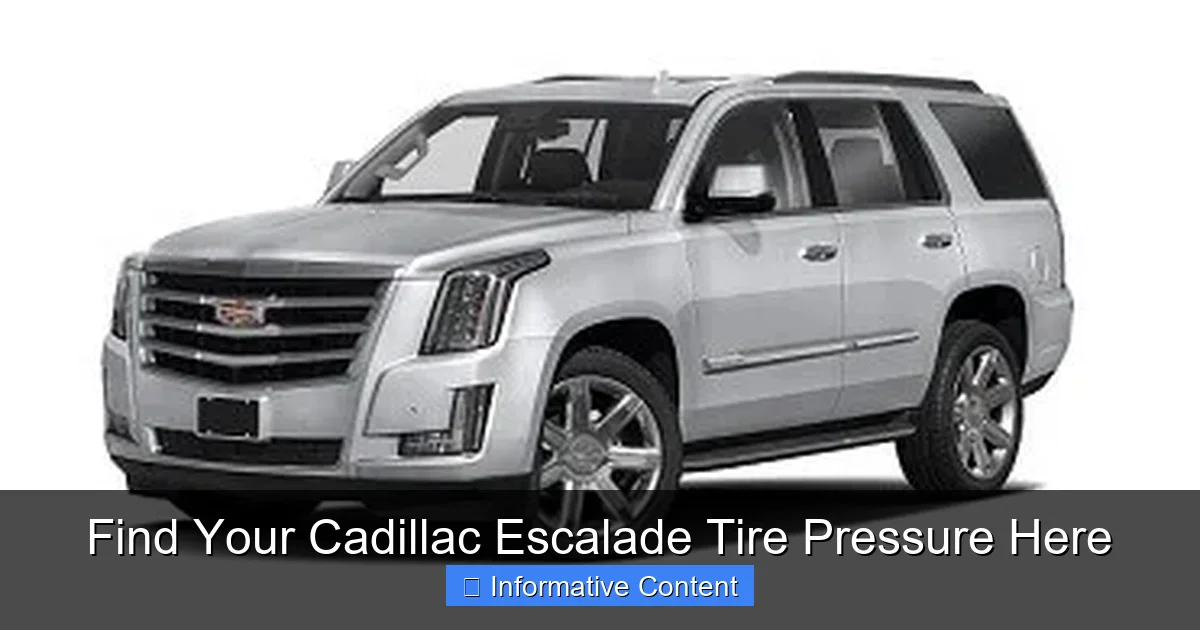
The recommended tire pressure for a Cadillac Escalade is typically 35 PSI for all four tires. This crucial specification is found on the driver’s side door jamb sticker, not the tire sidewall. Maintaining this pressure ensures optimal safety, handling, and fuel efficiency for your full-size luxury SUV.
Picture this. You’re about to head out on a long-awaited family road trip in your Cadillac Escalade. The cooler is packed, the playlist is ready, and everyone is buzzing with excitement. You slide into the driver’s seat, that familiar feeling of comfort and capability surrounding you. But before you hit the highway, there’s one silent, often-overlooked companion that needs a quick check-in: your tires.
More specifically, the air inside them. Getting your Cadillac Escalade tire pressure right isn’t just a line item in the owner’s manual; it’s the foundation of everything you love about driving this vehicle. It affects how smoothly it glides over the road, how securely it handles a sudden curve, how quietly the cabin remains, and even how often you have to stop for fuel. I learned this the hard way after a season of unexplained dips in my gas mileage and a ride that felt just a tad less “magic carpet” than usual. The culprit? Underinflated tires by just a few PSI.
So, let’s demystify this together. Finding and maintaining the correct tire pressure for your Cadillac Escalade is simpler than you think, and the benefits are massive. This guide will walk you through exactly where to look, what the numbers mean, and how to make tire pressure checks a painless part of your routine. Consider this your one-stop shop for keeping your Escalade rolling in peak form.
In This Article
- 1 Key Takeaways
- 2 📑 Table of Contents
- 3 Why Your Escalade’s Tire Pressure is a Big Deal
- 4 Finding Your Exact Cadillac Escalade Tire Pressure
- 5 Understanding “Cold” Tire Pressure and When to Check
- 6 A Practical Guide to Checking and Adjusting Pressure
- 7 Special Considerations: Load, Towing, and the Spare
- 8 Data Table: Cadillac Escalade Tire Pressure Reference (Common Model Years)
- 9 Making Tire Pressure Care a Simple Habit
- 10 Frequently Asked Questions
- 10.1 What is the recommended tire pressure for a Cadillac Escalade?
- 10.2 Where can I find the correct tire pressure for my Escalade?
- 10.3 Does Cadillac Escalade tire pressure change for towing?
- 10.4 Why is maintaining proper tire pressure important?
- 10.5 How often should I check my Escalade’s tire pressure?
- 10.6 What happens if my tire pressure warning light comes on?
Key Takeaways
- Check the placard: Find the official PSI on your driver’s side door jamb.
- Use recommended pressure: Typically 35 PSI for most Escalade models and years.
- Measure when cold: Check tires before driving or after three hours of rest.
- Maintain pressure monthly: Regular checks improve safety, tire life, and fuel economy.
- Adjust for heavy loads: Consult your manual for increased pressure when towing or hauling.
- Don’t use the sidewall: The max pressure listed there is not the recommended operating pressure.
📑 Table of Contents
- Why Your Escalade’s Tire Pressure is a Big Deal
- Finding Your Exact Cadillac Escalade Tire Pressure
- Understanding “Cold” Tire Pressure and When to Check
- A Practical Guide to Checking and Adjusting Pressure
- Special Considerations: Load, Towing, and the Spare
- Data Table: Cadillac Escalade Tire Pressure Reference (Common Model Years)
- Making Tire Pressure Care a Simple Habit
Why Your Escalade’s Tire Pressure is a Big Deal
You might think of tire pressure as a minor detail. I used to. But for a vehicle as substantial and sophisticated as the Escalade, it’s a critical setting. Think of your tires as the only point of contact between your 5,000+ pound SUV and the road. The air pressure inside is what allows them to perform that job correctly.
When pressure is perfect, the tire’s tread sits flat on the pavement. This gives you optimal grip for braking, cornering, and accelerating. When pressure is off, the tire’s shape distorts, and everything changes.
The Real Cost of Getting It Wrong
Driving on incorrect tire pressure isn’t just a theoretical problem. It has immediate, tangible effects on your safety, wallet, and comfort.
- Safety First: Underinflated tires are the enemy of control. They have excessive sidewall flex, which can lead to overheating and even a blowout at high speeds—a terrifying thought in a large SUV. They also increase stopping distance. Overinflated tires, on the other hand, are too rigid. They reduce the tire’s contact patch, leading to less traction, especially in wet conditions, and a harsher, more unpredictable ride.
- Your Wallet Will Feel It: The U.S. Department of Energy states that for every 1 PSI drop in pressure across all four tires, you can lose about 0.2% in fuel economy. On a large vehicle like the Escalade, that adds up fast. Underinflation also causes uneven tread wear, meaning you’ll be buying expensive new tires much sooner than you should.
- Comfort Compromised: Cadillac engineers tune the Escalade’s Magnetic Ride Control and suspension for a specific tire profile. The wrong pressure throws this tuning off. Underinflation can make the ride feel mushy and unresponsive, while overinflation transmits every tiny road imperfection right into the cabin, ruining that signature Cadillac serenity.
Finding Your Exact Cadillac Escalade Tire Pressure
This is the most important step: finding the right number for your specific vehicle. Never use the generic number molded on the tire’s sidewall! That’s the tire’s maximum pressure, not the recommended operating pressure for your SUV.
Visual guide about Cadillac Escalade tire pressure
Image source: i.ytimg.com
Cadillac determines the ideal pressure based on your Escalade’s exact model, year, trim level, and even optional equipment. Here’s where to look.
The Tire and Loading Information Label (Your Best Friend)
Open the driver’s side door and look at the door jamb—the area where the door latches. You’ll find a yellow and white sticker called the Tire and Loading Information label. This is your gospel. It lists the recommended tire pressure for the front and rear tires of your specific Escalade, measured in PSI (pounds per square inch). This is the “cold” pressure, which we’ll explain in a moment.
Other Places to Check
If the door jamb sticker is faded or missing, don’t worry. You have backup options:
- Your Owner’s Manual: The manual will have a section dedicated to tires and loading that states the recommended PSI.
- The Glove Box: Sometimes a quick-reference guide or a duplicate sticker is placed inside the glove compartment.
- The Fuel Filler Door: On some model years, you might even find the information on the inside of the fuel door.
Understanding “Cold” Tire Pressure and When to Check
You’ll see the term “cold tire pressure” everywhere. This is crucial. A “cold” tire means it hasn’t been driven on for at least three hours or has been driven for less than one mile at moderate speed.
Visual guide about Cadillac Escalade tire pressure
Image source: images.simplepart.com
Why does this matter? As you drive, friction heats up the tires and the air inside them. Hot air expands, increasing the pressure. If you check your tires after an hour on the highway, the reading will be artificially high—often 4-5 PSI higher than the cold specification. Adding air based on a “hot” reading will result in severe overinflation once the tires cool down.
The Best Time to Check
Make it a habit to check your Cadillac Escalade tire pressure first thing in the morning, before the sun has warmed the tires and before you’ve driven anywhere. This gives you a true “cold” reading. I keep a digital gauge in my door pocket and do a quick check once a month and always before any long trip. It takes two minutes and gives me immense peace of mind.
A Practical Guide to Checking and Adjusting Pressure
Don’t worry, you don’t need to be a mechanic. With a few simple tools, you can handle this like a pro.
Visual guide about Cadillac Escalade tire pressure
Image source: seventrumpet.com
Tools You’ll Need
- A Quality Tire Pressure Gauge: I highly recommend spending $15-$30 on a good digital gauge. They are far more accurate and easier to read than the old pencil-style gauges. The one at the gas station air pump is often beaten up and unreliable.
- An Air Source: Your home compressor, a portable air compressor that plugs into your 12V outlet (a fantastic investment), or the air pump at a gas station.
Step-by-Step Process
- Find Your “Cold” PSI: Refer to your door jamb sticker. Note the front and rear values; they can sometimes differ.
- Unscrew the Valve Cap: Remove the little black or metal cap on the tire’s valve stem. Keep it in a safe place like your pocket.
- Take a Reading: Press your gauge firmly onto the valve stem. You’ll hear a brief hiss. The gauge will display the current pressure.
- Add or Release Air: If the reading is low, use your air source to add air in short bursts, checking the pressure frequently with your gauge. If it’s too high, gently press the center pin in the valve stem with your gauge or a small tool to release air, checking often.
- Recheck and Recap: Once you’ve hit the target PSI, do a final check. Screw the valve cap back on tightly to keep dirt and moisture out. Repeat for all four tires—and don’t forget the spare!
Special Considerations: Load, Towing, and the Spare
The standard door jamb pressure is for normal driving conditions. But your Escalade is built for more, and so are its tires.
Carrying Heavy Loads or Towing
When you’re loading up the cargo area to the brim or hitching up a heavy trailer, you’re asking more from your tires. In these cases, Cadillac often recommends increasing the tire pressure. This information is also in your owner’s manual. It might say something like, “For sustained high-speed driving or when towing a trailer, increase pressure to XX PSI.” Always consult the manual before a big haul. Increasing pressure helps the tire better support the extra weight and reduces heat buildup.
Don’t Forget the Fifth Tire
That full-size spare tire tucked under the back of your Escalade is useless if it’s flat. Its recommended pressure is usually much higher than the four main tires—often 60 PSI or more. Check the sidewall of the spare itself or your owner’s manual for the correct inflation pressure. Check it during your seasonal tire checks so it’s ready in an emergency.
Data Table: Cadillac Escalade Tire Pressure Reference (Common Model Years)
While you should always confirm with your own door jamb sticker, this table provides a general reference for typical pressures across recent Escalade generations. This illustrates how specifications can vary.
Note: These are common COLD tire pressures in PSI. Trim levels (Sport, Platinum, etc.) and optional wheel sizes can affect this.
| Model Year Range | Example Trim / Wheel | Front Tire PSI | Rear Tire PSI | Spare Tire PSI |
|---|---|---|---|---|
| 2021 – Present (Full-Size SUV) | Premium Luxury, 22″ wheels | 35 | 35 | 60 |
| 2015 – 2020 | Standard 4WD, 20″ wheels | 35 | 35 | 60 |
| 2015 – 2020 | When Towing Max Load | 41 | 41 | 60 |
| 2007 – 2014 | Base Model | 30 | 35 | 60 |
Making Tire Pressure Care a Simple Habit
Let’s be honest, if it’s not easy, we won’t do it. Here’s how to integrate tire pressure maintenance into your life without it feeling like a chore.
Leverage Your Tire Pressure Monitoring System (TPMS)
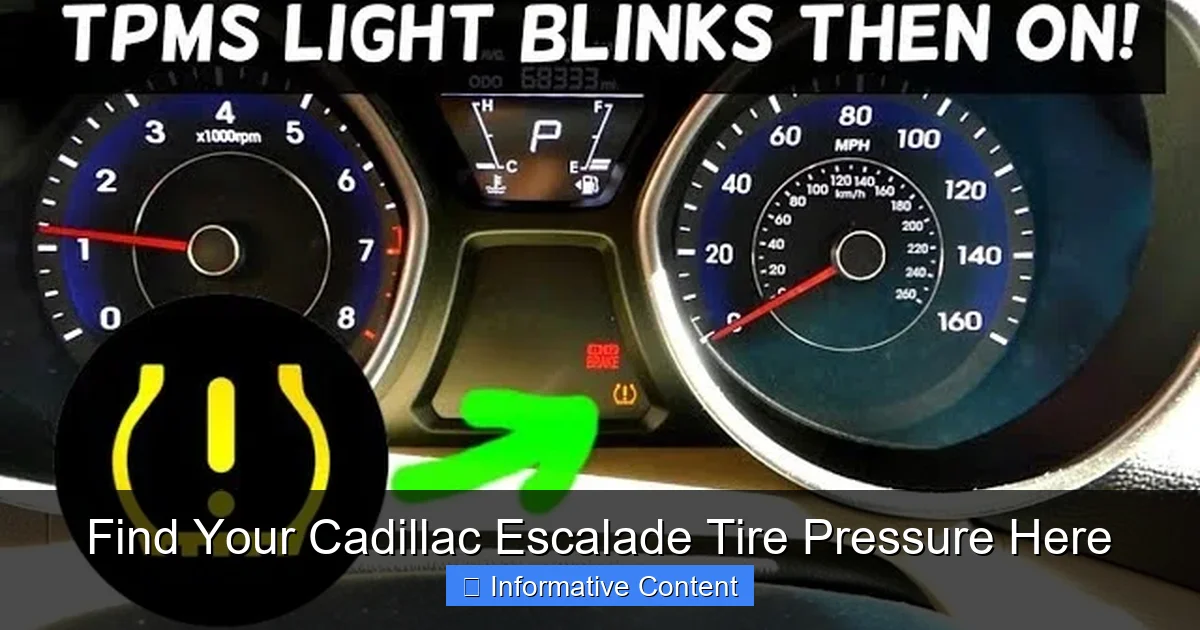
Every modern Escalade has a TPMS. It’s that little warning light on your dashboard that looks like a cross-section of a tire with an exclamation point. It’s a fantastic helper, but not a replacement for manual checks. The TPMS light typically only illuminates when pressure is 25% or more below the recommended level—that’s already too low for optimal performance and safety. Use it as a warning bell, but don’t wait for it to come on. Check proactively.
Set a Reminder
Tie your monthly tire check to another routine. For me, it’s the first Saturday of the month when I also run the car through the wash. You could do it when you pay your mortgage or on the first day of a new season. A small sticky note on the dashboard or a calendar reminder works wonders.
Investing in a portable 12V air compressor has been a game-changer for me. It lives in the rear cargo compartment. No more hunting for change or a working gas station air pump. If a tire looks low, I can top it off right in my driveway in seconds.
Taking care of your Cadillac Escalade tire pressure is one of the simplest, most impactful forms of preventative maintenance you can perform. It requires minimal time, a simple tool, and a bit of knowledge—which you now have. By keeping those four (plus one) contact patches perfectly inflated, you’re actively protecting your safety, enhancing the sublime driving experience you paid for, and saving money on fuel and premature tire wear. It’s the ultimate win-win. So, the next time you walk up to your Escalade, give those tires a quick glance. A few minutes of attention ensures it’s ready to deliver every bit of luxury, capability, and confidence you expect, mile after mile.
Frequently Asked Questions
What is the recommended tire pressure for a Cadillac Escalade?
The recommended tire pressure for a Cadillac Escalade is typically between 35 and 45 PSI (pounds per square inch). You should always check your specific vehicle’s placard, located on the driver’s side door jamb, for the exact figure, as it can vary by model year and trim. Using the correct pressure ensures optimal handling, fuel economy, and tire wear.
Where can I find the correct tire pressure for my Escalade?
The most accurate source for your Cadillac Escalade’s tire pressure is the tire information placard on the driver’s side door jamb or in your owner’s manual. This placard lists the manufacturer’s recommended cold tire pressure for both front and rear tires, which is essential for maintaining vehicle safety and performance.
Does Cadillac Escalade tire pressure change for towing?
Yes, tire pressure often needs to be increased when towing heavy loads with your Cadillac Escalade. Consult your owner’s manual for specific recommendations, but it’s common to add an additional 3-5 PSI to the rear tires to support the extra weight. Always re-adjust the pressure back to the standard recommendation after you finish towing.
Why is maintaining proper tire pressure important?
Maintaining the proper Cadillac Escalade tire pressure is crucial for safety, tire longevity, and fuel efficiency. Under-inflated tires can overheat and lead to blowouts, while over-inflation causes uneven wear and a harsh ride. Correct pressure ensures the best contact with the road for braking and handling.
How often should I check my Escalade’s tire pressure?
You should check your Cadillac Escalade’s tire pressure at least once a month and before any long trip. Always check when the tires are “cold,” meaning the vehicle has been parked for at least three hours, as driving heats the tires and gives an inaccurate reading. Regular checks help you catch slow leaks early.
What happens if my tire pressure warning light comes on?
If your Cadillac Escalade’s Tire Pressure Monitoring System (TPMS) light illuminates, it indicates one or more tires are significantly under-inflated. You should safely pull over and check the pressure as soon as possible, inflating all tires to the recommended cold pressure listed on your door jamb placard. If the light remains on, there may be a leak or a system fault requiring service.

At CarLegit, we believe information should be clear, factual, and genuinely helpful. That’s why every guide, review, and update on our website is created with care, research, and a strong focus on user experience.