
Choosing the correct battery for your 2015 Hyundai Sonata ensures reliable starts, optimal performance, and long-term savings. This guide covers the exact battery size, compatible types, installation tips, and maintenance advice to keep your Sonata powered up year-round.
If you own a 2015 Hyundai Sonata, you know it’s a reliable, comfortable, and fuel-efficient sedan that’s built to last. But like any vehicle, it depends heavily on one small but mighty component: the battery. Whether you’re dealing with a slow crank on a cold morning or preparing for seasonal changes, knowing what size battery your Sonata needs is essential. Getting the right battery isn’t just about fitting it under the hood—it’s about ensuring your car starts every time, powers all its electronics smoothly, and avoids costly repairs down the road.
The 2015 Hyundai Sonata comes in several trims—including SE, Sport, Limited, and Eco—and each may have slightly different electrical demands. That’s why simply guessing or picking the cheapest option at the auto parts store can lead to frustration. A mismatched battery might physically fit, but it could lack the necessary cranking power, drain too quickly, or even damage your car’s onboard computer systems. In this guide, we’ll walk you through everything you need to know about selecting, installing, and maintaining the perfect battery for your 2015 Sonata—so you can drive with confidence, no matter the weather or mileage.
In This Article
- 1 Key Takeaways
- 2 📑 Table of Contents
- 3 Understanding Your 2015 Hyundai Sonata’s Battery Needs
- 4 OEM vs. Aftermarket Batteries: Which Is Right for You?
- 5 How to Safely Replace Your 2015 Sonata’s Battery
- 6 Signs It’s Time to Replace Your Battery
- 7 Top Battery Recommendations for the 2015 Hyundai Sonata
- 8 Battery Maintenance Tips to Extend Lifespan
- 9 Conclusion
- 10 Frequently Asked Questions
- 10.1 What battery group size does a 2015 Hyundai Sonata use?
- 10.2 Can I use a different battery size if Group 35 is unavailable?
- 10.3 How often should I replace my Sonata’s battery?
- 10.4 Do I need to reprogram my car after replacing the battery?
- 10.5 Is it safe to replace the battery myself?
- 10.6 What’s the difference between AGM and flooded batteries?
Key Takeaways
- Correct Battery Size: The 2015 Hyundai Sonata typically uses a Group 35 battery with 600+ cold cranking amps (CCA) and 60+ amp-hour (Ah) capacity.
- Check Your Trim Level: Base models may use a smaller battery, while higher trims like Limited or Sport require higher-output batteries.
- Top Brands to Consider: Opt for trusted names like Optima, DieHard, Interstate, or Hyundai OEM for durability and warranty support.
- Professional Installation Recommended: Modern Sonatas have sensitive electronics; improper handling can trigger warning lights or damage the ECU.
- Regular Maintenance Matters: Clean terminals, check voltage monthly, and test the battery annually after three years of use.
- Avoid Cheap Knockoffs: Low-quality batteries may fit physically but fail prematurely and void electrical system warranties.
- Recycle Responsibly: Always return your old battery to a certified recycler—most auto shops offer free recycling with purchase.
📑 Table of Contents
- Understanding Your 2015 Hyundai Sonata’s Battery Needs
- OEM vs. Aftermarket Batteries: Which Is Right for You?
- How to Safely Replace Your 2015 Sonata’s Battery
- Signs It’s Time to Replace Your Battery
- Top Battery Recommendations for the 2015 Hyundai Sonata
- Battery Maintenance Tips to Extend Lifespan
- Conclusion
Understanding Your 2015 Hyundai Sonata’s Battery Needs
When it comes to car batteries, one size definitely does not fit all. The 2015 Hyundai Sonata, while sharing many components across trims, has specific electrical requirements that dictate the ideal battery size and type. At the core of this decision is the battery group size—a standardized classification system used by manufacturers to ensure compatibility. For most 2015 Sonata models, the recommended battery group is **Group 35**.
But what does “Group 35” actually mean? It refers to the physical dimensions, terminal placement, and hold-down configuration of the battery. A Group 35 battery is approximately 9 inches long, 6.8 inches wide, and 8.9 inches tall, with the positive terminal on the right side (when facing the battery). This size fits snugly in the Sonata’s battery tray and connects properly to the vehicle’s cables without modification.
Beyond physical fit, you also need to consider electrical specifications. The 2015 Sonata typically requires a battery with at least **600 cold cranking amps (CCA)**. CCA measures how well a battery can start your engine in cold temperatures—specifically, how many amps it can deliver at 0°F for 30 seconds while maintaining voltage above 7.2V. Since many Sonata owners live in regions with harsh winters, a battery with 600+ CCA ensures reliable cold-weather starts.
Additionally, the battery should have a **reserve capacity (RC)** of at least 90 minutes and an **amp-hour (Ah)** rating of 60 or higher. Reserve capacity tells you how long the battery can power essential systems if the alternator fails, while amp-hour indicates overall energy storage. These specs are especially important if you frequently use accessories like heated seats, infotainment systems, or rear defrosters without the engine running.
It’s also worth noting that higher-trim Sonatas—like the Limited or Sport models—often come with more electronics, such as premium audio systems, navigation, and advanced driver aids. These features draw more power, so they benefit from a higher-capacity battery. Even if your base model Sonata runs fine with a standard Group 35, upgrading to a premium battery can extend lifespan and improve performance.
OEM vs. Aftermarket Batteries: Which Is Right for You?
Visual guide about What Size Battery for a 2015 Hyundai Sonata
Image source: s1.cdn.autoevolution.com
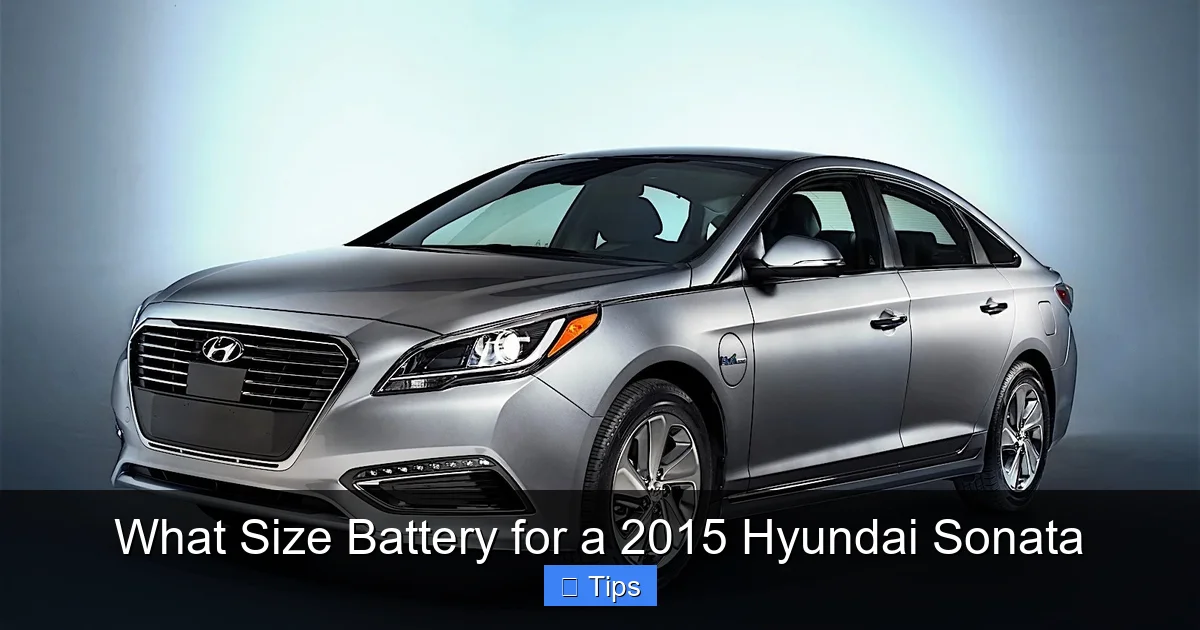
When replacing your 2015 Sonata’s battery, you’ll face a key decision: stick with Hyundai’s original equipment manufacturer (OEM) battery or go with an aftermarket option. Both have pros and cons, and the best choice depends on your budget, driving habits, and long-term plans for the vehicle.
Hyundai OEM batteries are designed specifically for your Sonata and often come with a warranty that matches the vehicle’s original coverage. They’re built to exact specifications and integrate seamlessly with the car’s electrical system. If you’re someone who values peace of mind and plans to keep your Sonata for many more years, an OEM battery is a solid investment. You can usually purchase one directly from a Hyundai dealership, though they tend to be more expensive than aftermarket alternatives.
On the other hand, aftermarket batteries offer greater variety, competitive pricing, and often superior performance. Brands like **Optima**, **DieHard**, **Interstate**, **ACDelco**, and **Duralast** produce high-quality batteries that meet or exceed OEM specs. For example, an Optima RedTop Group 35 battery delivers 760 CCA and features spiral-cell technology for longer life and better vibration resistance—ideal if you drive on rough roads or in extreme climates.
One major advantage of aftermarket batteries is their extended warranties. Many come with 3- to 5-year free replacement guarantees, whereas OEM batteries often have shorter coverage. Additionally, some aftermarket options are designed for enhanced performance, such as dual-purpose (starting and deep-cycle) batteries or those with built-in charge indicators.
That said, not all aftermarket batteries are created equal. Avoid ultra-cheap brands sold at discount retailers—they may use inferior materials, have inconsistent quality control, and fail prematurely. Always check customer reviews, warranty terms, and whether the battery is certified by organizations like the Battery Council International (BCI).
A practical tip: If you’re unsure which route to take, consult your owner’s manual or visit a trusted mechanic. Many Hyundai service centers can recommend compatible aftermarket batteries that won’t void your warranty. And remember—whether OEM or aftermarket, always ensure the replacement battery matches the Group 35 size and meets the 600+ CCA requirement.
How to Safely Replace Your 2015 Sonata’s Battery
Visual guide about What Size Battery for a 2015 Hyundai Sonata
Image source: d3nevzfk7ii3be.cloudfront.net
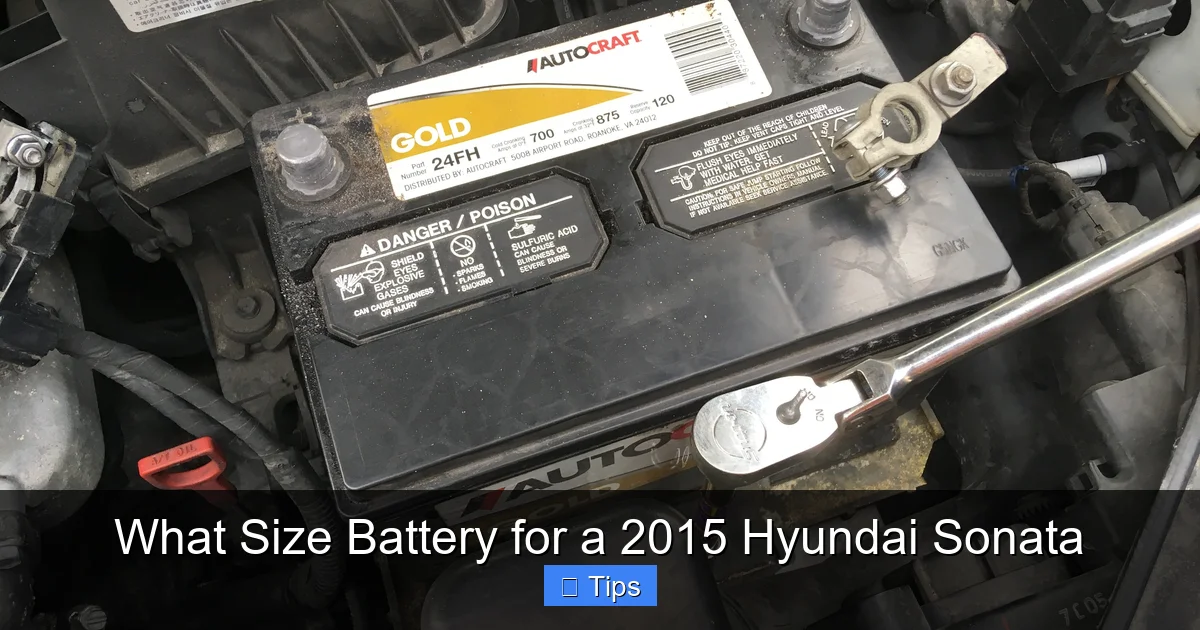
Replacing a car battery might seem straightforward, but the 2015 Hyundai Sonata has advanced electronics that require careful handling. A mistake during installation can trigger warning lights, reset infotainment settings, or even damage the engine control unit (ECU). Follow these steps to do it safely and correctly.
First, **prepare your workspace**. Park your Sonata on a level surface, turn off the engine, and engage the parking brake. Open the hood and locate the battery—it’s on the driver’s side, near the front of the engine bay. Before touching anything, put on safety glasses and gloves. Batteries contain sulfuric acid and can produce explosive hydrogen gas, so safety first.
Next, **disconnect the negative terminal first**. Use a 10mm wrench to loosen the nut on the negative (black) cable clamp. Pull the clamp off the terminal and tuck it away from the battery to prevent accidental contact. Then, disconnect the positive (red) terminal the same way. Always remove the negative first to avoid short circuits—if your wrench touches both terminals while loosening the positive, you could create a dangerous spark.
Once both cables are disconnected, remove any hold-down brackets or clamps securing the battery. Some Sonatas have a plastic cover over the battery; gently lift it off. Carefully lift the old battery out—batteries are heavy (usually 30–40 pounds), so use proper lifting technique or ask for help.
Before installing the new battery, **inspect the tray and cables**. Clean any corrosion with a mixture of baking soda and water, using an old toothbrush to scrub terminals and cable ends. Rinse with water and dry thoroughly. Apply a thin layer of dielectric grease to the terminals to prevent future corrosion.
Now, place the new Group 35 battery into the tray, ensuring the terminals align correctly (positive on the right). Secure it with the hold-down bracket. Reconnect the **positive terminal first**, tightening the nut securely. Then attach the negative terminal. Double-check that both connections are snug but not over-tightened—excessive force can crack the terminal posts.
Finally, **reset your vehicle’s systems**. Turn the ignition to “ON” (but don’t start the engine) for about 10 seconds, then turn it off. This allows the ECU to recognize the new battery. You may need to reset the clock, radio presets, and power windows. Some Sonatas also require a battery registration procedure using a diagnostic tool—this tells the car’s computer the new battery’s capacity and helps optimize charging. If you’re not comfortable doing this yourself, visit a Hyundai dealer or qualified mechanic.
Signs It’s Time to Replace Your Battery
Visual guide about What Size Battery for a 2015 Hyundai Sonata
Image source: i.ytimg.com
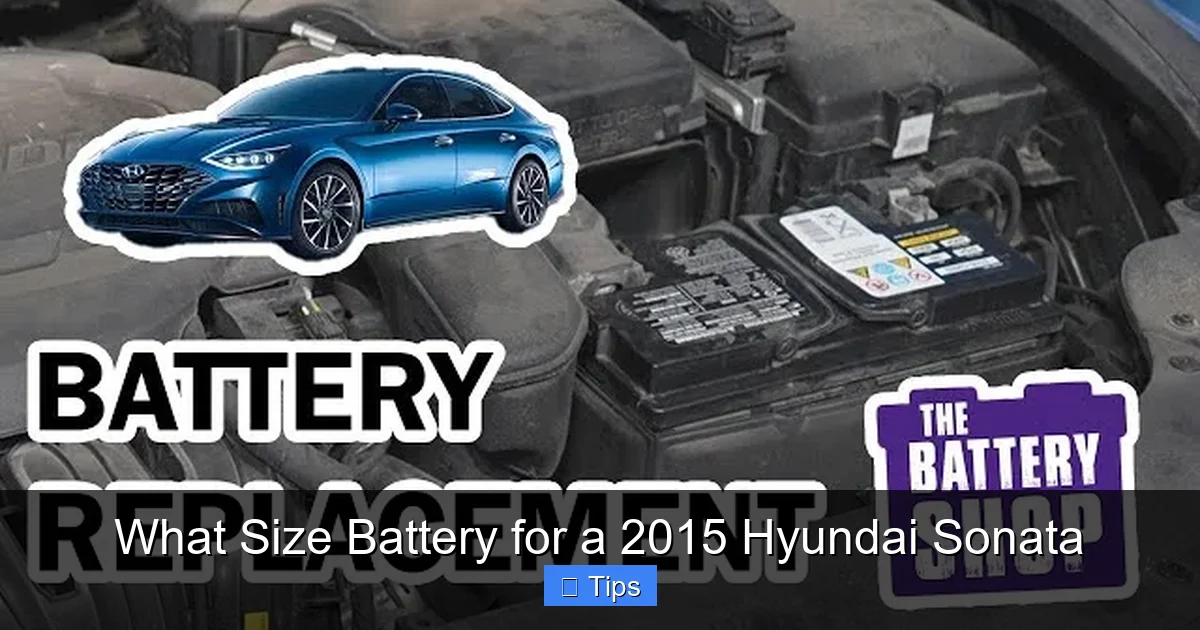
Even with proper maintenance, car batteries don’t last forever. The average lifespan of a 12-volt automotive battery is 3 to 5 years, depending on climate, driving habits, and usage patterns. If your 2015 Sonata is approaching or exceeding this range, it’s wise to start monitoring for warning signs.
One of the most obvious indicators is a **slow engine crank**. If your Sonata takes longer than usual to start—especially on cold mornings—it could mean the battery is losing its ability to deliver peak power. You might hear a clicking sound when you turn the key, which suggests the starter isn’t getting enough voltage.
Another red flag is **dimming headlights or interior lights**. When the battery weakens, it struggles to maintain consistent voltage. You may notice lights flicker when idling or dim when using accessories like the radio or A/C. Similarly, electronic features such as power seats, windows, or the infotainment system may operate sluggishly.
**Dashboard warning lights** can also signal battery trouble. While the “Check Engine” light usually points to other issues, a battery-shaped icon or “ALT” (alternator) warning could indicate charging system problems. Use an OBD2 scanner to check for codes like P0562 (low system voltage) or P0620 (generator control circuit malfunction).
Physical signs shouldn’t be ignored either. Check for **swelling, cracks, or leaks** on the battery case. A bulging battery often results from overcharging or extreme heat and poses a safety risk. Also, look for **corrosion** around the terminals—a white, green, or blue powdery substance that can interfere with electrical connections.
Finally, consider your **driving habits**. Short trips don’t allow the alternator enough time to fully recharge the battery, leading to gradual depletion. If you mostly drive locally or let the car sit for days, your battery may wear out faster. Similarly, extreme temperatures—both hot and cold—accelerate battery degradation.
If you notice any of these signs, don’t wait. Test your battery using a multimeter or visit an auto parts store for a free load test. Most will check voltage, CCA, and overall health in minutes. Replacing a weak battery before it fails completely saves you from being stranded and protects your Sonata’s electrical system.
Top Battery Recommendations for the 2015 Hyundai Sonata
With so many options on the market, choosing the right battery can feel overwhelming. To simplify your decision, here are five top-rated batteries that are compatible with the 2015 Hyundai Sonata and highly recommended by mechanics and owners alike.
First up is the **Optima RedTop 35**. This premium AGM (absorbent glass mat) battery delivers 760 CCA and is built to withstand vibrations, extreme temperatures, and frequent starts. Its spiral-cell design provides longer life and better performance than traditional flooded batteries. Ideal for drivers in cold climates or those who want maximum reliability.
Next is the **DieHard Platinum AGM 35**. With 750 CCA and a 5-year free replacement warranty, this battery offers excellent value. It’s designed for modern vehicles with high electrical demands and includes a built-in hydrometer to check charge status. DieHard is a trusted name, and this model consistently earns high marks for durability.
For budget-conscious buyers, the **Interstate MT-35** is a solid choice. It provides 650 CCA and comes with a 3-year warranty. While not as robust as AGM models, it’s a reliable flooded lead-acid battery that meets OEM specs and fits most Sonata trims. Great for daily commuters in mild climates.
If you prefer OEM quality, consider the **Hyundai Genuine Battery (Group 35)**. Available at dealerships, it’s engineered specifically for your Sonata and often includes a 2-year warranty. It’s a safe bet if you want factory-matched performance and don’t mind the higher price tag.
Lastly, the **ACDelco Professional 35** is a dependable aftermarket option with 640 CCA and a 3-year warranty. Known for consistent quality, ACDelco batteries are widely used in professional repair shops and offer good cold-weather performance.
When choosing, match the battery to your driving conditions and budget. AGM batteries cost more upfront but last longer and perform better in extreme conditions. Flooded batteries are cheaper but may need replacement sooner. Always verify compatibility with your specific Sonata trim before purchasing.
Battery Maintenance Tips to Extend Lifespan
A little maintenance goes a long way in keeping your 2015 Sonata’s battery in top shape. With simple habits, you can add years to its life and avoid unexpected failures.
Start by **cleaning the terminals every 6 months**. Corrosion buildup increases resistance and reduces efficiency. Mix 1 tablespoon of baking soda with 1 cup of water, apply with a brush, and rinse thoroughly. Dry and apply dielectric grease to prevent future buildup.
**Check voltage regularly**. A healthy battery should read 12.6 volts or higher when the car is off. Use a multimeter to test monthly. If it drops below 12.4 volts, recharge it or have it tested.
**Avoid deep discharges**. Don’t leave lights, phone chargers, or accessories on when the engine is off. These small drains can weaken the battery over time, especially in older models.
**Drive regularly**. Short trips don’t fully recharge the battery. Aim for at least 20–30 minutes of driving weekly to keep it topped up.
**Protect from extreme temperatures**. Park in a garage during winter and shade during summer when possible. Extreme heat accelerates chemical reactions inside the battery, while cold reduces cranking power.
Finally, **test annually after 3 years**. Most auto shops offer free battery testing. Early detection of weakness prevents being stranded.
Conclusion
Choosing the right battery for your 2015 Hyundai Sonata isn’t just about swapping parts—it’s about ensuring reliability, safety, and long-term performance. Stick with a Group 35 battery rated for 600+ CCA, whether you go OEM or aftermarket. Follow proper installation procedures, watch for warning signs, and maintain your battery regularly. With the right care, your Sonata will keep starting strong for years to come.
Frequently Asked Questions
What battery group size does a 2015 Hyundai Sonata use?
The 2015 Hyundai Sonata typically uses a Group 35 battery. This size ensures proper fit, terminal alignment, and electrical compatibility with the vehicle’s systems.
It’s not recommended. Using a non-Group 35 battery may cause fit issues, incorrect terminal placement, or electrical problems. Always choose a compatible Group 35 replacement.
How often should I replace my Sonata’s battery?
Most batteries last 3 to 5 years. Test annually after the third year and replace if voltage drops below 12.4V or if you notice slow cranking.
Do I need to reprogram my car after replacing the battery?
Some 2015 Sonatas require battery registration using a diagnostic tool to optimize charging. Visit a Hyundai dealer if warning lights appear after replacement.
Is it safe to replace the battery myself?
Yes, if you follow safety steps: disconnect negative first, wear gloves and goggles, and avoid short circuits. If unsure, have a professional handle it.
What’s the difference between AGM and flooded batteries?
AGM batteries are more durable, resistant to vibration, and perform better in extreme conditions. Flooded batteries are cheaper but may require more maintenance and have shorter lifespans.

At CarLegit, we believe information should be clear, factual, and genuinely helpful. That’s why every guide, review, and update on our website is created with care, research, and a strong focus on user experience.