
The 2005 Honda Civic comes with a 1.7L inline-4 engine across most trims, delivering reliable performance and excellent fuel economy. Whether you’re buying, maintaining, or upgrading, understanding the engine size and specs helps you make informed decisions.
In This Article
- 1 Key Takeaways
- 2 📑 Table of Contents
- 3 What Size Engine Does a 2005 Honda Civic Have?
- 4 Engine Options in the 2005 Honda Civic
- 5 Engine Specifications and Performance
- 6 How to Identify Your 2005 Honda Civic’s Engine
- 7 Fuel Economy and Efficiency Comparison
- 8 Maintenance and Reliability of the 2005 Civic Engine
- 9 Upgrading or Modifying the Engine
- 10 Conclusion
- 11 Frequently Asked Questions
- 11.1 What is the engine size of a 2005 Honda Civic?
- 11.2 How much horsepower does a 2005 Honda Civic have?
- 11.3 Is the 2005 Honda Civic engine reliable?
- 11.4 What kind of fuel economy can I expect from a 2005 Honda Civic?
- 11.5 Can I upgrade the engine in a 2005 Honda Civic?
- 11.6 How do I check what engine my 2005 Honda Civic has?
Key Takeaways
- Standard Engine Size: The 2005 Honda Civic is equipped with a 1.7-liter (1,668 cc) inline-4 engine, found in most non-hybrid models.
- Engine Code: The engine is identified as the D17A series, specifically the D17A1, D17A2, or D17A7 depending on trim and transmission.
- Horsepower and Torque: Output ranges from 115 to 127 horsepower and 110 to 128 lb-ft of torque, varying by model and transmission type.
- Fuel Efficiency: The 1.7L engine delivers impressive fuel economy, averaging 30–38 mpg combined, making it ideal for daily commuting.
- Hybrid Option: The 2005 Civic Hybrid features a 1.3L inline-4 engine paired with an electric motor, offering enhanced efficiency and lower emissions.
- Performance Variants: The sportier Si trim uses a 2.0L inline-4 engine (K20A3), producing 160 horsepower for a more dynamic driving experience.
- Reliability and Maintenance: The 1.7L engine is known for durability and low maintenance costs, especially with regular oil changes and timing belt replacements.
📑 Table of Contents
- What Size Engine Does a 2005 Honda Civic Have?
- Engine Options in the 2005 Honda Civic
- Engine Specifications and Performance
- How to Identify Your 2005 Honda Civic’s Engine
- Fuel Economy and Efficiency Comparison
- Maintenance and Reliability of the 2005 Civic Engine
- Upgrading or Modifying the Engine
- Conclusion
What Size Engine Does a 2005 Honda Civic Have?
If you’re looking into a 2005 Honda Civic—whether you’re buying one, maintaining one, or just curious—you’ve probably asked: *What size engine does a 2005 Honda Civic have?* The answer isn’t just a single number, because Honda offered several engine options that year depending on the trim, model, and region. But don’t worry—we’re going to break it all down in simple terms so you can understand exactly what’s under the hood of this iconic compact car.
The 2005 Honda Civic is part of the seventh generation (1996–2000) and eighth generation (2001–2005) lineup, with the 2005 model being the final year of the eighth-gen design. This generation was praised for its reliability, fuel efficiency, and practicality. It came in multiple body styles—sedan, coupe, and hatchback—and several trim levels, each with different engine configurations. So while most people associate the 2005 Civic with a 1.7-liter engine, there are actually a few variations worth knowing about.
In this guide, we’ll walk you through every engine option available in the 2005 Honda Civic, including the standard 1.7L inline-4, the hybrid 1.3L, and the sporty 2.0L Si engine. We’ll also cover performance specs, fuel economy, maintenance tips, and how to identify which engine your Civic has. Whether you’re a first-time buyer or a long-time owner, this article will give you the full picture.
Engine Options in the 2005 Honda Civic
Visual guide about What Size Engine Does a 2005 Honda Civic Have
Image source: images.thecarconnection.com
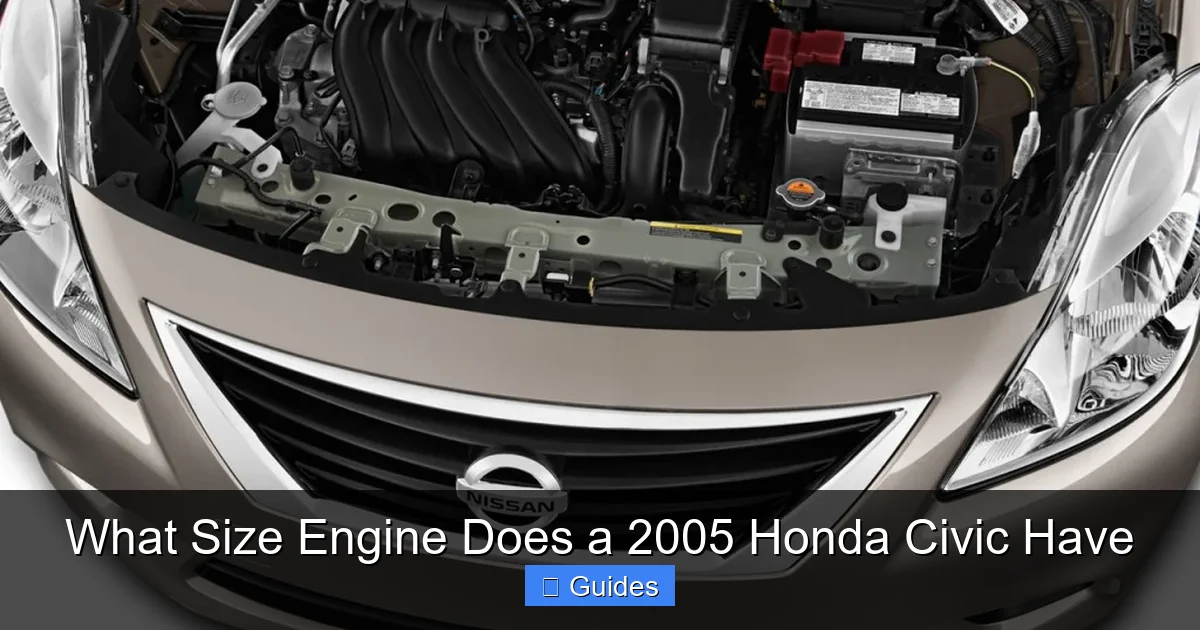
The 2005 Honda Civic didn’t come with just one engine—it had a few different powerplants depending on the trim and model. Let’s take a closer look at each one.
The Standard 1.7L Inline-4 Engine
The most common engine in the 2005 Honda Civic is the 1.7-liter (1,668 cc) inline-4. This engine was used in the majority of non-hybrid, non-Si models, including the DX, LX, EX, and HX trims. It’s part of Honda’s D-series engine family, specifically the D17A series.
This engine is known for its simplicity, durability, and excellent fuel economy. It’s not a powerhouse, but it’s more than enough for daily driving, commuting, and light highway travel. The 1.7L engine was designed to balance performance and efficiency, making it a favorite among budget-conscious drivers and those who value long-term reliability.
Depending on the specific trim and transmission (manual or automatic), the 1.7L engine produces between 115 and 127 horsepower. Torque ranges from 110 to 128 lb-ft. For example, the LX trim with a manual transmission might produce 127 hp, while the same engine in an automatic EX model could be rated at 115 hp due to slight tuning differences.
Despite the variation in output, the core engine design remains consistent. It features a single overhead camshaft (SOHC), 16 valves, and a cast-iron block with an aluminum cylinder head. It uses a timing belt (not a chain), which means it needs to be replaced every 60,000 to 100,000 miles to prevent catastrophic failure.
The 1.3L Hybrid Engine
For drivers looking for maximum fuel efficiency and lower emissions, Honda offered the 2005 Civic Hybrid. This model featured a 1.3-liter (1,339 cc) inline-4 engine paired with an Integrated Motor Assist (IMA) electric motor. The hybrid system was part of Honda’s early efforts in eco-friendly technology, predating the more advanced systems seen in later hybrids.
The 1.3L engine alone produces about 85 horsepower, but when combined with the electric motor, the total system output reaches approximately 93 horsepower. While this might seem low compared to the standard 1.7L, the hybrid system provides instant torque from the electric motor, improving low-end responsiveness.
The real benefit of the 1.3L hybrid engine is fuel economy. The 2005 Civic Hybrid achieves an EPA-estimated 46 mpg in the city and 51 mpg on the highway, making it one of the most fuel-efficient non-plug-in cars of its time. It’s ideal for city driving and long commutes where stop-and-go traffic is common.
One thing to note: the hybrid battery pack (a small NiMH unit) has a limited lifespan and may need replacement after 8–10 years or 100,000+ miles. While this can be costly, many owners report that the fuel savings over time offset the expense.
The 2.0L K20A3 Engine in the Si Trim
For those who wanted more excitement from their Civic, Honda offered the 2005 Civic Si—a sportier version with a significantly more powerful engine. Instead of the 1.7L, the Si came equipped with a 2.0-liter (1,998 cc) inline-4 engine from the K-series family, specifically the K20A3.
This engine produces 160 horsepower and 132 lb-ft of torque, which is a big jump from the standard 1.7L. It features a dual overhead camshaft (DOHC) design, variable valve timing (i-VTEC), and a higher compression ratio, all contributing to better performance and responsiveness.
The Si was only available as a coupe and came exclusively with a 6-speed manual transmission, emphasizing its driver-focused nature. It also included sport-tuned suspension, larger wheels, and a more aggressive exterior design.
While the 2.0L engine offers more power, it comes with a trade-off: fuel economy drops to around 25–28 mpg combined. Still, for enthusiasts who enjoy spirited driving, the Si remains a beloved model and a great example of how Honda balanced practicality with performance.
Engine Specifications and Performance
Visual guide about What Size Engine Does a 2005 Honda Civic Have
Image source: images.fitmentindustries.com
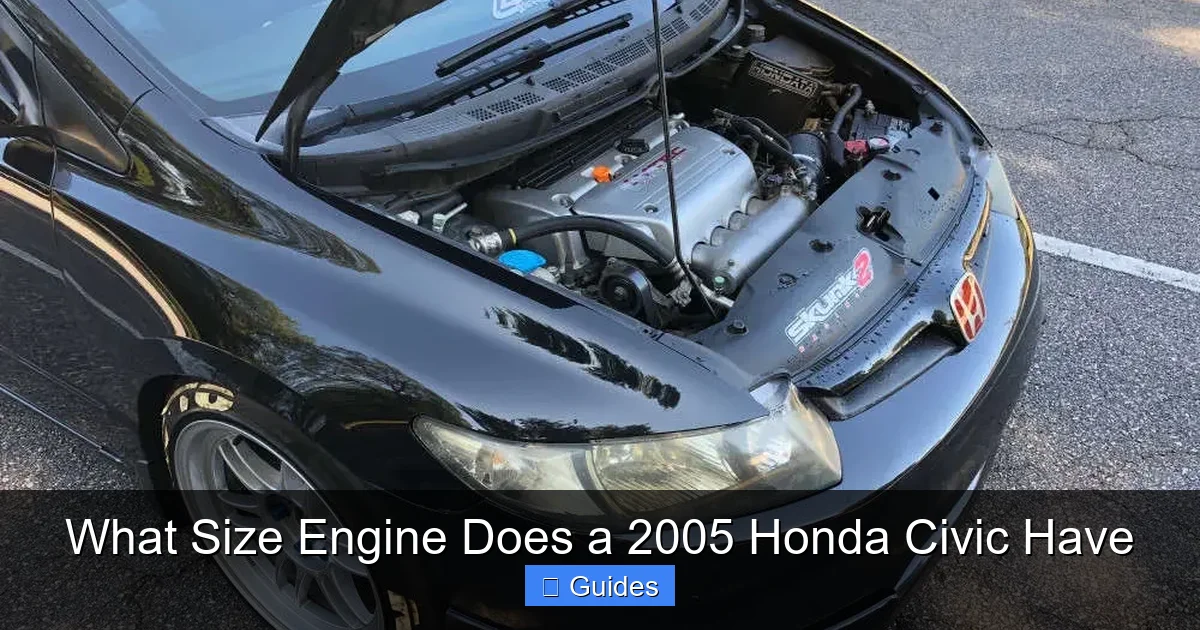
Now that we’ve covered the different engine options, let’s dive into the technical details and real-world performance of each.
1.7L Engine Specs and Performance
The 1.7L D17A engine is the heart of most 2005 Civics. Here’s a breakdown of its key specs:
– Displacement: 1.7 liters (1,668 cc)
– Configuration: Inline-4, SOHC, 16-valve
– Fuel System: Multi-point fuel injection
– Compression Ratio: 9.5:1 to 9.9:1 (varies by model)
– Horsepower: 115–127 hp @ 6,000 rpm
– Torque: 110–128 lb-ft @ 4,500 rpm
– Redline: ~6,500 rpm
In real-world driving, the 1.7L engine feels smooth and quiet, especially at highway speeds. It’s not fast, but it’s adequate for merging and passing. The manual transmission models feel more engaging, with better throttle response and a sportier feel. Automatic models are tuned for smoothness and fuel economy, which can make them feel a bit sluggish during acceleration.
One of the biggest strengths of the 1.7L engine is its fuel efficiency. On average, you can expect:
– 30–32 mpg city
– 36–38 mpg highway
– 32–35 mpg combined
These numbers make the 2005 Civic one of the most fuel-efficient cars in its class, especially when paired with the manual transmission.
1.3L Hybrid Engine Performance
The 1.3L hybrid engine prioritizes efficiency over performance. With only 93 horsepower combined, it’s not built for speed. However, the electric motor provides instant torque, which helps with initial acceleration from a stop.
The hybrid system uses regenerative braking to recharge the battery, and the engine automatically shuts off at stops to save fuel. This makes it ideal for city driving, where frequent stops are common.
Fuel economy is the standout feature:
– 46 mpg city
– 51 mpg highway
– 48 mpg combined
These numbers were impressive in 2005 and still hold up well today. The hybrid also produces lower emissions, making it a greener choice for environmentally conscious drivers.
2.0L Si Engine Performance
The 2.0L K20A3 engine transforms the Civic into a fun-to-drive compact coupe. With 160 horsepower and a 6-speed manual, it offers a more engaging driving experience.
– 0–60 mph: ~7.5 seconds
– Top Speed: ~125 mph (electronically limited)
– Fuel Economy: 25 mpg city / 28 mpg highway
The i-VTEC system provides a noticeable surge in power above 5,000 rpm, giving the Si a sporty character. The suspension is stiffer, and the steering is more responsive, making it enjoyable on winding roads.
While it’s not as powerful as modern hot hatches, the 2005 Civic Si remains a favorite among driving enthusiasts for its balance of performance, practicality, and affordability.
How to Identify Your 2005 Honda Civic’s Engine
Visual guide about What Size Engine Does a 2005 Honda Civic Have
Image source: thumbs.dreamstime.com
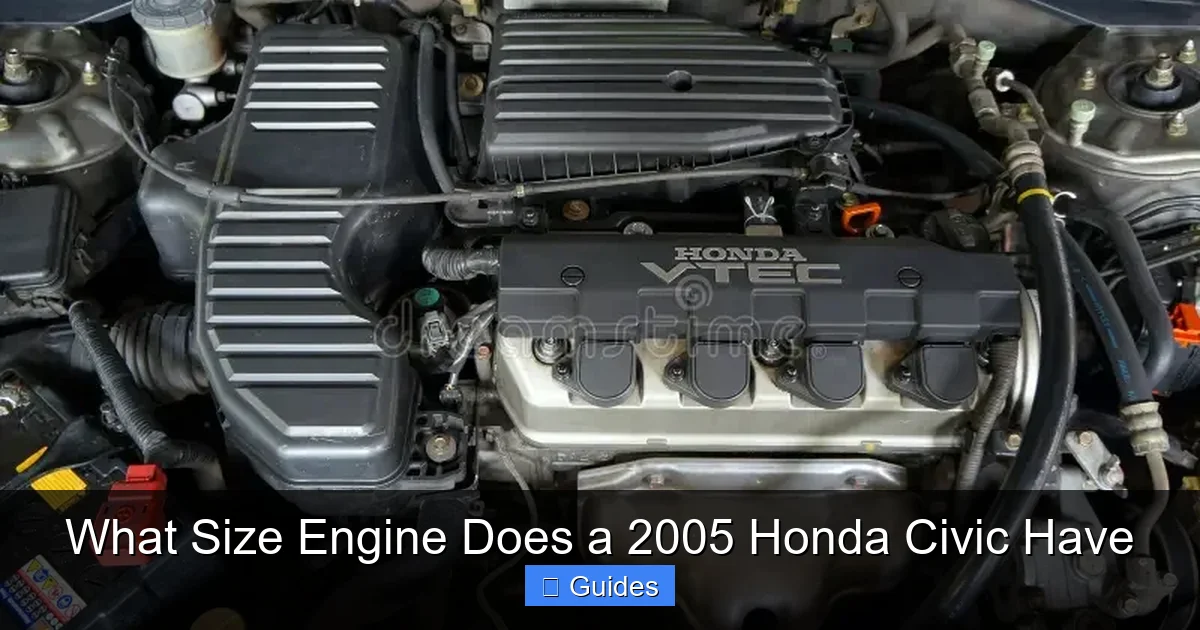
If you already own a 2005 Honda Civic or are looking to buy one, you might be wondering how to confirm which engine it has. Here are a few ways to identify the engine size and type.
Check the Vehicle Identification Number (VIN)
The VIN is a 17-character code that contains information about your car, including the engine type. You can find it on the driver’s side dashboard (visible through the windshield) or on the door jamb.
The 8th character of the VIN indicates the engine code. For the 2005 Civic:
– D17A1, D17A2, D17A7: 1.7L engine (most common)
– LDA1: 1.3L hybrid engine
– K20A3: 2.0L Si engine
You can use a free VIN decoder online or enter it on Honda’s official website to get detailed specs.
Look Under the Hood
Pop the hood and look at the engine block. The 1.7L engine is compact and has a single camshaft cover. The 2.0L Si engine is larger, with dual camshaft covers and a more complex valve train. The hybrid engine has additional components like the IMA motor and battery pack near the firewall.
You can also check the emissions label on the radiator support or strut tower. It will list the engine displacement and type.
Review the Owner’s Manual or Window Sticker
If you have the original owner’s manual or window sticker (Monroney label), it will list the engine size and horsepower. This is one of the easiest ways to confirm the specs.
Ask the Seller or Use a Vehicle History Report
When buying a used Civic, ask the seller for details or run a vehicle history report (like Carfax or AutoCheck). These reports often include engine information and can help verify the car’s configuration.
Fuel Economy and Efficiency Comparison
Fuel economy is a major reason why the 2005 Honda Civic remains popular today. Let’s compare the three engine options side by side.
| Engine Type | City MPG | Highway MPG | Combined MPG |
|——————-|———-|————-|————–|
| 1.7L (Manual) | 30–32 | 36–38 | 33–35 |
| 1.7L (Automatic) | 28–30 | 34–36 | 31–33 |
| 1.3L Hybrid | 46 | 51 | 48 |
| 2.0L Si | 25 | 28 | 26–27 |
As you can see, the hybrid is the clear winner in efficiency, while the Si sacrifices fuel economy for performance. The standard 1.7L strikes a great balance, offering excellent mileage without the added complexity of a hybrid system.
For most drivers, the 1.7L engine provides the best overall value. It’s reliable, efficient, and inexpensive to maintain. The hybrid is ideal for city commuters, while the Si is perfect for those who enjoy driving.
Maintenance and Reliability of the 2005 Civic Engine
One of the reasons the 2005 Honda Civic is so popular is its reputation for reliability. But like any engine, it needs proper maintenance to last.
Timing Belt Replacement
The 1.7L engine uses a timing belt, not a chain. This belt must be replaced every 60,000 to 100,000 miles (check your owner’s manual for specifics). If the belt breaks, it can cause severe engine damage. The water pump is often replaced at the same time, as it’s driven by the timing belt.
Oil Changes
Regular oil changes are crucial. Use 5W-30 synthetic or conventional oil and change it every 5,000 to 7,500 miles. Clean oil keeps the engine running smoothly and prevents sludge buildup.
Spark Plugs and Ignition System
The 1.7L engine uses platinum or iridium spark plugs that can last up to 100,000 miles. Still, it’s a good idea to inspect them around 60,000 miles. The ignition coils are generally reliable but can fail over time.
Cooling System
Check the coolant level regularly and flush the system every 60,000 miles. Overheating can damage the head gasket, especially in older engines.
Hybrid-Specific Maintenance
For hybrid models, the IMA battery may need replacement after 100,000+ miles. Costs can range from $1,500 to $3,000, but some owners have upgraded to lithium-ion batteries for better performance and longevity.
Upgrading or Modifying the Engine
While the 2005 Civic isn’t typically a performance car, some owners choose to modify their engines for more power or efficiency.
Common Upgrades for the 1.7L Engine
– Cold air intake: Improves airflow and adds a sporty sound.
– Performance exhaust: Reduces backpressure and enhances tone.
– ECU tuning: Can optimize fuel and timing for better performance (limited gains on SOHC engines).
– Lightweight pulleys: Reduce rotational mass for slightly better acceleration.
Note: Major power gains require internal engine work (e.g., forged pistons, camshafts), which is often not cost-effective for a 1.7L engine.
Si and Hybrid Modifications
The 2.0L Si engine responds well to bolt-on mods like intakes, exhausts, and tuning. Some owners even swap in K24 engines for more power.
Hybrid owners can upgrade to lithium batteries or install aftermarket regenerative systems, but these modifications require technical expertise.
Conclusion
So, what size engine does a 2005 Honda Civic have? The answer depends on the trim and model, but most Civics come with a reliable 1.7-liter inline-4 engine. This engine delivers excellent fuel economy, smooth performance, and long-term durability, making it a favorite among compact car buyers.
The 2005 Civic also offers two other engine options: a 1.3L hybrid for maximum efficiency and a 2.0L Si for sporty driving. Each engine has its strengths, and choosing the right one depends on your needs—whether it’s saving money at the pump, reducing emissions, or enjoying a more dynamic ride.
No matter which engine your Civic has, regular maintenance is key to keeping it running smoothly for years to come. With proper care, a 2005 Honda Civic can easily surpass 200,000 miles and remain a dependable daily driver.
Whether you’re buying your first Civic or upgrading from an older model, understanding the engine options will help you make the best choice. And now that you know what size engine a 2005 Honda Civic has, you can drive with confidence—knowing exactly what’s under the hood.
Frequently Asked Questions
What is the engine size of a 2005 Honda Civic?
The most common engine size in a 2005 Honda Civic is 1.7 liters (1,668 cc), found in most non-hybrid, non-Si models. However, the Civic Hybrid has a 1.3L engine, and the Si trim uses a 2.0L engine.
How much horsepower does a 2005 Honda Civic have?
Horsepower varies by engine: the 1.7L produces 115–127 hp, the 1.3L hybrid makes 93 hp combined, and the 2.0L Si delivers 160 hp.
Is the 2005 Honda Civic engine reliable?
Yes, the 1.7L engine is known for its reliability and longevity, especially with regular maintenance like oil changes and timing belt replacements.
What kind of fuel economy can I expect from a 2005 Honda Civic?
Fuel economy ranges from 25–28 mpg for the Si, 30–38 mpg for the 1.7L, and up to 46–51 mpg for the hybrid model.
Can I upgrade the engine in a 2005 Honda Civic?
Yes, bolt-on upgrades like intakes and exhausts are common. Major engine swaps are possible but may not be cost-effective for daily drivers.
How do I check what engine my 2005 Honda Civic has?
Check the 8th character of the VIN, look under the hood, or review the owner’s manual. Online VIN decoders can also provide engine details.

At CarLegit, we believe information should be clear, factual, and genuinely helpful. That’s why every guide, review, and update on our website is created with care, research, and a strong focus on user experience.