
The Cadillac CTS requires premium unleaded gasoline with an octane rating of 91 or higher for optimal performance and engine protection. Using regular fuel can cause engine knocking and reduce efficiency. Always consult your owner’s manual for your specific model year to confirm this requirement.
In This Article
- 1 Key Takeaways
- 2 📑 Table of Contents
- 3 What Gas Does a Cadillac CTS Require?
- 4 Understanding Fuel Octane Ratings: What Do the Numbers Mean?
- 5 A Generation-by-Generation Guide to Cadillac CTS Fuel Requirements
- 6 Why Following the Fuel Recommendation Matters for Your CTS
- 7 Practical Tips for Fueling and Maintaining Your Cadillac CTS
- 8 Cadillac CTS Fuel Requirements at a Glance
- 9 Conclusion: Fueling Your Cadillac CTS with Confidence
- 10 Frequently Asked Questions
- 10.1 What type of gas does a Cadillac CTS take?
- 10.2 Can I use regular 87 octane gas in my Cadillac CTS?
- 10.3 What happens if I use the wrong gas in my CTS?
- 10.4 Does the Cadillac CTS require premium gas for all model years?
- 10.5 What are the benefits of using premium gas in a Cadillac CTS?
- 10.6 What gas does a Cadillac CTS require for the best fuel mileage?
Key Takeaways
- Use Premium 91+ Octane: Required for optimal performance and engine health.
- Consult Your Owner’s Manual: It provides the definitive fuel recommendation for your model year.
- Regular Unleaded is Acceptable: But expect reduced power and efficiency.
- Avoid Ethanol Blends Over 15%: E85 is not approved for most CTS engines.
- Premium Fuel Protects the Engine: It prevents knocking in high-compression engines.
- Fuel Choice Impacts Longevity: Using the correct gas helps maintain engine value.
📑 Table of Contents
- What Gas Does a Cadillac CTS Require?
- Understanding Fuel Octane Ratings: What Do the Numbers Mean?
- A Generation-by-Generation Guide to Cadillac CTS Fuel Requirements
- Why Following the Fuel Recommendation Matters for Your CTS
- Practical Tips for Fueling and Maintaining Your Cadillac CTS
- Cadillac CTS Fuel Requirements at a Glance
- Conclusion: Fueling Your Cadillac CTS with Confidence
What Gas Does a Cadillac CTS Require?
Picture this. You’ve just pulled up to the gas station in your sleek Cadillac CTS. The sun is glinting off its chrome accents. You feel that familiar mix of pride and performance humming under the hood. Then, you grab the fuel nozzle, and a moment of doubt hits. Which button do I press? Is premium gas really necessary, or is it just a suggestion? If you’ve ever had this thought, you’re absolutely not alone.
Choosing the right fuel isn’t just about following the manual. It’s about protecting your investment, ensuring peak performance, and understanding the heart of your luxury sedan. The answer isn’t the same for every CTS, as it changed over its long and impressive production run. Using the wrong type can be a costly mistake, while using the right one unlocks the driving experience Cadillac engineers intended.
In this guide, we’ll clear up the confusion for good. We’ll walk through every generation, explain why fuel recommendations matter, and give you practical tips to keep your CTS running smoothly for years and miles to come. Let’s settle the question of what gas your Cadillac CTS truly requires.
Understanding Fuel Octane Ratings: What Do the Numbers Mean?
Before we dive into your specific CTS, let’s quickly demystify those numbers on the pump. You see 87, 89, 91, or 93. This is the octane rating, a measure of a fuel’s stability and its resistance to “knocking” or “pinging.”
Visual guide about Cadillac CTS fuel type
Image source: tankbig.com
Engine Knock and Why It’s Bad
Think of your engine’s cylinders as tiny, controlled explosion chambers. The spark plug ignites the fuel-air mixture at a precise moment. Lower octane fuel is less stable and can ignite prematurely from heat and pressure alone, before the spark plug fires. This creates a second, out-of-sync mini-explosion—that’s the knocking sound. Over time, this knocking is like a tiny hammer beating on your pistons and can cause serious engine damage.
High-Performance Engines Need High Octane
High-performance engines, like those in many Cadillac CTS models, often have higher compression ratios or use forced induction (turbocharging or supercharging). These create more heat and pressure inside the cylinders. Higher octane fuel withstands these conditions better, preventing knock and allowing the engine’s computer to optimize timing and boost for maximum power and efficiency. Using lower octane fuel in an engine designed for premium often forces the computer to pull back on performance to protect the engine, a process you might feel as sluggish acceleration.
A Generation-by-Generation Guide to Cadillac CTS Fuel Requirements
The Cadillac CTS evolved significantly from its 2003 debut to its final model year. Its fuel requirements evolved too. Here’s exactly what type of gas your Cadillac CTS takes, based on its generation and engine.
Visual guide about Cadillac CTS fuel type
Image source: storage.googleapis.com
First Generation (2003-2007)
The original CTS made a bold statement. For the standard 3.2L V6 and the later 3.6L V6 engines, Cadillac recommended premium unleaded gasoline (91 octane or higher). The owner’s manual for these models often stated that 87 octane regular unleaded could be used, but doing so would result in reduced performance and fuel economy. My advice? For these early models, using premium is the best way to experience the responsive, sporty feel they were designed for, especially if you enjoy spirited driving.
Second Generation (2008-2014)
This generation brought more power and refinement. The requirements became clearer and more critical.
- 3.6L V6 (Naturally Aspirated): For the standard V6, premium fuel (91 octane or higher) is recommended for optimal performance. Regular 87 octane is typically listed as acceptable, but with the same caveats about potential performance loss.
- 3.6L V6 (Direct Injection): The DI version of this engine, often found in later models and performance trims, more strongly preferred premium fuel.
- CTS-V (6.2L Supercharged V8): This is non-negotiable. The legendary high-performance CTS-V requires premium unleaded fuel (91 octane or higher). Using regular gas in this supercharged engine risks severe knocking and engine damage.
Third Generation (2014-2019)
The final generation saw a mix of technologies. The guidance here is crucial to follow.
- 2.0L Turbocharged I4: This efficient turbo-four engine requires premium fuel (91 octane or higher). Turbocharged engines are highly sensitive to octane due to increased cylinder pressure.
- 3.6L V6 (Naturally Aspirated): Premium fuel (91 octane or higher) is recommended.
- 3.6L Twin-Turbo V6 (CTS Vsport): This twin-turbo monster requires premium fuel (93 octane is often specified for peak performance). Do not compromise here.
- CTS-V (6.2L Supercharged V8): Again, requires premium fuel (93 octane recommended).
Why Following the Fuel Recommendation Matters for Your CTS
It’s easy to see the fuel recommendation as just another expense. But it’s really an integral part of your car’s engineering. Here’s what’s at stake when you choose the right—or wrong—fuel for your Cadillac CTS.
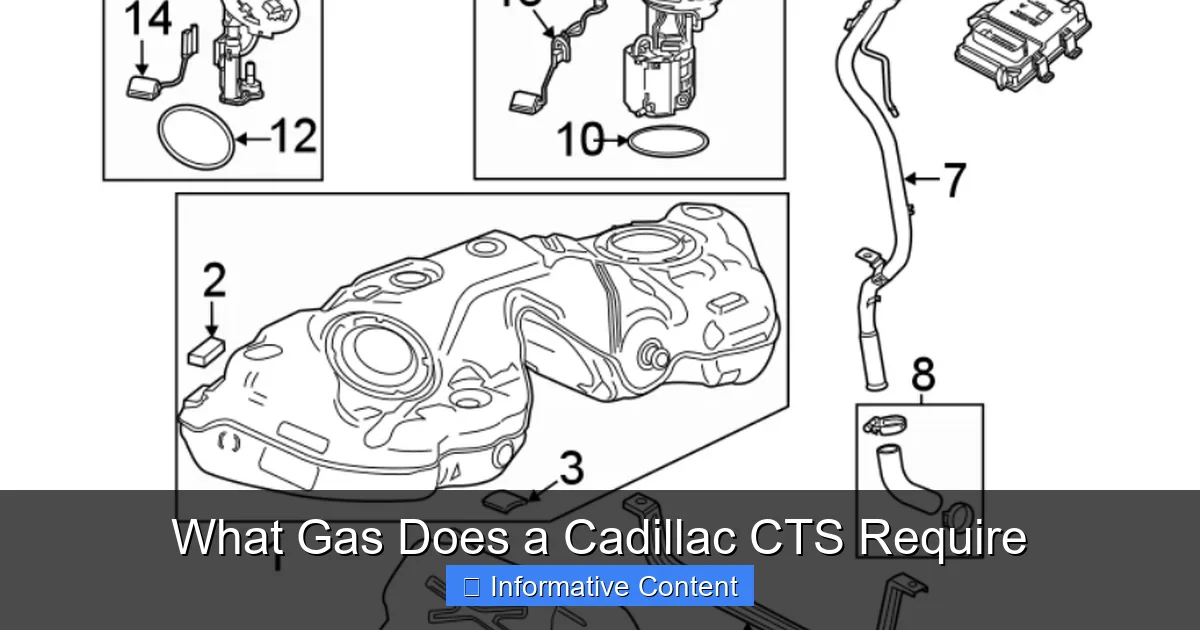
Visual guide about Cadillac CTS fuel type
Image source: images.simplepart.com
Performance and Driving Feel
Your CTS was tuned for a specific fuel. With premium in a car that requires it, the engine computer advances timing and, in turbo/supercharged models, can apply full boost. The result is the sharp throttle response and confident power delivery you paid for. Using regular gas often triggers the knock sensors, causing the computer to retard timing. You might not notice a huge difference on a casual grocery run, but when merging onto the highway or enjoying a winding road, the car will feel noticeably less eager and responsive.
Long-Term Engine Health and Reliability
Consistently using lower-octane fuel in an engine designed for premium increases the risk of persistent, low-level knocking. Over thousands of miles, this extra stress can contribute to wear on pistons, rings, and rod bearings. Forced induction engines (turbos and superchargers) run especially hot and under high pressure, making them even more vulnerable. The few dollars saved per tank could translate to costly repairs down the line.
Fuel Economy: A Surprising Consideration
This is a common point of debate. While premium fuel costs more per gallon, it can sometimes lead to better miles per gallon in engines that require it. Why? Because the engine runs more efficiently at its optimal settings. If using regular causes a 2-3 MPG drop, you might be spending the same amount of money to go fewer miles, negating any upfront savings. It’s worth tracking your mileage over a few tanks with each fuel type to see the real-world impact on your specific driving habits.
Practical Tips for Fueling and Maintaining Your Cadillac CTS
Now that you know what gas your Cadillac CTS requires, let’s talk about some smart habits at the pump and beyond.
How to Find Your Car’s Official Recommendation
Don’t rely on memory or a blog post alone (though I’m glad you’re here!). Always check:
- The Fuel Door: The most convenient place. Many models have a sticker here stating the required octane.
- The Owner’s Manual: This is the ultimate authority. Look in the index under “Fuel” or “Gasoline.”
- Your Specific VIN: A quick call to a Cadillac dealer with your Vehicle Identification Number can give you a definitive answer.
Choosing a Gas Station and Top Tier Gas
Not all gasoline is created equal. All major brands meet minimum detergent standards, but “Top Tier” gasoline (a licensed standard) contains a higher concentration of effective detergents. These help keep critical engine parts like fuel injectors and intake valves clean, which is especially important for direct injection engines found in many later CTS models. Look for the Top Tier logo on the pump. Using a Top Tier premium fuel is one of the best things you can do for your luxury performance engine.
What If You Accidentally Use the Wrong Gas?
Don’t panic. A single tank of regular 87 in a car that recommends (but doesn’t strictly require) premium is unlikely to cause harm. The engine computer will detect knock and adjust. Just drive gently until you can refill with the correct premium fuel. However, if your CTS requires premium (like a turbo, Vsport, or V model) and you fill it with regular, avoid hard acceleration and high engine loads. If you’ve put in the wrong fuel in a car that requires premium, the safest course is to top it off with premium immediately to raise the octane level in the tank, or in severe cases, have it drained.
Cadillac CTS Fuel Requirements at a Glance
This table summarizes the key information for quick reference. Remember, your owner’s manual is the final word.
| Generation & Years | Engine | Fuel Requirement | Key Notes |
|---|---|---|---|
| First Gen (2003-2007) | 3.2L & 3.6L V6 | Premium (91+) Recommended | Regular (87) is acceptable but may reduce performance. |
| Second Gen (2008-2014) | 3.6L V6 (Standard) | Premium (91+) Recommended | Similar to first gen; premium is best for optimal operation. |
| Second Gen (2008-2014) | 6.2L Supercharged V8 (CTS-V) | Premium (91+) Required | Do not use regular fuel. Essential for engine protection. |
| Third Gen (2014-2019) | 2.0L Turbo I4 | Premium (91+) Required | Turbocharged engine requires higher octane. |
| Third Gen (2014-2019) | 3.6L Twin-Turbo V6 (Vsport) | Premium (93 Recommended) Required | High-performance engine demands high-octane fuel. |
| Third Gen (2014-2019) | 6.2L Supercharged V8 (CTS-V) | Premium (93 Recommended) Required | Absolute requirement for the supercharged performance engine. |
Conclusion: Fueling Your Cadillac CTS with Confidence
So, what gas does a Cadillac CTS require? As we’ve seen, the answer depends on the year and the heartbeat under the hood—its engine. For most V6 models across all generations, premium fuel is strongly recommended to unlock their full potential. For the thrilling, high-performance variants—the turbocharged four-cylinder, the twin-turbo Vsport, and the supercharged V monsters—premium fuel is an absolute requirement, not a luxury.
Think of premium fuel in your Cadillac CTS not as an extra cost, but as an essential part of its maintenance. It’s the lifeblood that ensures the performance, efficiency, and longevity you expect from a luxury sports sedan. By using the correct octane, preferably from a Top Tier supplier, you’re honoring the engineering that went into your car and protecting the driving pleasure it delivers every time you turn the key.
Next time you’re at the pump, you can grab the correct nozzle with complete confidence, knowing you’re making the best choice for your Cadillac. Now, go enjoy that smooth, powerful drive.
Frequently Asked Questions
What type of gas does a Cadillac CTS take?
The Cadillac CTS requires premium unleaded gasoline with an octane rating of 91 or higher for optimal performance. Using the recommended fuel ensures the engine’s turbocharged or high-compression components operate as designed for maximum power and efficiency.
Can I use regular 87 octane gas in my Cadillac CTS?
While the vehicle may run on regular 87 octane gasoline, Cadillac strongly recommends against it for most CTS models, especially those with the V-Series or turbocharged engines. Using lower octane fuel can reduce performance, fuel economy, and may cause engine knocking over time.
What happens if I use the wrong gas in my CTS?
Consistently using gasoline with a lower octane than recommended can lead to pre-ignition (knocking), which may cause engine damage over the long term. For occasional use, the engine’s knock sensors will adjust timing to protect the engine, but power and fuel economy will suffer.
Premium fuel is recommended for most model years, particularly for the performance-oriented engines. However, it is always best to consult your specific owner’s manual, as requirements can vary slightly between model years and engine options like the base 3.6L V6.
Using premium gasoline ensures the high-performance engine delivers its advertised horsepower and torque while maintaining optimal fuel efficiency. It also helps prevent engine knock and keeps the fuel system and engine components cleaner for long-term reliability.
What gas does a Cadillac CTS require for the best fuel mileage?
To achieve the best fuel mileage, you should use the premium unleaded fuel (91+ octane) that Cadillac recommends. The engine’s computer is calibrated for higher octane, allowing for more efficient combustion and advanced ignition timing, which directly supports better fuel economy.

At CarLegit, we believe information should be clear, factual, and genuinely helpful. That’s why every guide, review, and update on our website is created with care, research, and a strong focus on user experience.