
Knowing where the catalytic converter on a Nissan Altima is located helps with maintenance, repairs, and theft prevention. This guide walks you through its position, function, signs of failure, and how to protect it.
If you own a Nissan Altima—or you’re thinking about buying one—you’ve probably heard about the catalytic converter. Maybe you’ve seen news reports about catalytic converter thefts, or perhaps your check engine light came on and a mechanic mentioned the “cat.” Either way, understanding where the catalytic converter is located on your Altima, how it works, and why it matters can save you time, money, and stress.
The catalytic converter is a crucial part of your car’s exhaust system. It’s designed to reduce harmful emissions by converting toxic gases into less dangerous ones before they leave your vehicle. While it might seem like a small, hidden component, it plays a big role in both environmental compliance and engine performance. And because it contains valuable metals, it’s also a target for thieves.
In this guide, we’ll walk you through everything you need to know about the catalytic converter on a Nissan Altima—starting with where it’s located, how to identify it, what signs indicate a problem, and how to protect it from theft. Whether you’re a DIY enthusiast or just want to be more informed as a car owner, this article will give you the knowledge you need to keep your Altima running smoothly and legally.
In This Article
- 1 Key Takeaways
- 2 📑 Table of Contents
- 3 What Is a Catalytic Converter and Why Does It Matter?
- 4 Where Is the Catalytic Converter Located on a Nissan Altima?
- 5 How to Identify the Catalytic Converter on Your Altima
- 6 Signs of a Failing Catalytic Converter
- 7 Catalytic Converter Theft: A Growing Problem for Altima Owners
- 8 Replacement and Maintenance Tips
- 9 Conclusion
- 10 Frequently Asked Questions
- 10.1 How many catalytic converters does a Nissan Altima have?
- 10.2 Can I drive my Altima with a bad catalytic converter?
- 10.3 How much does it cost to replace a catalytic converter on a Nissan Altima?
- 10.4 How can I tell if my catalytic converter was stolen?
- 10.5 Do I need a special tool to remove the catalytic converter?
- 10.6 Will a new catalytic converter improve my Altima’s fuel economy?
Key Takeaways
- Location varies by model year and engine: The catalytic converter on a Nissan Altima is typically found underneath the vehicle, near the exhaust manifold or along the exhaust pipe, but exact placement depends on the engine type and production year.
- Multiple converters may be present: Some newer Altima models, especially those with V6 or turbocharged engines, have more than one catalytic converter—often a pre-cat near the engine and a main cat further back.
- It’s part of the emissions system: The catalytic converter reduces harmful emissions by converting toxic gases like carbon monoxide and nitrogen oxides into less harmful substances before they exit the tailpipe.
- Theft is a growing concern: Due to precious metals like platinum, palladium, and rhodium inside, catalytic converters are frequently targeted by thieves—especially on sedans like the Altima that have moderate ground clearance.
- Warning signs include reduced performance and check engine light: A failing converter may cause poor fuel economy, sluggish acceleration, or a sulfur-like smell, often accompanied by an illuminated check engine light.
- Regular inspections help prevent major issues: Having your exhaust system checked during routine maintenance can catch converter problems early and save you from costly repairs down the road.
- Replacement can be expensive: Depending on the model and whether you use OEM or aftermarket parts, replacing a catalytic converter can cost anywhere from $800 to over $2,500, including labor.
📑 Table of Contents
- What Is a Catalytic Converter and Why Does It Matter?
- Where Is the Catalytic Converter Located on a Nissan Altima?
- How to Identify the Catalytic Converter on Your Altima
- Signs of a Failing Catalytic Converter
- Catalytic Converter Theft: A Growing Problem for Altima Owners
- Replacement and Maintenance Tips
- Conclusion
What Is a Catalytic Converter and Why Does It Matter?
Before we dive into the location, let’s take a moment to understand what a catalytic converter actually does. Think of it as your car’s environmental filter. Inside the engine, fuel is burned to create power, but this process also produces harmful byproducts like carbon monoxide (CO), nitrogen oxides (NOx), and unburned hydrocarbons (HC). These gases are dangerous to human health and contribute to air pollution and smog.
The catalytic converter uses a combination of heat and precious metal catalysts—usually platinum, palladium, and rhodium—to trigger chemical reactions that convert these toxins into safer substances. For example, carbon monoxide becomes carbon dioxide, nitrogen oxides break down into nitrogen and oxygen, and unburned fuel is oxidized into water and CO₂. This all happens inside a honeycomb-like structure made of ceramic or metal, which provides a large surface area for the reactions to occur.
Because of its role in reducing emissions, the catalytic converter is required by law in most countries, including the United States. Driving without a functioning catalytic converter can result in failing an emissions test, fines, or even having your vehicle deemed unroadworthy. Plus, a faulty converter can hurt your car’s performance, reduce fuel efficiency, and damage other parts of the exhaust system over time.
In the Nissan Altima, the catalytic converter is engineered to meet strict EPA and CARB (California Air Resources Board) standards. Depending on the model year and engine, your Altima may have one or two converters. Newer models, especially those with larger engines or turbocharging, often use a “dual cat” setup to improve emissions control and meet tighter regulations.
Where Is the Catalytic Converter Located on a Nissan Altima?
Visual guide about Where Is the Catalytic Converter on a Nissan Altima
Image source: guidemechanic.com
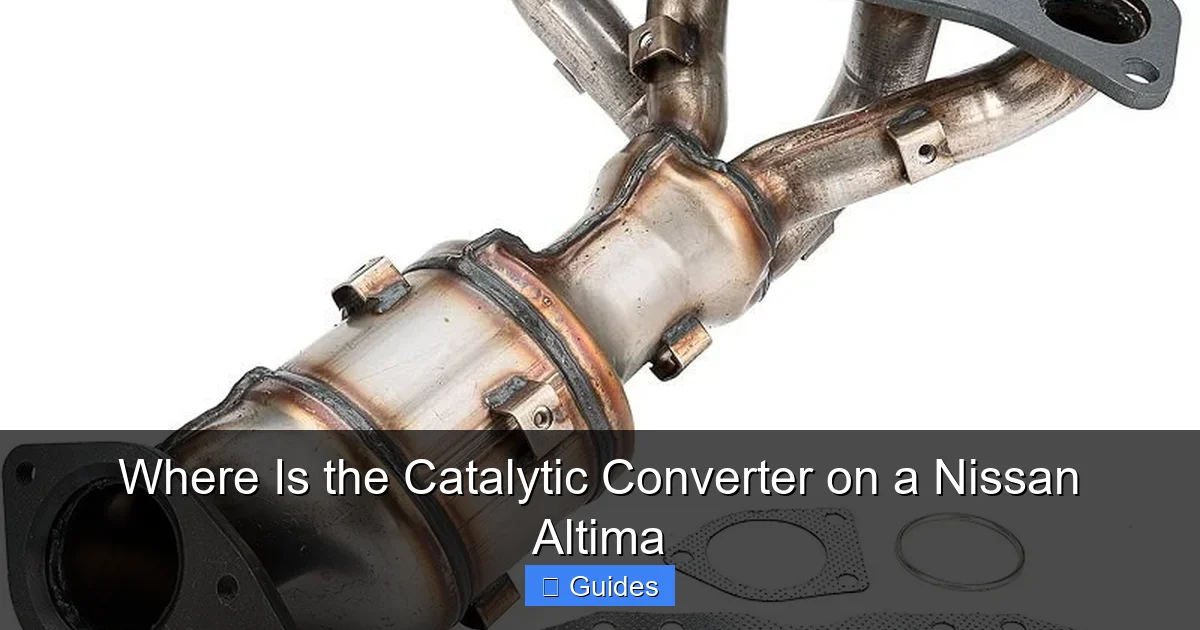
Now, let’s get to the main question: where exactly is the catalytic converter on a Nissan Altima? The short answer is that it’s underneath the vehicle, integrated into the exhaust system. But the exact location can vary depending on the model year, engine type, and drivetrain.
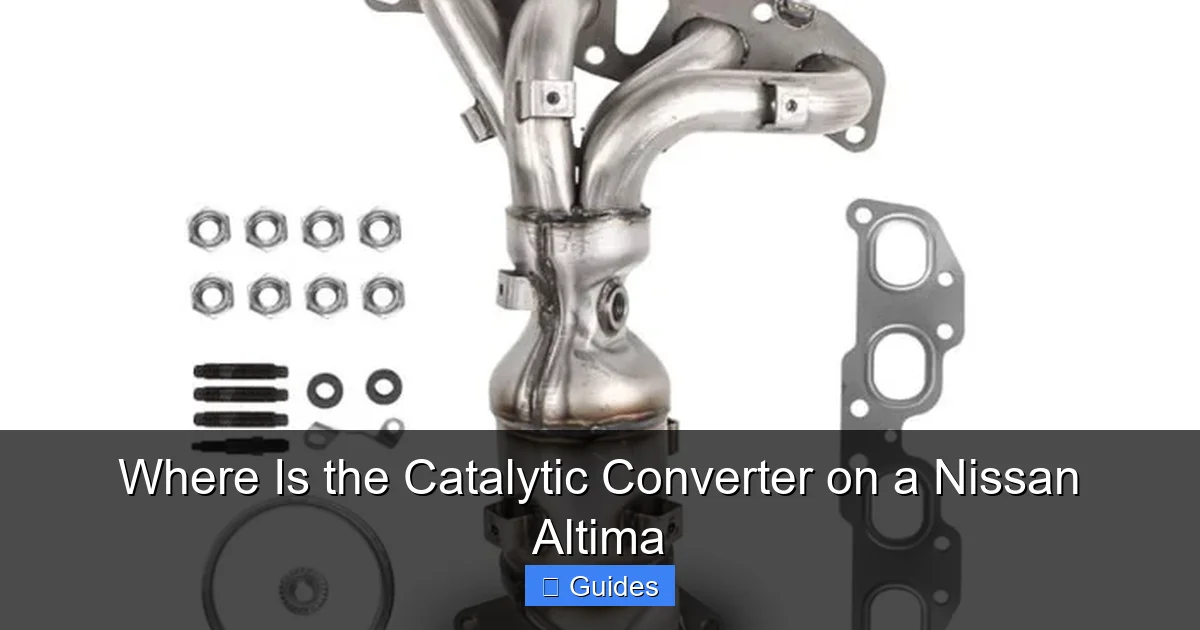
In most Nissan Altima models—especially those from the early 2000s to the mid-2010s with a 2.5L 4-cylinder engine—the catalytic converter is typically mounted close to the engine, just behind the exhaust manifold. This is known as a “pre-catalytic converter” or “manifold-mounted” converter. It’s designed to heat up quickly after the engine starts, which improves its efficiency in reducing cold-start emissions.
You can usually find it by looking underneath the front of the car, near where the exhaust pipe connects to the engine. It looks like a small, cylindrical or oval-shaped metal canister, often with heat shields around it. On some models, it’s bolted directly to the exhaust manifold, while on others, it’s connected via a short section of pipe.
For Altima models with a 3.5L V6 engine—common in trims like the SL or sport editions—there may be two catalytic converters. One is located near each exhaust manifold (one on the driver’s side, one on the passenger side), and sometimes a third “main” converter is positioned further back along the exhaust pipe, closer to the muffler. This setup helps manage the higher exhaust flow and emissions output of the V6 engine.
Starting around 2013 and especially in models from 2019 onward, Nissan began using more advanced exhaust systems to meet stricter emissions standards. In these newer Altimas, you might find a close-coupled catalytic converter (mounted very close to the engine for faster warm-up) and a secondary converter downstream. Some turbocharged variants, like those in the Altima SR or certain hybrid models, may also use specialized converters with different configurations.
To locate yours, the best approach is to consult your owner’s manual or look up a parts diagram for your specific model year and engine. You can also take your car to a trusted mechanic or Nissan dealership for a visual inspection. If you’re doing it yourself, always make sure the engine is cool and use proper safety gear—like jack stands and gloves—when working underneath the vehicle.
How to Identify the Catalytic Converter on Your Altima
Visual guide about Where Is the Catalytic Converter on a Nissan Altima
Image source: ic.carid.com
If you’re trying to find the catalytic converter on your Nissan Altima, here’s a step-by-step guide to help you identify it:
First, park your car on a level surface and engage the parking brake. For safety, never work under a vehicle supported only by a jack—always use jack stands. Let the engine cool completely if it’s been running.
Next, get under the front of the car and look toward the engine bay. You’re looking for a metal canister—usually about the size of a large soda can or smaller—that’s connected to the exhaust system. It’s often located just behind the engine, near where the exhaust manifolds meet the exhaust pipes.
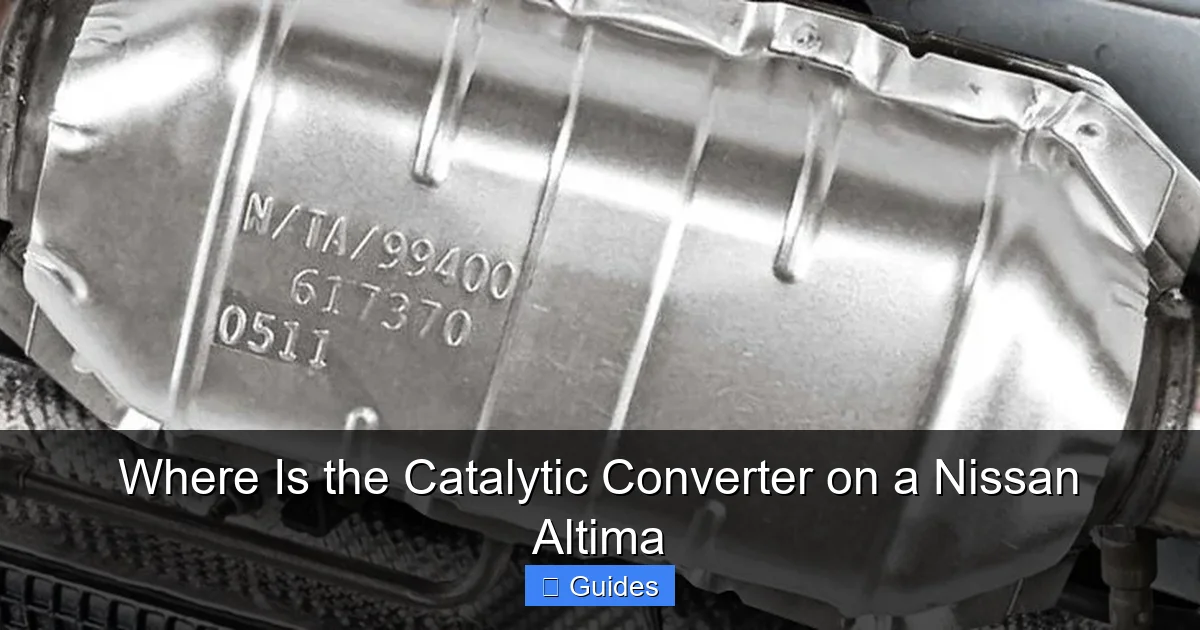
The catalytic converter will typically have a heat shield—a thin metal cover—wrapped around it to protect nearby components from excessive heat. You might also see oxygen sensors (O2 sensors) mounted before and after the converter. These sensors monitor the levels of oxygen in the exhaust to help the engine control unit (ECU) adjust the air-fuel mixture and ensure the converter is working properly.
On 4-cylinder Altimas, the converter is usually a single unit located on the driver’s side, near the firewall. On V6 models, you’ll likely see two smaller converters—one on each side of the engine—connected to the dual exhaust manifolds. In some cases, there’s also a larger converter further back, near the center of the car.
Another way to identify it is by its appearance. The catalytic converter often has a slightly rough or matte finish compared to the polished exhaust pipes around it. It may also have manufacturer markings or part numbers stamped on the casing.
If you’re unsure, you can use a mechanic’s stethoscope or even a long screwdriver to gently tap the converter while the engine is running (be careful—exhaust components get very hot). A functioning converter will produce a solid, consistent sound. If it rattles, that could indicate internal damage.
Keep in mind that some aftermarket or replacement converters may look different from the original. If you’ve had work done on your exhaust system, the converter might be positioned slightly differently or made from different materials.
Signs of a Failing Catalytic Converter
Visual guide about Where Is the Catalytic Converter on a Nissan Altima
Image source: catalyticsconverter.com
Even though the catalytic converter is built to last, it can eventually fail due to age, contamination, or engine problems. Here are some common signs that your Altima’s catalytic converter may be going bad:
One of the most obvious indicators is the check engine light. Modern vehicles, including the Altima, use oxygen sensors to monitor the efficiency of the catalytic converter. If the ECU detects that the converter isn’t reducing emissions effectively, it will trigger a diagnostic trouble code (DTC)—often P0420 or P0430—and illuminate the check engine light.
Another sign is reduced engine performance. A clogged or failing converter can restrict exhaust flow, making it harder for the engine to expel gases. This can lead to sluggish acceleration, reduced power, and poor fuel economy. You might notice that your Altima feels “choked” or struggles to maintain speed on hills.
You might also detect a sulfur-like smell—often described as “rotten eggs”—coming from the exhaust. This happens when the converter isn’t properly processing hydrogen sulfide, a byproduct of fuel combustion. While a small amount of this smell can be normal, especially when the engine is cold, a strong or persistent odor is a red flag.
In severe cases, you may hear rattling noises from underneath the car. This usually means the internal honeycomb structure of the converter has broken apart. A damaged converter can also cause excessive heat buildup, which may lead to glowing red exhaust components or even fire hazards.
Finally, if your car fails an emissions test, the catalytic converter is often the culprit. Most states require periodic emissions testing, and a malfunctioning converter will almost certainly cause you to fail.
If you notice any of these symptoms, it’s important to have your vehicle inspected by a qualified mechanic. Ignoring a failing converter can lead to more serious engine problems, including damage to the oxygen sensors, exhaust valves, or even the engine itself.
Catalytic Converter Theft: A Growing Problem for Altima Owners
Unfortunately, the catalytic converter on your Nissan Altima isn’t just important for emissions—it’s also a target for thieves. In recent years, catalytic converter theft has surged across the U.S., and mid-size sedans like the Altima are among the most commonly targeted vehicles.
Why? Because the converter contains precious metals—especially palladium and rhodium—that are extremely valuable on the black market. Thieves can sell a stolen converter for anywhere from $50 to $300, depending on the vehicle and metal content. And because the Altima has moderate ground clearance (not too high like an SUV, not too low like a sports car), it’s relatively easy for thieves to slide underneath and cut out the converter with basic tools.
The theft usually takes just a few minutes. Thieves use reciprocating saws or angle grinders to cut the converter out of the exhaust system, often damaging surrounding components in the process. Replacing a stolen converter can cost over $2,000, and insurance may not cover the full amount unless you have comprehensive coverage.
To protect your Altima, consider these theft prevention tips:
– Park in well-lit, secure areas—especially at night.
– Install a catalytic converter anti-theft device, such as a steel shield or cage.
– Engrave your VIN on the converter to make it harder to sell.
– Use motion-sensor lights or security cameras if you park at home.
– Consider comprehensive auto insurance that covers converter theft.
Some Nissan dealerships and third-party companies offer anti-theft etching services or protective shields specifically designed for the Altima. While no method is 100% foolproof, taking these steps can significantly reduce your risk.
Replacement and Maintenance Tips
If your catalytic converter does need to be replaced, it’s not a DIY job for most people. The process involves lifting the vehicle, removing exhaust components, and often welding or bolting in a new unit. Because of the complexity and safety concerns, it’s best left to professionals.
When replacing the converter, you have a few options:
– **OEM (Original Equipment Manufacturer) parts:** These are made by Nissan and are guaranteed to meet factory specifications. They’re the most reliable but also the most expensive.
– **Aftermarket converters:** These are made by third-party companies and can be more affordable. Look for EPA-compliant or CARB-certified units to ensure they meet emissions standards.
– **Universal converters:** These require custom fabrication and are typically used in performance or restoration projects. They’re not recommended for daily drivers unless properly tuned.
Labor costs can vary widely depending on your location and the shop you use. On average, replacing a catalytic converter on a Nissan Altima costs between $800 and $2,500, including parts and labor.
To extend the life of your converter, follow these maintenance tips:
– Use high-quality fuel and avoid leaded or contaminated gasoline.
– Fix engine problems promptly—misfires, rich fuel mixtures, and oil leaks can damage the converter.
– Avoid short trips that don’t allow the converter to reach operating temperature.
– Get regular tune-ups and emissions checks.
Remember, a healthy catalytic converter is essential for both performance and environmental responsibility. Taking care of it now can save you from costly repairs later.
Conclusion
The catalytic converter on a Nissan Altima is a small but mighty component that plays a big role in your car’s performance, emissions, and safety. Located underneath the vehicle—usually near the engine or along the exhaust pipe—it works quietly to reduce harmful gases and keep your Altima compliant with environmental regulations.
Understanding where it is, how it works, and what signs to watch for can help you catch problems early, avoid expensive repairs, and protect your investment from theft. Whether you’re performing routine maintenance, troubleshooting a check engine light, or simply trying to stay informed, knowing about your catalytic converter is a smart move.
While it may not be the most exciting part of your car, it’s one of the most important. Treat it well, and it will keep your Altima running clean and efficient for years to come.
Frequently Asked Questions
How many catalytic converters does a Nissan Altima have?
Most Nissan Altima models have one catalytic converter, typically located near the engine. However, V6 and some newer turbocharged models may have two or even three converters to meet stricter emissions standards.
Can I drive my Altima with a bad catalytic converter?
You can drive short distances, but it’s not recommended. A failing converter can reduce performance, damage the engine, and cause your car to fail emissions tests. It’s best to have it inspected and repaired as soon as possible.
How much does it cost to replace a catalytic converter on a Nissan Altima?
Replacement costs range from $800 to over $2,500, depending on the model year, engine type, and whether you use OEM or aftermarket parts. Labor and location also affect the final price.
How can I tell if my catalytic converter was stolen?
Signs include a loud rumbling noise from the exhaust, visible damage under the car, or a missing section of the exhaust system. If you suspect theft, contact the police and your insurance company immediately.
Do I need a special tool to remove the catalytic converter?
Yes, removing a catalytic converter typically requires jack stands, wrenches, and sometimes a reciprocating saw or torch. Due to the complexity and safety risks, it’s best handled by a professional mechanic.
Will a new catalytic converter improve my Altima’s fuel economy?
A properly functioning converter can help maintain optimal engine performance and fuel efficiency. If your old converter was clogged or failing, replacing it may restore lost MPG and improve acceleration.

At CarLegit, we believe information should be clear, factual, and genuinely helpful. That’s why every guide, review, and update on our website is created with care, research, and a strong focus on user experience.