
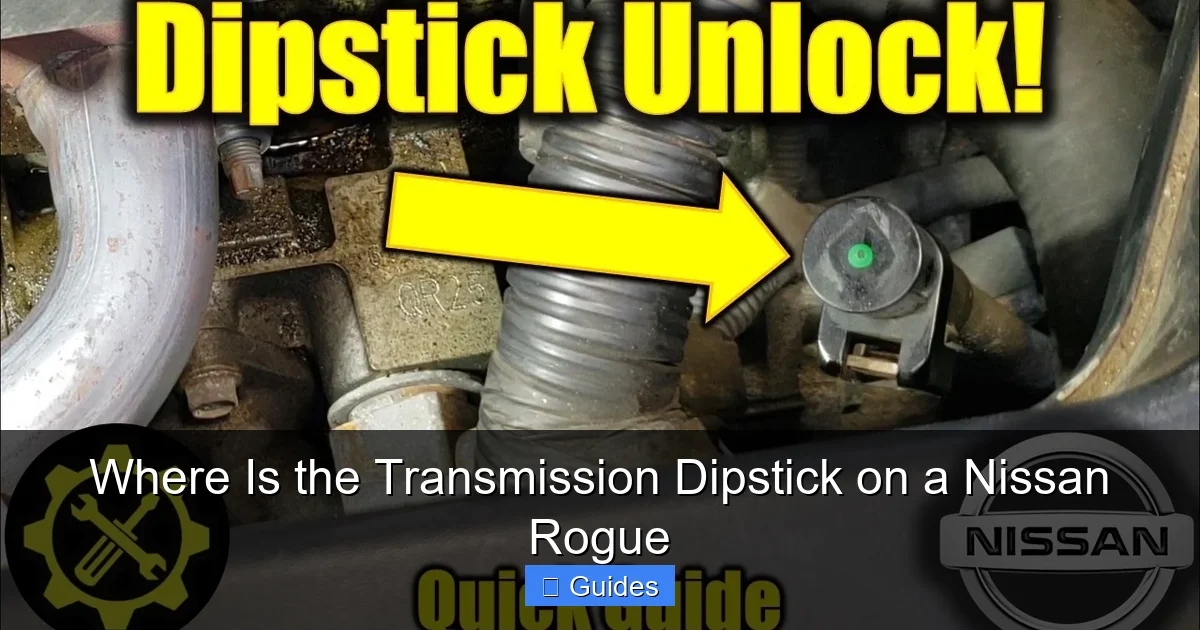
Many Nissan Rogue models don’t have a traditional transmission dipstick. Instead, they use a sealed Continuously Variable Transmission (CVT) that requires special tools and procedures to check fluid levels. This guide walks you through what to look for, how to safely inspect your CVT fluid, and when to visit a professional.
If you’ve popped the hood of your Nissan Rogue looking for the transmission dipstick—only to come up empty-handed—you’re not alone. Many owners are surprised to learn that their vehicle doesn’t have one at all. Unlike older cars with easily accessible dipsticks near the engine block, modern Nissan Rogues (especially those made after 2008) often feature a sealed Continuously Variable Transmission (CVT) system that doesn’t include a traditional dipstick. This design shift was made to reduce maintenance errors, improve reliability, and streamline under-hood packaging. But it also means that checking your transmission fluid isn’t as simple as pulling a yellow handle and wiping it clean.
So where *is* the transmission dipstick on a Nissan Rogue? The short answer: it might not exist. But that doesn’t mean you’re out of luck when it comes to monitoring your transmission health. Understanding how your Rogue’s CVT works—and how to properly maintain it—is essential for keeping your SUV running smoothly for years to come. In this guide, we’ll walk you through everything you need to know: from identifying whether your model has a dipstick, to recognizing signs of low fluid, to knowing when it’s time to visit a professional. Whether you’re a DIY enthusiast or just want to stay informed, this article will demystify the often-confusing world of Nissan Rogue transmission maintenance.
In This Article
- 1 Key Takeaways
- 2 📑 Table of Contents
- 3 Why Most Nissan Rogues Don’t Have a Transmission Dipstick
- 4 How to Check Transmission Fluid Without a Dipstick
- 5 Signs Your Transmission Fluid Needs Attention
- 6 Maintaining Your Nissan Rogue’s Transmission
- 7 Conclusion
- 8 Frequently Asked Questions
- 8.1 Does every Nissan Rogue have a transmission dipstick?
- 8.2 How can I check my CVT fluid without a dipstick?
- 8.3 What happens if my CVT fluid is low?
- 8.4 Can I add transmission fluid myself?
- 8.5 How often should I change the CVT fluid in my Nissan Rogue?
- 8.6 Is it safe to drive with a transmission warning light on?
Key Takeaways
- Most Nissan Rogues lack a standard transmission dipstick: Since 2008, Nissan has largely eliminated the traditional dipstick on Rogue models equipped with CVTs, favoring sealed systems.
- CVT fluid checks require specific tools: Accessing and checking the fluid level typically requires a scan tool, lift, and Nissan-approved procedures—not a simple dip-and-read method.
- Check your owner’s manual first: Always consult your vehicle’s manual to confirm whether your specific model year and trim have a dipstick or sealed system.
- Low or degraded CVT fluid causes serious issues: Symptoms like jerking, slipping, delayed acceleration, or warning lights often indicate low or contaminated fluid.
- DIY checks are limited but possible: Some older or base-model Rogues may have a fill plug you can inspect—but only when the engine is warm and the car is level.
- Professional service is recommended: For accurate fluid level checks and changes, especially on post-2010 models, trust certified technicians with OEM equipment.
- Regular maintenance prevents costly repairs: Even without a dipstick, scheduled CVT fluid changes (every 60,000–100,000 miles) are critical for longevity.
📑 Table of Contents
Why Most Nissan Rogues Don’t Have a Transmission Dipstick
To understand why your Nissan Rogue might be missing a transmission dipstick, it helps to know a bit about how modern transmissions work—and why Nissan made the switch. Starting around 2008, Nissan began phasing out traditional automatic transmissions in favor of Continuously Variable Transmissions (CVTs) across many of its models, including the Rogue. CVTs offer smoother acceleration, better fuel economy, and fewer gear shifts compared to conventional automatics. But they also operate under higher pressures and temperatures, requiring more precise fluid management.
Because of these demands, Nissan designed the CVT system in the Rogue as a “sealed for life” unit. This means the transmission is filled with specialized fluid at the factory and isn’t meant to be opened or checked by the average owner. There’s no dipstick because the fluid level isn’t meant to be monitored manually—instead, it’s controlled by internal valves and sensors that maintain optimal levels during operation. The idea is to reduce the risk of overfilling, underfilling, or using the wrong type of fluid, all of which can cause catastrophic damage to a CVT.
This design philosophy aligns with broader industry trends. Many automakers—including Honda, Toyota, and Hyundai—have moved toward sealed transmissions in recent years. While this reduces the chance of user error, it also shifts responsibility for maintenance to dealerships and certified repair shops equipped with the right tools. For Rogue owners, this means you can’t just pop the hood and check the fluid like you would with an older car. But that doesn’t mean you’re helpless. With the right knowledge and precautions, you can still stay on top of your transmission’s health—even without a dipstick.
The Role of the CVT in Modern Nissan Rogues
The Continuously Variable Transmission is the heart of your Nissan Rogue’s drivetrain. Unlike traditional automatics that use fixed gear ratios, a CVT uses a system of pulleys and a steel belt (or chain) to provide an infinite range of gear ratios. This allows the engine to operate at its most efficient RPM for any given speed, improving both performance and fuel economy. In city driving, you’ll notice smoother acceleration without the “shift shock” common in older automatics. On the highway, the CVT keeps the engine humming at lower revs, reducing noise and wear.
But this efficiency comes with a trade-off: CVTs are more sensitive to fluid condition than conventional transmissions. The fluid in a CVT doesn’t just lubricate—it also transmits power, controls clutch engagement, and regulates temperature. If the fluid breaks down, becomes contaminated, or drops below the correct level, the transmission can start to slip, jerk, or even fail entirely. That’s why Nissan uses a highly specialized fluid (typically Nissan NS-2 or NS-3, depending on the model year) that’s formulated to handle the unique stresses of a CVT.
Because the fluid is so critical—and because improper handling can ruin the transmission—Nissan made the decision to seal the system. This prevents owners from accidentally adding the wrong fluid, overfilling, or introducing air into the system. While this approach protects the transmission, it also means that routine checks require specialized equipment. Dealerships use scan tools to read transmission temperature and fluid level data directly from the vehicle’s computer, ensuring accuracy without opening the system.
Exceptions: When Your Rogue Might Have a Dipstick
While most Nissan Rogues don’t have a transmission dipstick, there are a few exceptions—especially in earlier model years or specific trims. For example, some 2008–2010 base-model Rogues with the 2.5L 4-cylinder engine and a conventional automatic transmission (not a CVT) may still feature a dipstick. These older automatics are less common, but they do exist, particularly in base S trims or fleet vehicles.
If you own a 2008–2010 Rogue and aren’t sure whether you have a CVT or a traditional automatic, here’s a quick way to check: Look under the hood. If you see a long, metal rod with a yellow or red handle near the engine block (usually on the passenger side), you likely have a dipstick. It may be labeled “ATF” (Automatic Transmission Fluid). However, even if you find one, be cautious—many owners mistakenly assume all Rogues have dipsticks, only to damage their CVT by checking it incorrectly.
Another clue is your owner’s manual. If it mentions a transmission dipstick or includes instructions for checking fluid levels, your vehicle likely has one. But if the manual says the transmission is “sealed” or recommends visiting a dealer for fluid checks, you’re dealing with a CVT. Always double-check your model year, engine type, and transmission code (found on the driver’s side door jamb) before attempting any DIY maintenance.
How to Check Transmission Fluid Without a Dipstick
Visual guide about Where Is the Transmission Dipstick on a Nissan Rogue
Image source: i.ytimg.com
So what do you do if your Nissan Rogue doesn’t have a dipstick? The good news is that you’re not completely out of options. While you can’t perform a traditional dip-and-read check, there are still ways to monitor your transmission fluid—especially if you’re willing to get your hands a little dirty or visit a professional.
The most reliable method involves using the transmission’s fill plug. On many CVT-equipped Rogues, there’s a fill plug located on the side of the transmission housing. This plug is used during manufacturing and servicing to add fluid and check levels. When the transmission is at the correct operating temperature and the vehicle is on level ground, the fluid should just reach the bottom of the fill hole. If it’s below that point, you’re low. If it’s spilling out, you’re overfilled.
To check using the fill plug, you’ll need to warm up the engine by driving for at least 10–15 minutes. Then, park on a flat surface, turn off the engine, and locate the fill plug (usually a 10mm or 12mm bolt on the side of the transmission). Remove it carefully—fluid may drip out if the level is correct. If no fluid comes out, you’re likely low. But be warned: this method requires precision. Overfilling can cause foaming, overheating, and transmission damage. And if you’re not comfortable working under the car, it’s best to leave this to a professional.
Another option is to use an OBD2 scanner with transmission monitoring capabilities. Some advanced scanners can read live data from your Rogue’s transmission control module, including fluid temperature and estimated level. While this won’t give you a precise measurement, it can alert you to potential issues—like overheating or low fluid—before they become serious. These tools are affordable (starting around $50) and widely available online.
Step-by-Step: Checking Fluid via the Fill Plug
If you decide to check your transmission fluid using the fill plug, follow these steps carefully:
1. **Warm up the engine**: Drive your Rogue for at least 15 minutes to bring the transmission fluid to operating temperature (around 175–200°F). Cold fluid gives inaccurate readings.
2. **Park on level ground**: Use a garage floor or driveway that’s perfectly flat. Even a slight incline can throw off the reading.
3. **Turn off the engine**: Let it sit for 1–2 minutes to allow fluid to settle.
4. **Locate the fill plug**: On most Rogues, it’s a bolt on the side of the transmission, near the front axle. It’s usually marked or easy to identify by its size (10mm or 12mm).
5. **Remove the plug**: Use a wrench or socket. Be ready for fluid to drip—this is normal if the level is correct.
6. **Check the level**: If fluid trickles out, the level is good. If nothing comes out, you’re low. If it pours out forcefully, you may be overfilled.
7. **Reinstall the plug**: Tighten it to the manufacturer’s torque specification (usually 15–20 ft-lbs). Don’t overtighten.
Remember: This method only works if your Rogue has a fill plug. Some models may have a sealed design with no access point at all. And always use the correct Nissan-approved CVT fluid if you need to top off.
When to Use a Professional
While DIY checks are possible, they come with risks. If you’re unsure about the procedure, don’t have the right tools, or simply prefer peace of mind, it’s always best to visit a Nissan dealership or certified mechanic. These professionals have the equipment to perform a proper fluid level check using Nissan’s proprietary scan tools. They can also inspect for leaks, contamination, or wear that you might miss.
Additionally, if your Rogue is still under warranty, DIY fluid checks could void coverage if done incorrectly. Dealerships can document service records and ensure everything is done to factory standards. For most owners, especially those with newer models, professional service is the safest and most reliable option.
Signs Your Transmission Fluid Needs Attention

Visual guide about Where Is the Transmission Dipstick on a Nissan Rogue
Image source: thecarhow.com
Even without a dipstick, you can still tell when your transmission fluid might be low or degraded. Pay attention to how your Rogue drives—subtle changes in performance can be early warning signs.
One of the most common symptoms is **jerking or hesitation during acceleration**. If your SUV feels like it’s “slipping” when you press the gas—especially from a stop—it could mean the CVT isn’t getting enough fluid pressure. You might also notice **delayed engagement** when shifting from Park to Drive or Reverse. The transmission may take a second or two to respond, which is unusual for a well-maintained CVT.
Another red flag is **unusual noises**. A whining, grinding, or humming sound from under the vehicle—particularly when idling or accelerating—can indicate low fluid or internal wear. While some CVTs make a faint noise by design, anything loud or persistent should be checked immediately.
**Warning lights** on the dashboard are also a clear signal. If the Check Engine Light, Transmission Warning Light, or Slip Indicator comes on, don’t ignore it. These lights often point to fluid issues, sensor problems, or overheating. Use an OBD2 scanner to read the trouble codes, or visit a mechanic for diagnosis.
Finally, watch for **fluid leaks** under your vehicle. Transmission fluid is typically red or pink when fresh, but turns brown or black when old. If you see puddles or stains on your driveway, especially near the front of the car, have it inspected right away. Leaks can quickly lead to low fluid levels and serious damage.
What to Do If You Notice Symptoms
If you experience any of these signs, take action quickly. Start by checking for obvious leaks and ensuring your vehicle hasn’t been driven excessively hard or overheated. If the problem persists, avoid driving long distances—continued operation with low or degraded fluid can destroy the transmission.
Next, consult your owner’s manual for recommended service intervals. Most Nissan Rogues require a CVT fluid change every 60,000 to 100,000 miles, depending on driving conditions. If you’re near or past that mileage, a fluid change might resolve the issue.
Finally, schedule an appointment with a trusted mechanic or Nissan dealer. They can perform a full inspection, check fluid condition, and reset any warning codes. Early intervention can save you thousands in repair costs.
Maintaining Your Nissan Rogue’s Transmission

Visual guide about Where Is the Transmission Dipstick on a Nissan Rogue
Image source: images.simplepart.com
Proper maintenance is the key to a long-lasting transmission—even without a dipstick. While you can’t check the fluid yourself on most models, you can still take steps to protect your CVT.
First, **follow the recommended service schedule**. Your owner’s manual will specify when to change the CVT fluid. For most Rogues, this is every 60,000 miles under normal driving, or every 30,000–40,000 miles if you frequently tow, drive in stop-and-go traffic, or live in extreme temperatures. Skipping this service is one of the leading causes of CVT failure.
Second, **use only Nissan-approved fluid**. Never substitute generic ATF or other transmission fluids. CVTs require specific additives and viscosity ratings that generic fluids don’t provide. Using the wrong fluid can cause slipping, overheating, and premature wear.
Third, **avoid aggressive driving**. Hard acceleration, rapid braking, and towing beyond your Rogue’s capacity put extra stress on the transmission. Drive smoothly, allow extra stopping distance, and use cruise control on the highway to reduce strain.
Finally, **keep an eye on fluid temperature**. If your Rogue has a transmission temperature gauge (some higher trims do), monitor it during long drives or hot weather. Overheating is a major cause of CVT failure. If the temperature rises above normal, pull over and let the engine idle to cool down.
The Cost of Neglect
Ignoring transmission maintenance can lead to expensive repairs. A full CVT replacement can cost $4,000–$8,000, depending on the model and labor rates. Even a fluid change at a dealership typically runs $200–$400. But by staying proactive—scheduling regular service, using the right fluid, and addressing symptoms early—you can avoid these costs and keep your Rogue running smoothly for over 200,000 miles.
Conclusion
So, where is the transmission dipstick on a Nissan Rogue? In most cases, it simply doesn’t exist. Modern Rogues use sealed CVTs that require specialized tools and procedures for fluid checks. While this design eliminates the convenience of a dipstick, it also reduces the risk of user error and helps protect the transmission from damage.
That said, you’re not powerless. By understanding your vehicle’s design, recognizing warning signs, and following a regular maintenance schedule, you can keep your Rogue’s transmission in top condition. Whether you choose to check the fill plug yourself or rely on a professional, the key is staying informed and proactive.
Remember: your transmission is one of the most critical—and expensive—components in your vehicle. Treat it with care, and it will reward you with smooth, reliable performance for years to come. When in doubt, consult your owner’s manual or visit a certified technician. Your Rogue—and your wallet—will thank you.
Frequently Asked Questions
Does every Nissan Rogue have a transmission dipstick?
No, most Nissan Rogues made after 2008 do not have a traditional transmission dipstick. These models use a sealed CVT system that requires professional tools to check fluid levels.
How can I check my CVT fluid without a dipstick?
You can check the fluid using the fill plug on the side of the transmission, but only when the engine is warm and the car is level. Alternatively, use an OBD2 scanner or visit a mechanic for a professional inspection.
What happens if my CVT fluid is low?
Low CVT fluid can cause slipping, jerking, delayed acceleration, overheating, and eventually transmission failure. It’s important to address low fluid immediately to avoid costly repairs.
Can I add transmission fluid myself?
Only if your model has a fill plug and you use the correct Nissan-approved CVT fluid. Overfilling or using the wrong fluid can damage the transmission. When in doubt, consult a professional.
How often should I change the CVT fluid in my Nissan Rogue?
Most Nissan Rogues require a CVT fluid change every 60,000 to 100,000 miles, depending on driving conditions. Check your owner’s manual for the exact interval.
Is it safe to drive with a transmission warning light on?
No, driving with a transmission warning light can cause serious damage. Have your vehicle inspected immediately to diagnose the issue and prevent further problems.

At CarLegit, we believe information should be clear, factual, and genuinely helpful. That’s why every guide, review, and update on our website is created with care, research, and a strong focus on user experience.