
Choosing between the Honda CR-V and Subaru Outback depends on your lifestyle and priorities. The CR-V shines with better fuel efficiency, a refined ride, and top-tier reliability, while the Outback offers standard all-wheel drive, more ground clearance, and rugged capability for off-road adventures.
In This Article
- 1 Key Takeaways
- 2 📑 Table of Contents
- 3 Introduction: Two Titans of the Midsize SUV Segment
- 4 Performance and Powertrain Comparison
- 5 Fuel Economy: Saving at the Pump
- 6 Interior Space and Cargo Capacity
- 7 Safety Features and Ratings
- 8 Technology and Infotainment
- 9 Driving Experience and Ride Quality
- 10 Reliability and Long-Term Value
- 11 Conclusion: Which Is Better for You?
- 12 Frequently Asked Questions
- 12.1 Which SUV has better fuel economy, the Honda CR-V or Subaru Outback?
- 12.2 Does the Subaru Outback come with all-wheel drive standard?
- 12.3 Which vehicle offers more cargo space?
- 12.4 Can the Honda CR-V or Subaru Outback tow a trailer?
- 12.5 Which SUV has better safety ratings?
- 12.6 Is the Honda CR-V or Subaru Outback more reliable?
Key Takeaways
- Fuel Efficiency: The Honda CR-V delivers better gas mileage, especially in city driving, making it ideal for commuters.
- Standard AWD: The Subaru Outback comes with all-wheel drive standard, giving it an edge in snow, rain, and light off-road conditions.
- Cargo Space: The Outback offers more cargo room behind the rear seats, perfect for road trips or outdoor gear.
- Ride Comfort: The CR-V provides a smoother, quieter cabin and more car-like handling for daily driving.
- Safety Ratings: Both vehicles earn top safety scores, but the Outback has a slight edge in real-world crash protection.
- Towing Capacity: The Outback can tow up to 2,700 pounds, while the CR-V maxes out at 1,500 pounds—important if you plan to haul trailers or boats.
- Technology & Infotainment: The CR-V has a more intuitive touchscreen and better smartphone integration, while the Outback offers larger screens in higher trims.
📑 Table of Contents
- Introduction: Two Titans of the Midsize SUV Segment
- Performance and Powertrain Comparison
- Fuel Economy: Saving at the Pump
- Interior Space and Cargo Capacity
- Safety Features and Ratings
- Technology and Infotainment
- Driving Experience and Ride Quality
- Reliability and Long-Term Value
- Conclusion: Which Is Better for You?
Introduction: Two Titans of the Midsize SUV Segment
When it comes to reliable, practical, and family-friendly SUVs, few models stand out like the Honda CR-V and the Subaru Outback. Both have earned loyal followings over the years, thanks to their strong safety records, dependable performance, and versatile interiors. But if you’re shopping for a new vehicle and narrowing your choices down to these two, you’re likely wondering: Which is better—Honda CR-V or Subaru Outback?
This isn’t just a question of brand loyalty. It’s about matching your vehicle to your lifestyle. Are you a city commuter who values fuel economy and a smooth ride? Or are you an outdoor enthusiast who needs all-weather capability and extra cargo space for weekend adventures? The answer could point you toward one SUV over the other. In this guide, we’ll break down every key factor—from performance and fuel efficiency to safety, technology, and long-term value—so you can make an informed decision that fits your needs.
Performance and Powertrain Comparison
Under the hood, the Honda CR-V and Subaru Outback take different approaches to power and efficiency. The CR-V comes standard with a 1.5-liter turbocharged four-cylinder engine that produces 190 horsepower and 179 lb-ft of torque. It’s paired with a continuously variable transmission (CVT) that prioritizes smoothness and fuel savings. While the engine isn’t the most thrilling, it’s responsive enough for daily driving, merging onto highways, and climbing hills with a full load of passengers.
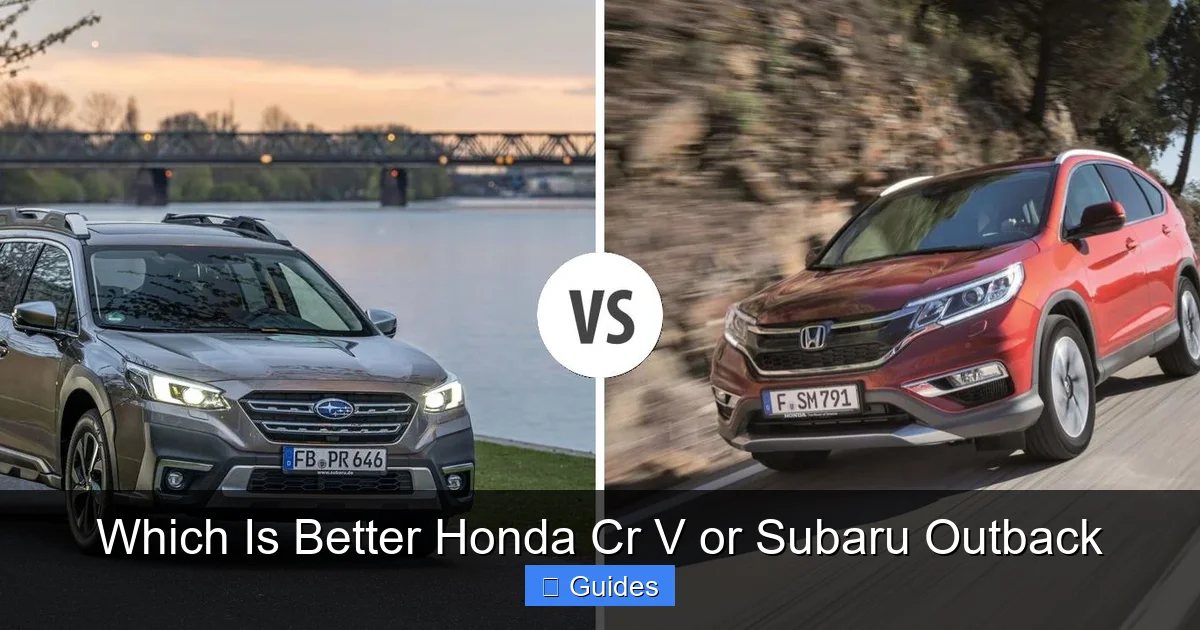
Visual guide about Which Is Better Honda Cr V or Subaru Outback
Image source: autogott.de
Honda CR-V: Efficiency Meets Refinement
The CR-V’s powertrain is tuned for comfort and economy. Honda’s engineering focuses on minimizing engine noise and vibration, resulting in a cabin that feels quiet and composed, even at highway speeds. The CVT mimics traditional gear shifts to reduce the “rubber band” effect some drivers dislike, and the overall driving experience is relaxed and predictable. For most buyers, this is a major plus—especially if you spend a lot of time in stop-and-go traffic.
Subaru Outback: Rugged Capability with Standard AWD
The Subaru Outback, on the other hand, offers two engine options. The base model comes with a 2.5-liter naturally aspirated four-cylinder engine producing 182 horsepower and 176 lb-ft of torque. While it’s slightly less powerful than the CR-V’s turbo engine, it feels more linear in its power delivery. The real standout is that all Outbacks come with standard all-wheel drive (AWD)—a feature that’s optional on the CR-V. This gives the Outback a significant advantage in snowy, rainy, or unpaved conditions.
For those who want more power, the Outback also offers a 2.4-liter turbocharged engine with 260 horsepower and 277 lb-ft of torque. This upgrade transforms the Outback into a more capable hauler, especially when towing or driving on steep mountain roads. The turbo model can tow up to 2,700 pounds, nearly double the CR-V’s 1,500-pound limit. If you plan to tow a small trailer, camper, or boat, the Outback is the clear winner.
Fuel Economy: Saving at the Pump
Fuel efficiency is a major consideration for many SUV buyers, especially with fluctuating gas prices. The Honda CR-V consistently outperforms the Subaru Outback in this category. According to the EPA, the front-wheel-drive (FWD) CR-V achieves up to 28 mpg in the city and 34 mpg on the highway, with a combined rating of 30 mpg. Even with AWD, the CR-V still manages 27 mpg city and 32 mpg highway—impressive for a vehicle of its size.

Visual guide about Which Is Better Honda Cr V or Subaru Outback
Image source: blog.qualitysubaru.com
CR-V: The Fuel-Sipping Champion
The CR-V’s turbocharged engine and lightweight design contribute to its excellent fuel economy. It’s one of the most efficient non-hybrid SUVs in its class. For commuters driving 30–50 miles daily, this can translate to real savings over time. For example, driving 15,000 miles per year at $3.50 per gallon, the CR-V would cost about $1,750 annually in fuel, compared to around $2,100 for the Outback.
Outback: Slightly Lower MPG, But Worth It for Some
The Subaru Outback’s standard AWD system adds weight and mechanical drag, which reduces fuel efficiency. The 2.5-liter engine gets an EPA-estimated 26 mpg city and 33 mpg highway, with a combined 29 mpg. The turbocharged model drops further to 23 mpg city and 30 mpg highway. While these numbers are still respectable, they’re not quite on par with the CR-V. However, for drivers in regions with harsh winters or frequent rain, the trade-off in fuel economy may be worth the added traction and control.
Interior Space and Cargo Capacity
Both the CR-V and Outback offer spacious interiors with room for five passengers, but they differ in layout and practicality. The CR-V excels in passenger comfort and ease of use, while the Outback provides more cargo space and a more rugged, utilitarian feel.

Visual guide about Which Is Better Honda Cr V or Subaru Outback
Image source: pictures.dealer.com
Passenger Comfort and Seating
The CR-V’s cabin is designed with a focus on comfort and simplicity. The front seats are supportive and adjustable, with ample legroom and headroom for taller drivers. Rear passengers also enjoy generous legroom—nearly 40 inches—making long trips more comfortable. The seats are upholstered in high-quality materials, and even base models feel upscale.
The Outback’s interior is equally roomy, but with a more truck-like seating position. The higher ride height gives drivers a commanding view of the road, which some prefer. However, the rear seats are slightly less plush than the CR-V’s, and the overall cabin feels more functional than luxurious. That said, the Outback’s standard AWD doesn’t eat into interior space, so there’s no compromise in passenger room.
Cargo Space: Outback Takes the Lead
When it comes to hauling gear, the Outback has a clear advantage. With the rear seats up, the Outback offers 32.5 cubic feet of cargo space, compared to the CR-V’s 30.8 cubic feet. Fold down the rear seats, and the difference becomes more pronounced: the Outback expands to 75.7 cubic feet, while the CR-V reaches 75.8 cubic feet—essentially a tie. However, the Outback’s wider cargo opening and flat load floor make it easier to load bulky items like bikes, coolers, or camping gear.
For families who frequently travel with sports equipment, strollers, or luggage, the extra space can make a big difference. The Outback also includes useful features like under-floor storage compartments and tie-down hooks, adding to its practicality.
Safety Features and Ratings
Safety is a top priority for both Honda and Subaru, and both the CR-V and Outback consistently earn top marks from the National Highway Traffic Safety Administration (NHTSA) and the Insurance Institute for Highway Safety (IIHS).
Honda Sensing vs. Subaru EyeSight
The CR-V comes standard with Honda Sensing, a suite of advanced driver-assistance features including adaptive cruise control, lane-keeping assist, forward collision warning, and automatic emergency braking. These systems are well-calibrated and reliable, helping drivers avoid accidents in real-world conditions.
The Outback includes Subaru’s EyeSight system as standard on most trims. EyeSight offers similar features—adaptive cruise control, lane departure warning, pre-collision braking—and is known for its accuracy and responsiveness. In independent tests, EyeSight has been praised for its ability to detect pedestrians and cyclists at night, giving it a slight edge in low-visibility scenarios.
Crash Test Performance
Both vehicles have earned five-star overall safety ratings from the NHTSA. In IIHS testing, the Outback has consistently received “Top Safety Pick+” honors, the highest award available, thanks to strong performance in crash tests and superior headlight ratings. The CR-V also earns high marks, but has occasionally fallen short in headlight evaluations, especially on lower trims.
For families with young children, both SUVs offer LATCH anchors for car seats and available rear-seat reminder systems. The Outback’s higher ride height can make it slightly easier to install car seats, but the CR-V’s lower floor and wider doors also provide good access.
Technology and Infotainment
Modern drivers expect seamless connectivity, intuitive controls, and responsive touchscreens. Here, the CR-V and Outback take different approaches.
Honda CR-V: User-Friendly and Reliable
The CR-V features a 7-inch touchscreen on most trims, with a physical volume knob and shortcut buttons for easy use while driving. Apple CarPlay and Android Auto are standard, and the system responds quickly to inputs. Higher trims add wireless smartphone integration, a premium audio system, and a head-up display. The interface is clean and easy to navigate, even for tech newcomers.
Subaru Outback: Bigger Screens, Slower Response
The Outback comes with an 8-inch touchscreen on most models, and the top Limited and Touring trims get a massive 11.6-inch vertical display. While the screen is large and visually impressive, some users report that the system can be slow to respond and overly complex. Subaru’s interface requires more taps to access common functions, which can be distracting.
That said, the Outback includes standard features like wireless Apple CarPlay and Android Auto (on newer models), a built-in Wi-Fi hotspot, and available navigation. The larger screen is great for maps and media, but the learning curve may frustrate some drivers.
Driving Experience and Ride Quality
How a vehicle feels on the road can make or break your daily commute. The CR-V and Outback offer distinct driving experiences tailored to different preferences.
CR-V: Smooth, Quiet, and Car-Like
The CR-V rides on a well-tuned suspension that absorbs bumps and potholes with ease. Road and wind noise are minimal, creating a serene cabin environment. Steering is light and precise, making it easy to maneuver in tight parking lots or city streets. It feels more like a tall hatchback than a rugged SUV—perfect for urban and suburban drivers.
Outback: Confident and Capable
The Outback has a stiffer suspension and higher ground clearance (8.7 inches vs. the CR-V’s 7.8 inches), giving it better off-road capability. It handles rough roads and gravel paths with confidence, and the standard AWD system provides excellent grip in slippery conditions. However, the ride can feel slightly busier on smooth pavement, and the steering is heavier, which some may find less engaging.
For weekend warriors who enjoy camping, hiking, or driving on unpaved roads, the Outback’s ruggedness is a major advantage. But if you spend most of your time on highways and city streets, the CR-V’s smoother ride may be more appealing.
Reliability and Long-Term Value
Both Honda and Subaru are known for building durable, long-lasting vehicles. According to J.D. Power and Consumer Reports, both the CR-V and Outback rank highly in reliability and owner satisfaction.
Honda CR-V: A Proven Performer
The CR-V has a reputation for longevity, with many owners reporting 200,000+ miles with minimal issues. Honda’s 1.5-liter turbo engine has been refined over several generations, and the CVT has become more reliable with updates. Maintenance costs are low, and resale value remains strong.
Subaru Outback: Built to Last
The Outback is equally dependable, with a track record of surviving harsh climates and rough use. Subaru’s boxer engines are known for their durability, and the AWD system is engineered to last. However, some older models had issues with head gaskets and CVTs, though recent years have seen significant improvements. The Outback also holds its value well, especially in regions where AWD is essential.
Conclusion: Which Is Better for You?
So, which is better—Honda CR-V or Subaru Outback? The answer depends on your priorities.
If you value fuel efficiency, a quiet cabin, and a smooth ride for daily commuting, the Honda CR-V is the smarter choice. It’s more refined, easier to drive in the city, and costs less to operate over time. It’s ideal for urban families, commuters, and anyone who wants a reliable, no-fuss SUV.
On the other hand, if you live in a snowy or rainy climate, enjoy outdoor adventures, or need extra cargo space and towing capacity, the Subaru Outback is the better fit. Its standard AWD, higher ground clearance, and rugged design make it a true all-weather companion. It’s perfect for road trips, camping, and anyone who values capability over fuel economy.
Ultimately, both vehicles are excellent choices. Test drive both, consider your lifestyle, and choose the one that feels right for you. Whether you pick the CR-V or the Outback, you’re getting a safe, reliable, and well-built SUV that will serve you well for years to come.
Frequently Asked Questions
Which SUV has better fuel economy, the Honda CR-V or Subaru Outback?
The Honda CR-V has better fuel economy, especially in city driving. It achieves up to 28 mpg city and 34 mpg highway, while the Outback gets 26 mpg city and 33 mpg highway with its standard 2.5-liter engine.
Does the Subaru Outback come with all-wheel drive standard?
Yes, all Subaru Outback models come with standard all-wheel drive, which gives it an advantage in snow, rain, and off-road conditions compared to the CR-V, where AWD is optional.
Which vehicle offers more cargo space?
The Subaru Outback offers slightly more cargo space behind the rear seats (32.5 cubic feet vs. 30.8 in the CR-V), making it better for hauling gear, luggage, or outdoor equipment.
Can the Honda CR-V or Subaru Outback tow a trailer?
The Subaru Outback can tow up to 2,700 pounds with the turbocharged engine, while the Honda CR-V maxes out at 1,500 pounds. The Outback is better suited for towing small trailers or boats.
Which SUV has better safety ratings?
Both vehicles have top safety ratings, but the Subaru Outback has earned the IIHS “Top Safety Pick+” award more consistently, thanks to superior headlight performance and strong crash test results.
Is the Honda CR-V or Subaru Outback more reliable?
Both are highly reliable, but the Honda CR-V has a slight edge in long-term dependability and lower maintenance costs, according to industry reports and owner surveys.

At CarLegit, we believe information should be clear, factual, and genuinely helpful. That’s why every guide, review, and update on our website is created with care, research, and a strong focus on user experience.