
Choosing between the Nissan Rogue and Mitsubishi Outlander 2? The Rogue offers better fuel efficiency, a smoother ride, and more advanced tech, while the Outlander 2 provides a lower starting price and standard third-row seating. Your choice depends on priorities—comfort and efficiency or affordability and space.
In This Article
- 1 Key Takeaways
- 2 📑 Table of Contents
- 3 Introduction: Picking the Right Compact SUV
- 4 Performance and Fuel Efficiency: Efficiency vs. Practicality
- 5 Interior Space and Comfort: Room to Grow
- 6 Technology and Infotainment: Staying Connected
- 7 Safety Ratings and Reliability: Peace of Mind
- 8 Pricing and Value: What You Get for Your Money
- 9 Conclusion: Which One Should You Choose?
- 10 Frequently Asked Questions
- 10.1 Does the Mitsubishi Outlander 2 have a third row?
- 10.2 Which SUV has better fuel economy, the Rogue or Outlander 2?
- 10.3 Is the Nissan Rogue more reliable than the Mitsubishi Outlander 2?
- 10.4 Can you get wireless Apple CarPlay in the Mitsubishi Outlander 2?
- 10.5 Which SUV has more cargo space?
- 10.6 Are safety features standard on both SUVs?
Key Takeaways
- Fuel Efficiency: The Nissan Rogue leads with up to 35 mpg highway, making it the better choice for long commutes and road trips.
- <>Third-Row Seating: The Mitsubishi Outlander 2 includes a standard third row, offering seating for seven—ideal for larger families.
- Tech and Infotainment: The Rogue features a more intuitive 8-inch touchscreen with wireless Apple CarPlay, while the Outlander 2 uses a smaller, wired system.
- Ride Comfort: The Rogue delivers a quieter cabin and smoother suspension, especially on rough roads.
- Starting Price: The Outlander 2 starts around $27,000, about $2,000 less than the Rogue, offering better upfront value.
- Safety Ratings: Both earn top marks, but the Rogue includes more standard driver-assist features across all trims.
- Cargo Space: The Rogue offers more cargo room behind the second row, especially when the third row isn’t needed.
📑 Table of Contents
- Introduction: Picking the Right Compact SUV
- Performance and Fuel Efficiency: Efficiency vs. Practicality
- Interior Space and Comfort: Room to Grow
- Technology and Infotainment: Staying Connected
- Safety Ratings and Reliability: Peace of Mind
- Pricing and Value: What You Get for Your Money
- Conclusion: Which One Should You Choose?
Introduction: Picking the Right Compact SUV
So, you’re in the market for a reliable, family-friendly compact SUV. You’ve narrowed it down to two solid options: the Nissan Rogue and the Mitsubishi Outlander 2. Both are popular choices, packed with features and built for everyday driving. But which one truly fits your lifestyle?
It’s not just about looks or brand loyalty. You want a vehicle that balances comfort, efficiency, space, and value. Maybe you’re shuttling kids to soccer practice, planning weekend getaways, or just need something that won’t guzzle gas on your daily commute. The good news? Both the Rogue and Outlander 2 are strong contenders. But they cater to slightly different needs.
In this guide, we’ll break down everything you need to know—from performance and interior space to tech features and long-term reliability. By the end, you’ll have a clear picture of which SUV aligns best with your priorities. Whether you’re leaning toward the refined ride of the Rogue or the budget-friendly versatility of the Outlander 2, we’ve got you covered.
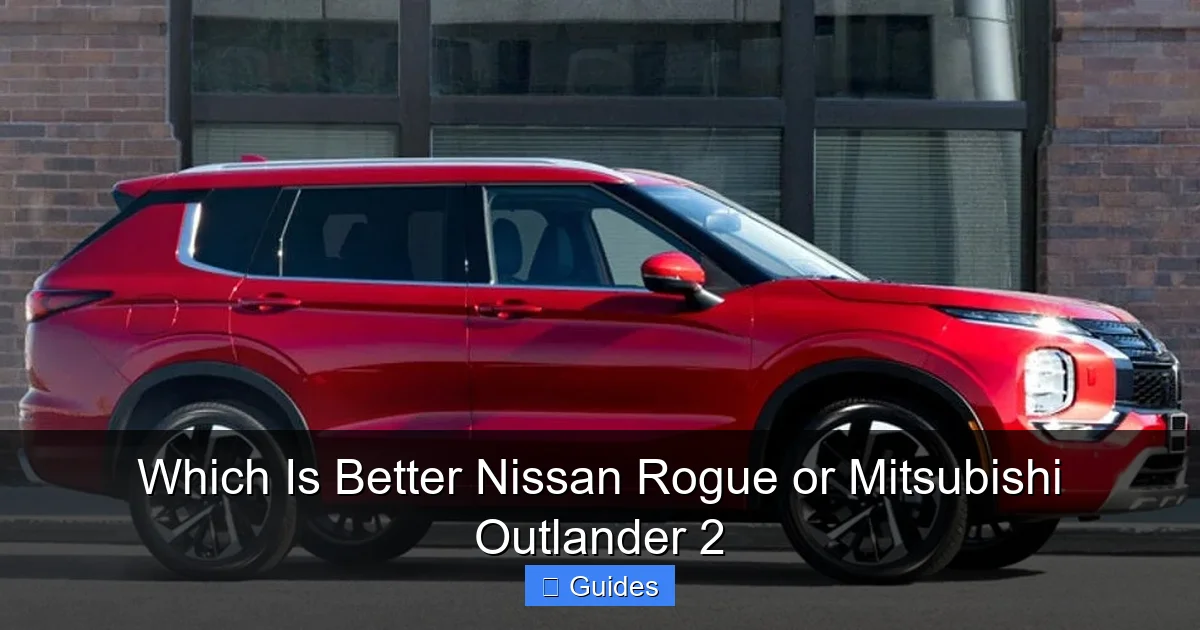
Performance and Fuel Efficiency: Efficiency vs. Practicality
Visual guide about Which Is Better Nissan Rogue or Mitsubishi Outlander 2
Image source: dealerinspire-image-library-prod.s3.us-east-1.amazonaws.com
When it comes to how these SUVs perform on the road, there are some clear differences. Let’s start with what’s under the hood.
Engine and Power Output
The 2024 Nissan Rogue comes with a 1.5-liter turbocharged three-cylinder engine. It delivers 201 horsepower and 225 lb-ft of torque. That might sound modest, but thanks to the turbocharger, it feels responsive in city driving and confident on highways. The engine is paired with a continuously variable transmission (CVT), which helps optimize power delivery and fuel economy.
In contrast, the 2024 Mitsubishi Outlander 2 uses a 2.5-liter four-cylinder engine. It produces 181 horsepower and 181 lb-ft of torque. While it has a larger displacement, it’s actually less powerful than the Rogue’s turbo engine. The Outlander 2 also uses a CVT, but some drivers report it feels less refined, especially during hard acceleration.
Fuel Economy Comparison
Here’s where the Rogue really shines. The Nissan Rogue achieves up to 27 mpg in the city and 35 mpg on the highway. That’s impressive for a non-hybrid SUV. If you drive a lot—say, 15,000 miles a year—you could save hundreds on fuel compared to less efficient models.
The Mitsubishi Outlander 2 gets 24 mpg city and 30 mpg highway. That’s decent, but not quite as strong. The difference might not seem huge, but over time, those extra miles per gallon add up. For example, driving 12,000 miles a year at $3.50 per gallon, the Rogue could save you over $150 annually in fuel costs.
Driving Dynamics and Handling
The Rogue offers a more polished driving experience. Its suspension is tuned for comfort, absorbing bumps and potholes with ease. Steering feels light and precise, making it easy to maneuver in tight parking lots or busy city streets. The cabin is also noticeably quieter, thanks to better sound insulation.
The Outlander 2 feels more utilitarian. It handles well enough for daily driving, but the ride can feel a bit stiff on rough roads. The steering is heavier, which some drivers like, but it lacks the finesse of the Rogue. If you prioritize a smooth, quiet ride, the Rogue has the edge.
All-Wheel Drive and Off-Road Capability
Both SUVs offer optional all-wheel drive (AWD), which is great for rain, snow, or light off-roading. The Rogue’s AWD system is more advanced, with multiple drive modes (including off-road settings) and better traction control. It’s not a true off-roader, but it handles gravel roads and muddy trails with confidence.
The Outlander 2’s AWD system is simpler but still effective. It automatically sends power to the wheels with the most grip. It’s fine for snowy winters or gravel driveways, but don’t expect serious trail capability. If you live in a region with harsh weather, both are solid choices—but the Rogue’s system is more refined.
Interior Space and Comfort: Room to Grow
Visual guide about Which Is Better Nissan Rogue or Mitsubishi Outlander 2
Image source: wallacemitsubishijohnsoncity.com
Now let’s talk about what matters most to families: space. How much room do you really get inside these SUVs?
Seating Capacity and Layout
This is where the Mitsubishi Outlander 2 stands out. It comes standard with three rows of seating, accommodating up to seven passengers. The third row is tight—best for kids or short trips—but it’s a rare feature in this class. If you often carpool or have a large family, this could be a game-changer.
The Nissan Rogue, on the other hand, is strictly a five-seater. There’s no third row option. That means less passenger flexibility, but it frees up more cargo space. If you don’t need seven seats, the Rogue’s second row is more spacious and comfortable for adults.
Legroom and Headroom
Let’s break it down by row.
In the Rogue, front-seat passengers enjoy 43.8 inches of legroom and 41.1 inches of headroom. The second row offers 38.5 inches of legroom and 39.5 inches of headroom. That’s generous for a compact SUV, especially for taller passengers.
The Outlander 2 has slightly less front legroom at 41.0 inches, but similar headroom at 40.6 inches. The second row has 37.9 inches of legroom and 39.7 inches of headroom. Again, decent, but not quite as roomy as the Rogue.
The third row in the Outlander 2? It’s tight. Legroom is just 28.3 inches—fine for kids under 10, but not suitable for adults on long drives.
Cargo Space and Storage
When it comes to hauling gear, the Rogue wins hands down—especially if you don’t need the third row.
With all seats up, the Rogue offers 36.5 cubic feet of cargo space. Fold down the second row, and you get 74.1 cubic feet. That’s enough for strollers, groceries, luggage, or even small furniture.
The Outlander 2 has 11.7 cubic feet behind the third row—usable, but not much. Fold the third row, and you get 33.0 cubic feet. Fold both rear rows, and it expands to 79.7 cubic feet. That’s actually more than the Rogue, but only if you remove the third row entirely.
So, if you need occasional seven-passenger capacity, the Outlander 2 is useful. But if you prioritize cargo space and don’t need a third row, the Rogue is the better choice.
Interior Materials and Build Quality
The Rogue feels more upscale inside. Higher trims feature soft-touch plastics, leather upholstery, and ambient lighting. The dashboard layout is clean and modern, with intuitive controls.
The Outlander 2’s interior is functional but less refined. Materials are mostly hard plastics, and the design feels a bit dated. That said, it’s well-organized and easy to clean—great for families with messy kids.
Technology and Infotainment: Staying Connected
Visual guide about Which Is Better Nissan Rogue or Mitsubishi Outlander 2
Image source: motorbiscuit.com
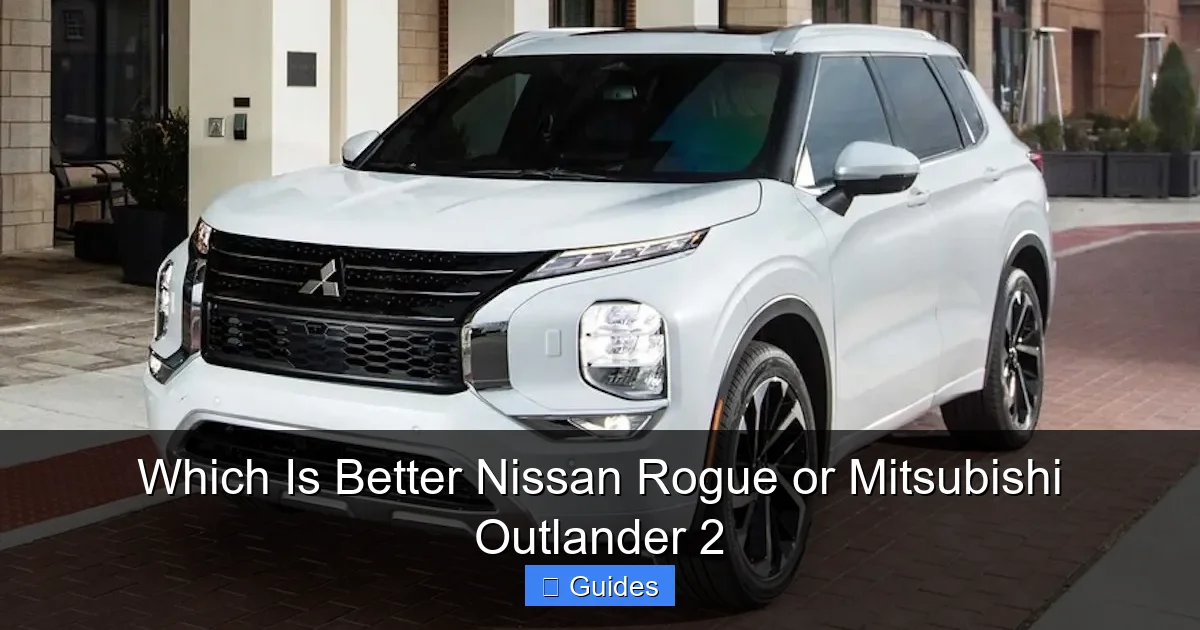
In today’s world, your SUV needs to keep you connected. Let’s see how these two stack up.
Infotainment System
The Nissan Rogue comes standard with an 8-inch touchscreen. Higher trims upgrade to a 9-inch display. It supports wireless Apple CarPlay and Android Auto—a big plus if you hate dealing with cables. The interface is responsive, and the graphics are sharp.
The Mitsubishi Outlander 2 uses a 7-inch touchscreen. It supports Apple CarPlay and Android Auto, but only via wired connection. That means you’ll need to plug in your phone every time. The system works, but it feels a step behind the Rogue in terms of convenience and modernity.
Audio and Connectivity
The Rogue offers a standard six-speaker audio system, with an optional Bose premium setup on higher trims. Bluetooth, USB ports, and Wi-Fi hotspot capability are standard.
The Outlander 2 has a six-speaker system as well, but no premium audio option. It includes Bluetooth and USB ports, but no built-in Wi-Fi. If you rely on streaming music or navigation, the Rogue’s wireless features are a real advantage.
Driver Assistance and Safety Tech
Both SUVs come with a strong suite of safety features, but the Rogue includes more as standard.
The Rogue’s Nissan Safety Shield 360 includes:
– Automatic emergency braking
– Blind-spot monitoring
– Rear cross-traffic alert
– Lane departure warning
– High beam assist
– Rear automatic braking
These features are standard on all Rogue trims.
The Outlander 2’s Mitsubishi Safety Sense includes:
– Forward collision mitigation
– Lane departure warning
– Automatic high beams
– Rear cross-traffic alert
But blind-spot monitoring and rear automatic braking are only available on higher trims. That means you’ll pay more to get the full safety package.
Digital Displays and Instrument Clusters
The Rogue offers a 7-inch digital instrument cluster on higher trims, displaying navigation, audio, and driver-assist info. It’s sleek and customizable.
The Outlander 2 uses a traditional analog cluster with a small digital screen. It’s functional but lacks the modern flair of the Rogue.
Safety Ratings and Reliability: Peace of Mind
Safety is non-negotiable. Let’s see how these SUVs perform in crash tests and long-term dependability.
NHTSA and IIHS Ratings
Both the Nissan Rogue and Mitsubishi Outlander 2 earn top marks from the National Highway Traffic Safety Administration (NHTSA), with 5-star overall safety ratings.
The Insurance Institute for Highway Safety (IIHS) gives the Rogue a “Top Safety Pick” award, praising its crashworthiness and front crash prevention systems.
The Outlander 2 also earns “Good” ratings in most IIHS categories, but it doesn’t qualify for the “Top Safety Pick” due to slightly lower scores in headlight performance and front crash prevention.
Reliability and Warranty
Reliability is where Mitsubishi has a reputation for durability. The Outlander 2 comes with a 10-year/100,000-mile powertrain warranty—one of the best in the industry. The basic warranty is 5 years/60,000 miles.
The Nissan Rogue offers a 5-year/60,000-mile basic warranty and a 5-year/60,000-mile powertrain warranty. That’s solid, but not as generous as Mitsubishi’s.
In long-term reliability surveys, the Rogue has shown strong performance, with few major issues reported. The Outlander 2 is also reliable, though some owners note minor electrical glitches over time.
Real-World Safety Performance
In real-world driving, both SUVs perform well. The Rogue’s advanced driver aids—like lane-keeping assist and adaptive cruise control—make highway driving less stressful. The Outlander 2’s systems are helpful but less refined.
If safety tech is a top priority, the Rogue’s standard features give it an edge.
Pricing and Value: What You Get for Your Money
Let’s talk dollars and cents. Which SUV gives you more bang for your buck?
Starting MSRP
The 2024 Mitsubishi Outlander 2 starts at around $27,000. That’s about $2,000 less than the base Nissan Rogue, which starts at $29,000.
But price isn’t everything. You need to consider what you get at each trim level.
Trim Levels and Features
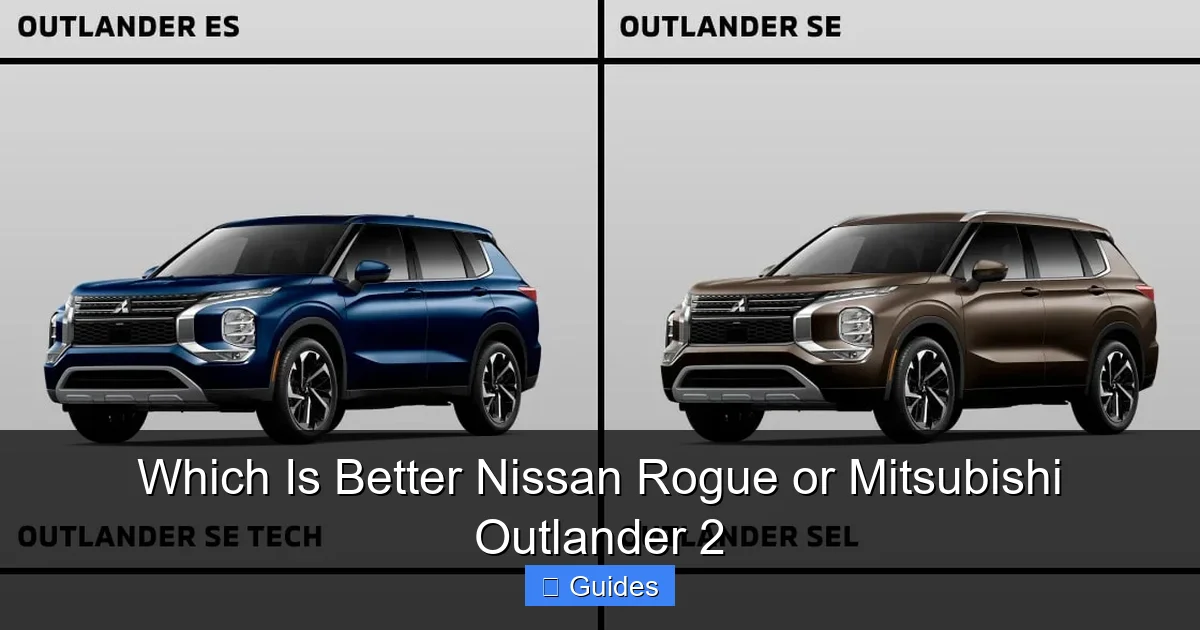
The Outlander 2 comes in three trims: ES, SE, and SEL. Even the base ES includes the third row, AWD option, and basic safety features. Step up to the SE, and you get blind-spot monitoring and a power driver’s seat.
The Rogue offers four trims: S, SV, SL, and Platinum. The base S trim includes wireless Apple CarPlay, automatic emergency braking, and an 8-inch screen. Higher trims add leather, heated seats, a panoramic sunroof, and premium audio.
Resale Value
The Nissan Rogue tends to hold its value better than the Outlander 2. According to Kelley Blue Book, the Rogue retains about 50% of its value after three years, compared to 45% for the Outlander 2.
That means if you plan to sell or trade in your SUV later, the Rogue could save you money in the long run.
Cost of Ownership
Over five years, the Rogue’s better fuel economy and lower maintenance costs (thanks to Nissan’s widespread service network) can save you hundreds. The Outlander 2 is cheaper upfront, but higher fuel and potential repair costs might narrow the gap.
Conclusion: Which One Should You Choose?
So, which is better: the Nissan Rogue or the Mitsubishi Outlander 2?
It depends on what you value most.
Choose the Nissan Rogue if you want:
– Better fuel efficiency
– A smoother, quieter ride
– More advanced tech and safety features
– A more upscale interior
– Stronger resale value
It’s the better all-around package for daily driving, long commutes, and families who prioritize comfort and technology.
Choose the Mitsubishi Outlander 2 if you:
– Need seven seats (even if just occasionally)
– Want a lower starting price
– Value a long powertrain warranty
– Don’t mind sacrificing some refinement for practicality
It’s a solid choice for budget-conscious buyers who need extra seating and don’t mind a less polished experience.
Ultimately, both are reliable, safe, and capable SUVs. But if you’re looking for the best balance of efficiency, comfort, and modern features, the Nissan Rogue edges out the competition. The Outlander 2 is a great value play—especially if you truly need that third row.
Take both for a test drive. See which one feels right. Because when it comes to choosing a vehicle, the best one is the one that fits your life.
Frequently Asked Questions
Does the Mitsubishi Outlander 2 have a third row?
Yes, the Mitsubishi Outlander 2 comes standard with a third row of seating, allowing it to accommodate up to seven passengers. However, the third row is best suited for children or short trips due to limited legroom.
Which SUV has better fuel economy, the Rogue or Outlander 2?
The Nissan Rogue has better fuel economy, achieving up to 35 mpg on the highway compared to the Outlander 2’s 30 mpg. This makes the Rogue a better choice for long commutes and frequent driving.
Is the Nissan Rogue more reliable than the Mitsubishi Outlander 2?
Both are reliable, but the Outlander 2 comes with a longer powertrain warranty (10 years/100,000 miles). The Rogue has stronger resale value and fewer reported issues over time, making it a close call.
Can you get wireless Apple CarPlay in the Mitsubishi Outlander 2?
No, the Mitsubishi Outlander 2 only supports wired Apple CarPlay and Android Auto. The Nissan Rogue offers wireless connectivity, which is more convenient for daily use.
Which SUV has more cargo space?
The Nissan Rogue offers more cargo space behind the second row (36.5 cubic feet) compared to the Outlander 2 (33.0 cubic feet with the third row folded). If you don’t need seven seats, the Rogue is better for hauling gear.
Are safety features standard on both SUVs?
Both include key safety features, but the Nissan Rogue offers more standard driver-assist technologies across all trims, including blind-spot monitoring and rear automatic braking, which are optional on the Outlander 2.

At CarLegit, we believe information should be clear, factual, and genuinely helpful. That’s why every guide, review, and update on our website is created with care, research, and a strong focus on user experience.