
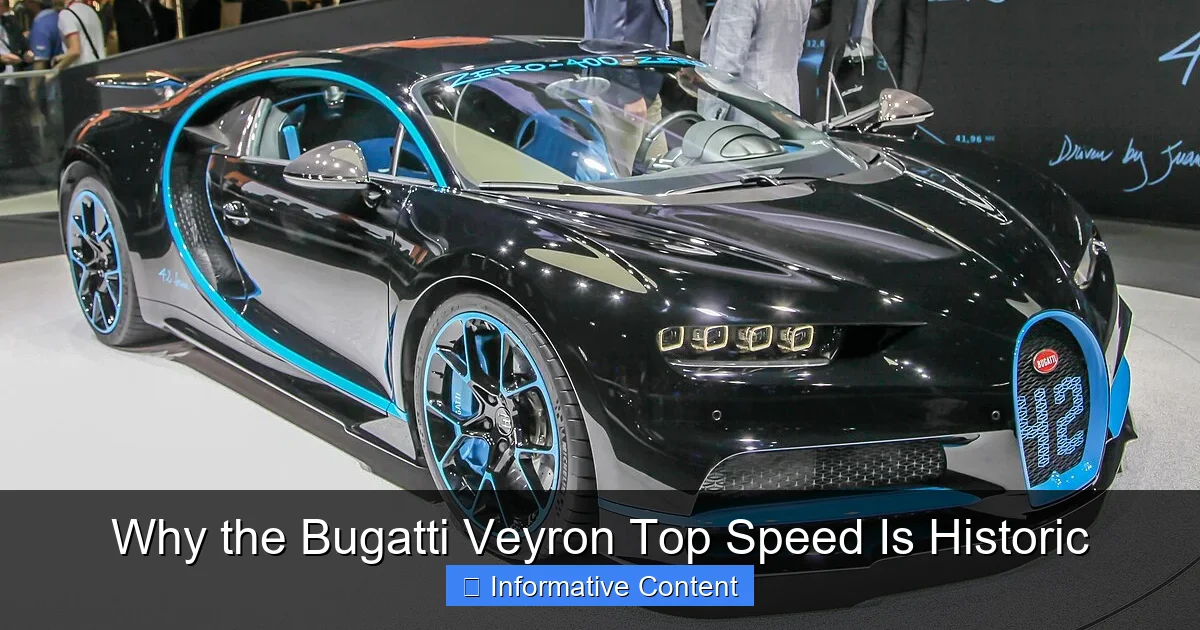
The Bugatti Veyron’s 253 mph top speed in 2005 wasn’t just a number—it was a physics-defying declaration that redefined the hypercar. Achieving this milestone required an unprecedented engineering effort, merging a colossal 1,000+ horsepower W16 engine with advanced aerodynamics and tire technology capable of surviving the immense forces at play. This monumental feat secured its place in history, setting a benchmark for a generation and proving that extreme speed could be achieved with reliability and luxury.
Picture this: it’s the early 2000s. The fastest production cars in the world are pushing the envelope, hitting speeds just over 200 miles per hour. It’s a thrilling, exclusive club. Then, in 2005, a car arrives that doesn’t just join the club—it blows the doors off, redefines the rulebook, and makes every other supercar look like it’s standing still. That car was the Bugatti Veyron 16.4.
I remember seeing the first photos. It looked like a spaceship that had forgotten to go home. But the real story wasn’t just its looks. It was the number. 253 miles per hour. To put that in perspective, that’s faster than most small planes take off. It was a number that seemed plucked from science fiction, yet here it was, a car you could theoretically buy. The Bugatti Veyron top speed wasn’t just a new record; it was a historic leap that changed everything we thought was possible.
But why does this specific achievement, nearly two decades old, still echo so loudly today? It’s because the Veyron’s top speed was more than a statistic. It was the culmination of an insane engineering promise, a battle against physics itself, and a statement that in the modern era, a car could be both brutally fast and utterly refined. Let’s dive into why the Bugatti Veyron top speed remains a historic, untouchable monument in the automotive world.
In This Article
- 1 Key Takeaways
- 2 📑 Table of Contents
- 3 The Unthinkable Promise: Engineering Against All Odds
- 4 More Than Power: The Physics of 253 MPH
- 5 A Benchmark in Manufacturing and Quality
- 6 The Numbers That Defined an Era
- 7 The Cultural Impact: Redefining the Possible
- 8 The Legacy: Why It Still Matters Today
- 9 Frequently Asked Questions
- 9.1 Why is the Bugatti Veyron’s top speed considered historic?
- 9.2 What made reaching the Bugatti Veyron top speed so difficult?
- 9.3 How did the Veyron change the hypercar industry?
- 9.4 Is the Bugatti Veyron’s top speed record still standing?
- 9.5 Why was the Veyron’s top speed so important for Bugatti?
- 9.6 Could you drive the Veyron at top speed anywhere?
Key Takeaways
- Redefined Engineering Limits: It proved a 250+ mph production car was possible.
- Unprecedented Power Management: Its W16 engine required revolutionary cooling systems.
- Set a New Supercar Benchmark: It forced competitors to aim for higher performance.
- Prioritized Stability at Extreme Speed: Its advanced aerodynamics ensured control was maintained.
- Involved Massive Financial Investment: Each car sold was at a significant loss.
- Remains a Symbol of Ambition: It was built to achieve a singular, historic goal.
📑 Table of Contents
The Unthinkable Promise: Engineering Against All Odds
The story of the Bugatti Veyron top speed begins with a promise, one that nearly broke the engineers tasked with keeping it. When the Volkswagen Group revived the legendary Bugatti name, they didn’t want to just make a fast car. They set a target that seemed ludicrous: 1,000 metric horsepower and a top speed of over 400 km/h (250 mph).
This wasn’t a goal born in a marketing meeting; it was a moonshot. At the time, no production car came close. The challenge wasn’t just making power—it was managing the apocalyptic forces that come with such speed.
A Powerplant Like No Other
To reach its target, Bugatti didn’t tweak an existing engine. They built an 8.0-liter W16 engine from the ground up. Imagine two narrow-angle V8 engines sharing a common crankshaft. This masterpiece, with four turbochargers, produced 1,001 PS. The power was monstrous, but it was only the first of a thousand problems.
Taming the Thermodynamic Beast
All that power creates insane heat. At top speed, the Veyron’s engine and radiators needed to dissipate enough heat to warm several houses. The solution? A radiator system so large it took up the entire front of the car. They had ten radiators: three for the engine, two for the intercoolers, one for the transmission, one for the differential, and three for the air conditioning and oil systems. It was a mobile cooling plant.
More Than Power: The Physics of 253 MPH
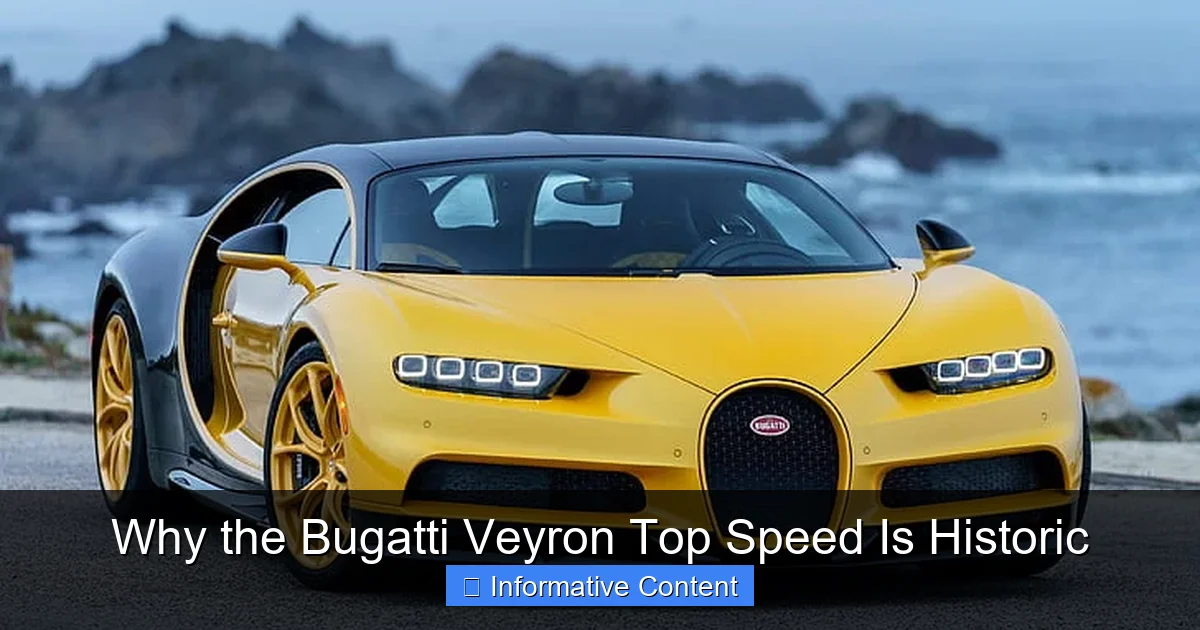
Anyone can put a big engine in a car. But making a car stable, safe, and controllable at 253 mph is a different universe of difficulty. This is where the true genius of the Bugatti Veyron top speed achievement lies. It had to become an aerodynamic and mechanical Swiss Army knife.
Visual guide about Bugatti Veyron top speed
Image source: c4.wallpaperflare.com
The Two-Faced Aerodynamic Personality
The Veyron needed downforce to stick to the road in corners, but downforce creates drag, which kills top speed. The engineers’ solution was ingenious and active. At the push of a button, the car transformed.
- Handling Mode: The rear wing extends, the front diffuser lowers. The car hunkers down, generating massive downforce for grip and stability.
- Top Speed Mode: The wing retracts flush, the diffuser raises, and the car hunkers down even lower. Drag is minimized, turning the Veyron into a sleek, ground-hugging bullet. You needed a special key to even access this mode—a literal key to unlock its ultimate potential.
Gripping the Road at Insane Speeds
Special tires were developed with Michelin that could survive the centrifugal forces of 253 mph, where the outer diameter of the tire grows nearly an inch. They were so specialized that if you got a puncture, you couldn’t just put on the spare. The car had to be flat-bedded to a specialist. The brakes were equally colossal, capable of bringing the car from 250 mph to a stop repeatedly without fading.
A Benchmark in Manufacturing and Quality
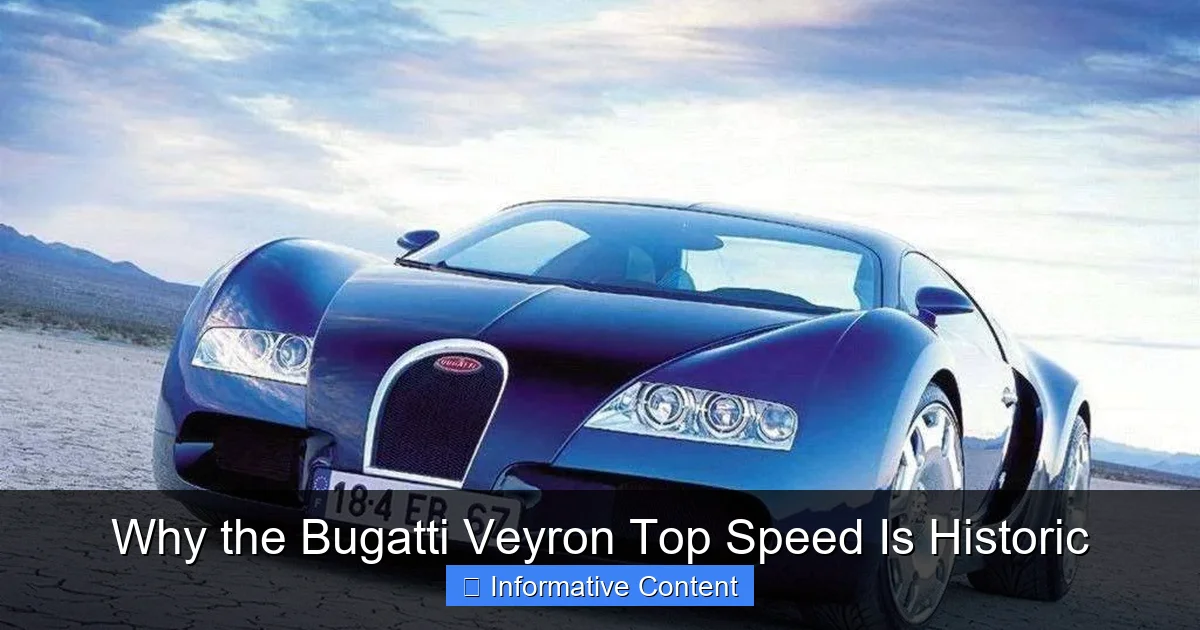
The Bugatti Veyron top speed was a headline figure, but the car’s mission was broader: to be the most complete, luxurious, and reliable hypercar ever. This made its achievement historic. It wasn’t a stripped-out, noisy race car for the road. It was a leather-lined, quiet, and comfortable grand tourer.
Visual guide about Bugatti Veyron top speed
Image source: 4.bp.blogspot.com
An Uncompromising Daily Driver (For Billionaires)
You could drive a Veyron to the opera. The cabin was whisper-quiet at low speeds, fitted with exquisite leather and a premium sound system. The ride was firm but compliant. It had a boot (trunk) that could actually hold luggage. This duality—world-destroying speed and serene comfort—had never been achieved before at this level. It set a new benchmark for what a hypercar should be.
The Staggering Cost of Perfection
This level of engineering and quality came at a catastrophic financial cost. It’s widely reported that Bugatti lost millions on every Veyron sold. The development and parts cost were simply astronomical. This wasn’t a business venture; it was a statement project. The Veyron proved that with unlimited resources and willpower, the “impossible” could be made real, reliable, and repeatable.
The Numbers That Defined an Era
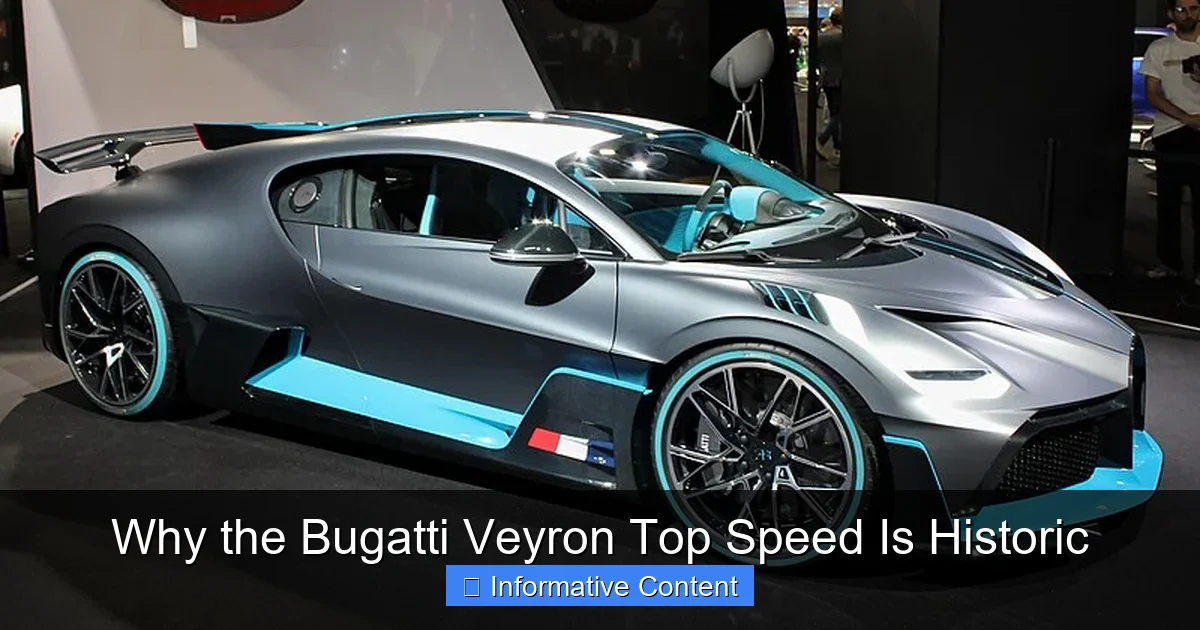
To understand the scale of the leap, you have to look at the data. The Bugatti Veyron top speed didn’t just edge past the previous record; it demolished it, and its acceleration figures were equally mind-bending.
Visual guide about Bugatti Veyron top speed
Image source: carwiki.de
Let’s put the Veyron’s performance in context with its predecessor and a modern rival to see the historic gap it created.
| Car Model | Year | Top Speed (mph) | 0-60 mph (seconds) | Engine Power |
|---|---|---|---|---|
| McLaren F1 (Previous Record Holder) | 1998 | 240.1 | 3.2 | 627 hp |
| Bugatti Veyron 16.4 | 2005 | 253.2 | 2.5 | 1,001 hp |
| Koenigsegg Agera RS (Later Record Breaker) | 2017 | 277.9 | 2.6 | 1,360 hp |
This table shows the monumental jump. The Veyron added over 13 mph to a record that had stood for years, and it did so with staggering acceleration. Notice the 12-year gap before its top speed record was significantly surpassed. That’s a testament to how far ahead of its time it was.
The Cultural Impact: Redefining the Possible
The Bugatti Veyron top speed did something rare: it broke out of the car enthusiast bubble and became a global cultural icon. It was the ultimate symbol of technological achievement and excess.
The Ultimate Status Symbol
In the mid-2000s, if you asked a child to draw the fastest car in the world, they’d draw a Veyron. It featured in countless video games, movies, and music videos. It became shorthand for “the best.” Owning one wasn’t just about wealth; it was about owning a piece of history, a rolling piece of engineering art that represented the peak of what humans could build.
Inspiring a New Generation of Hypercars
The Veyron’s existence forced every other manufacturer to aim higher. It sparked the modern “hypercar war.” Companies like Koenigsegg, Hennessey, and later, Bugatti itself with the Chiron, were driven to push boundaries further. The Veyron raised the bar so high that it created an entirely new competitive landscape focused on four-digit horsepower and 250+ mph targets.
The Legacy: Why It Still Matters Today
Today, cars like the Koenigsegg Jesko Absolut and the SSC Tuatara claim higher top speeds. They are lighter, more aerodynamically efficient, and even more powerful. So why is the Veyron’s achievement still historic?
The Pioneer’s Halo
It was the first. It proved it could be done in a complete, usable, and federally legal package. The modern hypercars stand on the shoulders of the giant that was the Veyron. It solved problems nobody had ever faced in a production car, writing the manual for everyone who followed.
The End of an Era of Pure Mechanical Fury
The Veyron may represent the last great, purely mechanical hypercar. Its successor, the Chiron, and most of its modern rivals, rely heavily on hybrid technology and advanced computer systems. The Veyron was a analog beast in a digital dawn—a massive, turbocharged, naturally aspirated-style engine achieving its goals through sheer mechanical force and ingenuity. In that sense, it is a timeless monument to a certain kind of engineering bravery.
In the end, the Bugatti Veyron top speed is historic not just for a number on a screen, but for the story behind it. It was a promise kept against impossible odds. It was a car that could tear a hole in the atmosphere at 253 mph and then glide you home in air-conditioned, leather-trimmed silence. It was a loss-leader that pricelessly elevated an entire brand and industry. It showed us that with enough passion and resources, the barriers of physics aren’t walls, but challenges waiting to be engineered into submission. That’s an achievement that will never be forgotten.
Frequently Asked Questions
Why is the Bugatti Veyron’s top speed considered historic?
The Bugatti Veyron’s top speed of over 250 mph was a monumental engineering leap, being the first production car to reliably and safely exceed that barrier. It represented a decade-defining achievement that required solving immense challenges in aerodynamics, cooling, and tire technology, setting a new benchmark for hypercars.
What made reaching the Bugatti Veyron top speed so difficult?
Pushing a car past 250 mph creates extreme forces that threaten to tear it apart. Engineers had to develop a bespoke W16 engine with four turbochargers, a complex all-wheel-drive system for stability, and special tires rated for the immense centrifugal force, making its top speed a triumph of integrated design.
How did the Veyron change the hypercar industry?
The Bugatti Veyron redefined the limits of what was possible, forcing competitors to pursue higher performance benchmarks. It proved that extreme speed could be paired with luxury and daily usability, shifting the entire hypercar market towards more technologically sophisticated and multi-million-dollar projects.
Is the Bugatti Veyron’s top speed record still standing?
While later Bugatti models like the Chiron and its derivatives have surpassed the original Veyron’s top speed, its record as the first production car to break the 250 mph barrier remains a historic milestone. It paved the way for all subsequent speed records in the modern era.
Why was the Veyron’s top speed so important for Bugatti?
Achieving this historic Bugatti Veyron top speed was crucial for the brand’s revival under Volkswagen Group, proving its engineering prowess on the world stage. It fulfilled founder Ettore Bugatti’s vision of combining immense power with refined artistry, cementing Bugatti’s modern legacy.
Could you drive the Veyron at top speed anywhere?
No, reaching the Bugatti Veyron’s top speed required specific conditions, primarily a long, straight track like the Ehra-Lessien test facility. The car would consume its entire fuel tank in about 12 minutes at full throttle, and the specially designed Michelin tires were only certified for short bursts at the maximum speed.

At CarLegit, we believe information should be clear, factual, and genuinely helpful. That’s why every guide, review, and update on our website is created with care, research, and a strong focus on user experience.