
If your car insurance just jumped by $100, you’re not alone—and it’s not always your fault. Rate hikes can stem from accidents, credit changes, location shifts, or even inflation. Understanding the reasons helps you take control and find ways to save.
In This Article
- 1 Key Takeaways
- 2 📑 Table of Contents
- 3 Why Did My Car Insurance Go Up $100? Understanding the Surprising Reasons
- 4 1. You Had an Accident or Traffic Violation
- 5 2. Your Credit Score Dropped
- 6 3. You Moved to a New Area
- 7 4. Your Driving Habits Changed
- 8 5. Inflation and Rising Repair Costs
- 9 6. Your Discounts Expired or Were Removed
- 10 How to Fight Back and Lower Your Premium
- 11 Conclusion: You’re Not Powerless
- 12 Frequently Asked Questions
- 12.1 Why did my car insurance go up $100 even though I haven’t had an accident?
- 12.2 How long does an accident stay on my insurance record?
- 12.3 Can my insurance company raise my rate without notice?
- 12.4 Will my rate go down if I improve my credit score?
- 12.5 Is it worth switching insurers to save $100 per month?
- 12.6 Can I negotiate my car insurance premium?
Key Takeaways
- Accidents and violations stay on your record: Even one at-fault accident can spike your premium by hundreds of dollars for 3–5 years.
- Credit score impacts pricing: In most states, insurers use credit-based insurance scores—lower scores often mean higher rates.
- Where you live matters: Moving to an area with higher theft, traffic, or weather risks can trigger a rate increase.
- Vehicle type and usage changes: Driving more miles, upgrading to a sports car, or adding a teen driver can raise costs.
- Inflation and repair costs are rising: Parts, labor, and medical expenses are up, so insurers adjust premiums to keep up.
- Policy renewal isn’t always automatic savings: Loyalty doesn’t guarantee discounts—shopping around annually can save $500+ per year.
- Discounts may have expired: Safe driver or low-mileage discounts can disappear if conditions change or aren’t renewed.
📑 Table of Contents
- Why Did My Car Insurance Go Up $100? Understanding the Surprising Reasons
- 1. You Had an Accident or Traffic Violation
- 2. Your Credit Score Dropped
- 3. You Moved to a New Area
- 4. Your Driving Habits Changed
- 5. Inflation and Rising Repair Costs
- 6. Your Discounts Expired or Were Removed
- How to Fight Back and Lower Your Premium
- Conclusion: You’re Not Powerless
Why Did My Car Insurance Go Up $100? Understanding the Surprising Reasons
You open your mailbox or email, expecting another routine bill—only to find your car insurance premium has jumped by $100 or more. Your first thought? “Why did my car insurance go up $100?” It feels unfair, especially if you haven’t had an accident or changed your policy. But the truth is, car insurance rates aren’t static. They shift based on a mix of personal, regional, and economic factors—many of which happen behind the scenes.
Insurance companies use complex algorithms to assess risk. Every year, they reevaluate your profile, your driving history, your car, and even your neighborhood. If any of these elements suggest you’re more likely to file a claim, your premium goes up. And sometimes, it’s not about you at all—it’s about broader trends like rising repair costs, increased accidents in your area, or inflation. The good news? Once you understand why your rate increased, you can take steps to bring it back down.
This guide will walk you through the most common reasons your car insurance went up by $100—or even more—and give you actionable tips to fight back. Whether it’s a recent ticket, a change in your credit score, or simply bad timing, we’ll help you make sense of the numbers and take control of your coverage.
1. You Had an Accident or Traffic Violation
Visual guide about Why Did My Car Insurance Go Up 100
Image source: cardinalinsurancegroup.com
One of the most direct reasons your car insurance went up $100 is a recent accident or moving violation. Even a minor fender bender can trigger a significant rate hike, especially if you were found at fault. Insurance companies see drivers with recent claims as higher risk, and they adjust premiums accordingly.
How Accidents Affect Your Premium
When you file a claim—especially for property damage or bodily injury—your insurer pays out money. To offset that cost, they raise your rate. The size of the increase depends on the severity of the accident, your driving history, and your insurer’s policies. For example, a single at-fault accident can increase your premium by 20% to 50%. On a $200 monthly policy, that’s $40 to $100 extra per month—exactly the kind of jump you’re seeing.
Let’s say you rear-ended another car at a stoplight. No one was hurt, but there was $3,000 in damage. You file a claim, and your insurer covers it. Six months later, your renewal notice arrives with a $90 monthly increase. That’s not a coincidence—it’s the cost of that claim showing up in your rate.
Traffic Tickets and Points on Your License
Even if you didn’t file a claim, a speeding ticket or red-light violation can still raise your rates. Most states use a point system for traffic violations. Accumulating points signals to insurers that you’re a riskier driver. A single speeding ticket might add $20–$50 to your monthly premium. But if you have multiple violations, the increases stack up fast.
For instance, getting caught going 20 mph over the limit in a school zone could result in a $75 monthly hike. Combine that with a previous ticket, and you’re suddenly paying $150 more than last year. And these points can stay on your record for 3 to 5 years, depending on your state.
What You Can Do
– **Take a defensive driving course:** Many insurers offer discounts for completing approved courses, and some states allow you to remove points from your license.
– **Ask about accident forgiveness:** Some companies offer this perk for your first at-fault accident, preventing a rate increase.
– **Drive safely:** The best way to avoid future hikes is to keep a clean record. No tickets, no claims, no surprises.
2. Your Credit Score Dropped
Visual guide about Why Did My Car Insurance Go Up 100
Image source: paperless-insurance.com
You might not think your credit score affects your car insurance—but in most states, it does. Insurers use a credit-based insurance score (different from your FICO score) to predict how likely you are to file a claim. Studies show that people with lower credit scores tend to file more claims, so insurers charge them more.
How Credit Impacts Insurance Rates
If your credit score dropped due to missed payments, maxed-out credit cards, or a recent loan application, your insurer may have recalculated your rate at renewal. A drop of 50 points could easily result in a $50–$100 monthly increase. For example, if your score went from 720 to 670, you might see your premium jump from $180 to $280 per month.
This practice is legal in 47 states (not allowed in California, Hawaii, or Massachusetts). Insurers argue that credit history is a strong predictor of risk. While it may seem unfair, it’s a standard part of their underwriting process.
Real-Life Example
Sarah, a 34-year-old teacher, always paid her bills on time—until she lost her job during a pandemic layoff. She missed two credit card payments and her score dropped from 740 to 680. When her car insurance renewed, her premium increased by $95 per month. She was shocked. “I’ve never had an accident,” she said. “Why am I being punished?” The answer? Her credit score.
What You Can Do
– **Check your credit report:** Get a free copy annually at AnnualCreditReport.com. Look for errors and dispute them.
– **Pay bills on time:** Even one late payment can hurt your score.
– **Reduce credit utilization:** Keep balances below 30% of your credit limit.
– **Ask your insurer:** Some companies offer discounts for improving your credit over time.
3. You Moved to a New Area
Visual guide about Why Did My Car Insurance Go Up 100
Image source: cheepinsurance.ca
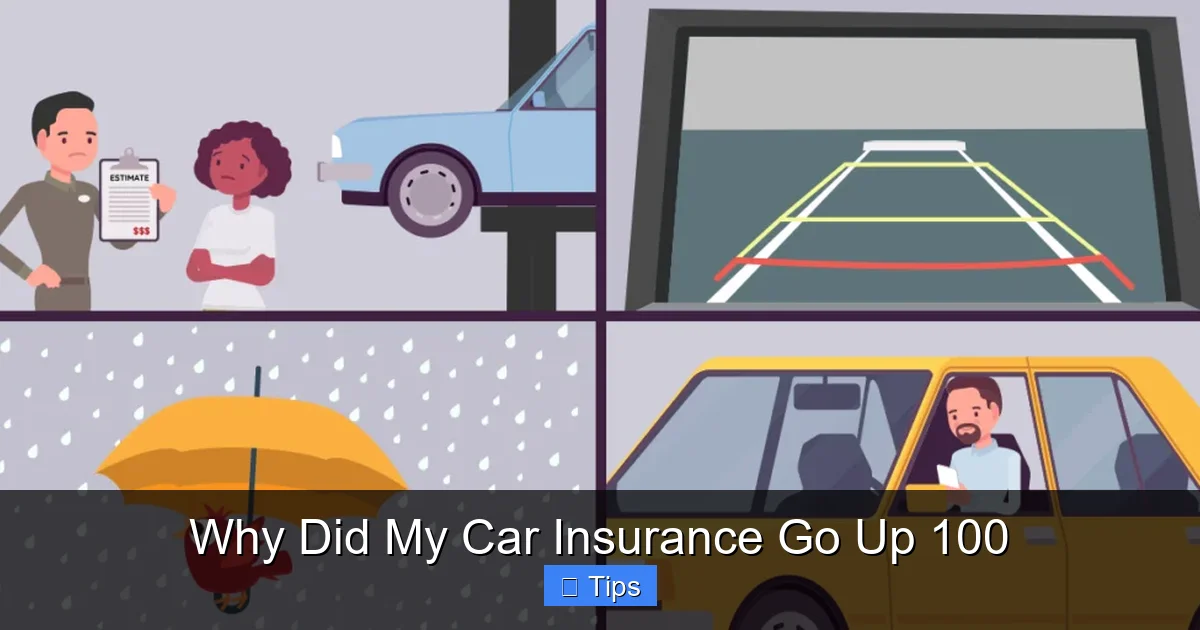
Did you recently move to a new city, suburb, or even a different ZIP code? That could be why your car insurance went up $100. Insurance rates vary widely by location due to differences in crime rates, traffic density, weather risks, and local repair costs.
Urban vs. Rural Rates
Living in a densely populated city often means higher premiums. Why? More cars on the road increase the chance of accidents. Higher theft and vandalism rates also drive up costs. For example, drivers in Detroit or Baltimore often pay twice as much as those in rural Nebraska.
Even within the same city, rates can vary by neighborhood. A ZIP code with a high rate of auto theft or frequent flooding will have higher premiums. Insurers use geolocation data to assess risk down to the block level.
Weather and Natural Disasters
If you moved to an area prone to hurricanes, hailstorms, or flooding, your comprehensive coverage costs will rise. For instance, homeowners and drivers in Florida or Texas often see higher premiums due to hurricane risk. A $100 increase might reflect added protection against storm damage.
What You Can Do
– **Compare insurers in your new area:** Rates vary widely. A local insurer might offer better deals than your national provider.
– **Ask about location-based discounts:** Some companies offer discounts for living in low-risk zones or installing anti-theft devices.
– **Consider usage-based insurance:** If you drive less in your new location, pay-per-mile plans could save you money.
4. Your Driving Habits Changed
Insurance companies don’t just look at where you live—they also consider how much and how you drive. If your annual mileage increased, you started using your car for work, or you added a new driver to your policy, your premium could spike.
Mileage Matters
The more you drive, the higher your risk of an accident. If you used to work from home but now commute 50 miles round-trip, your insurer may classify you as a higher-risk driver. Many policies assume a baseline of 10,000–12,000 miles per year. Going over that can trigger a rate increase.
For example, if you started driving 15,000 miles annually, your insurer might raise your premium by $60–$100 per month. Some companies even use telematics devices or apps to track your mileage and driving behavior.
Adding a Teen or New Driver
Adding a 16-year-old to your policy is one of the biggest reasons for a rate jump. Teen drivers are statistically more likely to be in accidents. Insurers often charge 2–3 times more when a young driver is added.
Imagine your premium was $150 per month. After adding your son, it jumps to $350. That’s a $200 increase—well over the $100 you’re wondering about. Even if you don’t add a driver, letting a friend or family member drive your car regularly could affect your rates.
What You Can Do
– **Switch to a low-mileage plan:** If you drive less than 7,500 miles a year, ask about discounts.
– **Use telematics:** Safe driving apps like Progressive’s Snapshot or Allstate’s Drivewise can lower your rate based on behavior.
– **Keep teen drivers on their own policy:** Sometimes, it’s cheaper than adding them to yours—especially if they’re in school and maintain good grades.
5. Inflation and Rising Repair Costs
Even if nothing in your life has changed, your car insurance might still go up—because the world around you has. Inflation, supply chain issues, and rising labor costs are driving up the price of car repairs, medical care, and vehicle replacements. Insurers pass these costs on to consumers.
The Cost of Fixing Modern Cars
Today’s vehicles are packed with advanced technology—sensors, cameras, radar systems—that make repairs more expensive. A simple bumper replacement on a 2023 Honda Accord can cost $2,000 or more, compared to $800 a decade ago. When insurers pay more for claims, they raise premiums for everyone.
For example, if the average claim cost increases by 10% due to inflation, your premium might go up by $50–$100 annually—even if you’ve never filed a claim.
Medical Costs and Liability Claims
Medical expenses are also rising. A minor injury that once cost $5,000 to treat might now cost $8,000. Since liability coverage pays for others’ injuries, higher medical costs mean higher premiums across the board.
What You Can Do
– **Review your coverage:** If your car is older, consider dropping collision or comprehensive coverage if the cost exceeds the car’s value.
– **Increase your deductible:** Raising your deductible from $500 to $1,000 can save $100+ per year.
– **Bundle policies:** Combine auto, home, or renters insurance for a multi-policy discount.
6. Your Discounts Expired or Were Removed
You might have enjoyed lower rates thanks to discounts—safe driver, good student, low mileage, or multi-car. But if those discounts expired or no longer apply, your premium could jump by $100 or more.
Common Discounts That Vanish
– **Safe driver discount:** Lost after a ticket or accident.
– **Low-mileage discount:** Gone if you started driving more.
– **Good student discount:** Expires when your teen graduates.
– **Multi-car discount:** Lost if you sold a vehicle.
– **Loyalty discount:** Some insurers reduce or remove this over time.
For example, Maria had a $75 safe driver discount. After a minor accident, it was removed. Her premium went from $175 to $250 per month—a $75 increase. Combined with inflation adjustments, she’s now paying $100 more.
What You Can Do
– **Ask your agent:** Review your policy and confirm which discounts you’re receiving.
– **Re-qualify for discounts:** Take a defensive driving course or maintain good grades to regain savings.
– **Shop around:** Other insurers may offer better discounts for your profile.
How to Fight Back and Lower Your Premium
Now that you know why your car insurance went up $100, it’s time to take action. You don’t have to accept the increase—there are proven strategies to reduce your rate.
Shop Around Annually
Loyalty doesn’t pay in insurance. The best way to save is to compare quotes from at least three insurers every year. Use online comparison tools or work with an independent agent. You could save $500 or more.
Improve Your Credit
Pay down debt, avoid new credit applications, and dispute errors. A 50-point credit score improvement can save you $100+ per year.
Adjust Your Coverage
If your car is worth less than $4,000, dropping collision and comprehensive might make sense. Just make sure you have enough liability coverage.
Take Advantage of Discounts
Ask about every discount: safe driver, good student, military, senior, low mileage, and telematics. Stack them to maximize savings.
Consider a Higher Deductible
Raising your deductible from $500 to $1,000 can reduce your premium by 15–30%. Just make sure you can afford the out-of-pocket cost if you file a claim.
Conclusion: You’re Not Powerless
Finding out your car insurance went up $100 can feel frustrating—but it’s not the end of the world. By understanding the reasons behind the increase, you can take control and make smarter decisions. Whether it’s improving your credit, shopping for a better rate, or adjusting your coverage, there are always options.
Don’t wait for your next renewal to act. Review your policy today, check your credit, and get a few quotes. You might be surprised how much you can save. And remember: the question “Why did my car insurance go up $100?” has answers—and those answers can lead to real savings.
Frequently Asked Questions
Why did my car insurance go up $100 even though I haven’t had an accident?
Your rate could have increased due to factors like a drop in credit score, moving to a higher-risk area, rising repair costs, or expired discounts—even without an accident.
How long does an accident stay on my insurance record?
Most at-fault accidents affect your premium for 3 to 5 years, depending on your insurer and state. Safe driving can help reduce the impact over time.
Can my insurance company raise my rate without notice?
Yes, insurers can adjust rates at renewal based on updated risk assessments. They’re required to send a renewal notice, but the increase may come as a surprise.
Will my rate go down if I improve my credit score?
Yes, in most states, improving your credit score can lead to lower premiums. Insurers regularly review credit, and better scores often mean better rates.
Is it worth switching insurers to save $100 per month?
Absolutely. Saving $100 per month adds up to $1,200 per year. Just make sure the new policy offers comparable coverage and customer service.
Yes, you can ask your agent about discounts, adjust your deductible, or bundle policies to lower your rate. If you’ve been a loyal customer, mention it.

At CarLegit, we believe information should be clear, factual, and genuinely helpful. That’s why every guide, review, and update on our website is created with care, research, and a strong focus on user experience.