
If your 2012 Nissan Altima won’t accelerate, it could be due to a faulty throttle body, clogged fuel filter, or transmission issues. This guide covers the most common causes, how to diagnose them, and when to seek professional help.
In This Article
- 1 Key Takeaways
- 2 📑 Table of Contents
- 3 Why Does My 2012 Nissan Altima Won’t Accelerate? A Complete Guide
- 4 Understanding the Basics: How Acceleration Works in Your Altima
- 5 Top 6 Reasons Your 2012 Nissan Altima Won’t Accelerate
- 5.1 1. Throttle Body and Throttle Position Sensor Issues
- 5.2 2. Fuel System Problems: Pump, Filter, and Injectors
- 5.3 3. Transmission Issues: Slipping, Low Fluid, or Solenoid Failure
- 5.4 4. Air Intake and Sensor Malfunctions
- 5.5 5. Electrical and Wiring Problems
- 5.6 6. Exhaust System and Catalytic Converter Blockage
- 6 Diagnostic Tools and When to See a Mechanic
- 7 Prevention and Maintenance Tips
- 8 Conclusion
- 9 Frequently Asked Questions
- 9.1 Why does my 2012 Nissan Altima hesitate when I press the gas?
- 9.2 Can a bad battery cause acceleration problems in my Altima?
- 9.3 How often should I replace the fuel filter in my 2012 Altima?
- 9.4 Is it safe to drive my Altima if it won’t accelerate?
- 9.5 Can I clean the throttle body myself?
- 9.6 Why does my Altima go into limp mode when accelerating?
Key Takeaways
- Throttle body problems are a top cause: Carbon buildup or a malfunctioning throttle position sensor can prevent proper acceleration.
- Fuel system issues matter: A clogged fuel filter, weak fuel pump, or dirty fuel injectors can restrict fuel flow and reduce engine power.
- Transmission troubles may be to blame: Slipping gears, low fluid, or solenoid failures can make your Altima feel sluggish or unresponsive.
- Check engine light is a clue: Use an OBD2 scanner to read diagnostic trouble codes (DTCs) and pinpoint the issue quickly.
- Air intake and sensors play a role: A dirty mass airflow (MAF) sensor or restricted air filter can disrupt the air-fuel mixture.
- Electrical and wiring faults can interfere: Damaged connectors or corroded wiring in the throttle system may cause intermittent acceleration problems.
- Regular maintenance prevents issues: Replacing filters, fluids, and inspecting components can keep your Altima running smoothly.
📑 Table of Contents
Why Does My 2012 Nissan Altima Won’t Accelerate? A Complete Guide
You’re driving your 2012 Nissan Altima, everything seems fine, and then—nothing. You press the gas pedal, but the car doesn’t respond. No surge of power, no increase in speed. Just silence or a sluggish crawl. It’s scary, frustrating, and potentially dangerous, especially if it happens on the highway or at an intersection.
This problem isn’t uncommon in the 2012 Nissan Altima. Many owners have reported sudden loss of acceleration, hesitation, or a complete lack of response when pressing the accelerator. While it can be alarming, the good news is that most causes are identifiable and often fixable—especially if you catch them early.
In this guide, we’ll walk you through the most common reasons your 2012 Nissan Altima won’t accelerate. We’ll explain what each issue looks like, how to diagnose it, and what you can do about it. Whether you’re a DIY enthusiast or prefer to leave it to the pros, this article will help you understand what’s going on under the hood—and how to get your Altima back to performing like it should.
Understanding the Basics: How Acceleration Works in Your Altima

Visual guide about Why Does My 2012 Nissan Altima Wont Accelerate
Image source: engineauditor.com
Before diving into the specific problems, it helps to understand how your car’s acceleration system works. When you press the gas pedal, you’re not directly opening the throttle like in older cars. Instead, you’re sending an electronic signal to the engine control unit (ECU), which then tells the throttle body how much to open. This allows the right amount of air into the engine. At the same time, the ECU adjusts fuel injection to maintain the ideal air-fuel ratio.
This system relies on several key components working together:
– The accelerator pedal position sensor (APPS)
– The throttle position sensor (TPS)
– The mass airflow (MAF) sensor
– The fuel pump and injectors
– The transmission control module (TCM)
If any of these parts fail or send incorrect signals, your car may hesitate, stall, or refuse to accelerate. The 2012 Altima uses an electronic throttle control (ETC) system, also known as “drive-by-wire,” which means there’s no physical cable connecting the pedal to the throttle. This makes it more efficient but also more sensitive to electrical faults.
Common Symptoms of Acceleration Problems
Not all acceleration issues look the same. Here are some signs to watch for:
– **Hesitation or jerking** when you press the gas
– **Delayed response**—you press the pedal, but the car doesn’t move for a second or two
– **Lack of power** when merging or going uphill
– **Stalling** after coming to a stop
– **Check Engine Light (CEL)** or other warning lights on the dashboard
– **Rough idling** or engine misfires
If you notice any of these, it’s time to investigate. The sooner you act, the less likely you are to cause further damage—or end up stranded.
Top 6 Reasons Your 2012 Nissan Altima Won’t Accelerate
Visual guide about Why Does My 2012 Nissan Altima Wont Accelerate
Image source: tankbig.com
Now let’s get into the heart of the matter: the most common causes of acceleration failure in the 2012 Nissan Altima. We’ll cover each in detail, with practical tips and real-world examples.
1. Throttle Body and Throttle Position Sensor Issues
The throttle body is like the gatekeeper of your engine’s air supply. In the 2012 Altima, it’s electronically controlled and contains a throttle position sensor (TPS) that tells the ECU how far the throttle is open. Over time, carbon buildup can accumulate inside the throttle body, especially around the throttle plate. This restricts airflow and can cause the plate to stick, leading to poor acceleration or even stalling.
A faulty TPS can also send incorrect signals. For example, if it tells the ECU the throttle is closed when it’s actually open, the engine won’t get enough fuel, causing hesitation or lack of power.
How to check: Remove the air intake hose and inspect the throttle body. If you see thick, black carbon deposits, it’s time to clean it. You can use a throttle body cleaner spray and a soft brush. Be gentle—don’t force the throttle plate open.
DIY tip: After cleaning, reset the ECU by disconnecting the battery for 10–15 minutes. This allows the system to relearn the throttle position.
If cleaning doesn’t help, the TPS may need replacement. Look for symptoms like erratic idle, surging, or a check engine light with codes like P0121 or P0221.
2. Fuel System Problems: Pump, Filter, and Injectors
Your engine needs a steady supply of fuel to accelerate. If any part of the fuel system fails, performance suffers.
Fuel Pump: The fuel pump sends gasoline from the tank to the engine. A weak or failing pump can’t maintain proper pressure, especially under load (like when accelerating). Symptoms include sputtering at high speeds, difficulty starting, or a whining noise from the fuel tank area.
Fuel Filter: The fuel filter traps dirt and debris. Over time, it can become clogged, restricting fuel flow. A dirty filter is a common cause of sluggish acceleration, especially in older vehicles like the 2012 Altima. Most manufacturers recommend replacing it every 30,000 to 60,000 miles.
Fuel Injectors: These spray fuel into the engine’s intake manifold. If they’re clogged with carbon or varnish, they won’t deliver the right amount of fuel. This can cause misfires, rough idle, and poor acceleration.
How to diagnose: Use a fuel pressure gauge to test the pump’s output. Normal pressure for the 2012 Altima is around 55–62 psi. If it’s low, the pump or filter may be the issue. For injectors, listen for a clicking sound with a mechanic’s stethoscope—silent injectors may be clogged.
DIY tip: Add a fuel system cleaner to your gas tank every 3,000–5,000 miles to help prevent injector clogs. For a clogged filter, replacement is usually straightforward—just locate it along the fuel line (often under the car near the tank) and swap it out.
3. Transmission Issues: Slipping, Low Fluid, or Solenoid Failure
The transmission plays a crucial role in acceleration. If it’s not shifting properly, your car may feel like it’s “struggling” or not responding to the gas pedal.
Low Transmission Fluid: Automatic transmissions rely on fluid to transfer power and cool components. Low fluid levels can cause slipping, delayed shifts, or no acceleration at all. Check the dipstick (with the engine running and warm)—the fluid should be bright red and smell slightly sweet. Dark, burnt-smelling fluid indicates overheating or internal wear.
Transmission Solenoids: These electronic valves control fluid flow within the transmission. A faulty solenoid can cause harsh shifts, slipping, or a complete loss of power. The 2012 Altima uses a continuously variable transmission (CVT), which is especially sensitive to solenoid issues.
CVT Belt or Pulley Problems: The CVT uses a belt and pulleys instead of traditional gears. If the belt slips or the pulleys wear out, acceleration becomes inconsistent or nonexistent. This is a serious issue that often requires professional repair.
How to check: Start with the fluid level and condition. If it’s low, top it off and look for leaks. If the fluid is dirty or burnt, a flush may help—but if the transmission is already damaged, it may need rebuilding.
DIY tip: Avoid “topping off” with the wrong fluid. Use only Nissan NS-2 or NS-3 CVT fluid. Mixing fluids can cause severe damage.
If you suspect solenoid or internal CVT issues, visit a transmission specialist. These problems often trigger diagnostic codes like P0700 or P0776.
4. Air Intake and Sensor Malfunctions
Your engine needs the right mix of air and fuel to run efficiently. If the air intake system is compromised, acceleration suffers.
Mass Airflow (MAF) Sensor: This sensor measures how much air is entering the engine. A dirty or faulty MAF can send incorrect data to the ECU, causing the engine to run rich (too much fuel) or lean (too little fuel). Symptoms include hesitation, poor fuel economy, and a check engine light.
Air Filter: A clogged air filter restricts airflow, reducing engine power. It’s one of the easiest and cheapest fixes—replace it every 15,000 to 30,000 miles.
Intake Manifold Gasket Leak: If the gasket between the intake manifold and engine fails, unmetered air can enter the system, disrupting the air-fuel ratio. This can cause rough idle, stalling, and lack of power.
How to check: Inspect the air filter—if it’s dirty, replace it. For the MAF sensor, use a can of MAF cleaner (not regular carb cleaner) to spray the delicate wires inside. Avoid touching the sensor elements.
DIY tip: After cleaning the MAF, reset the ECU by disconnecting the battery. This allows the system to recalibrate.
If the problem persists, use an OBD2 scanner to check for codes like P0101 (MAF performance) or P0171 (system too lean).
5. Electrical and Wiring Problems
Since the 2012 Altima uses an electronic throttle system, electrical faults can directly affect acceleration.
Faulty Accelerator Pedal Position Sensor (APPS): This sensor tells the ECU how far you’ve pressed the gas pedal. If it fails, the car may not respond or may go into “limp mode” (reduced power for safety).
Damaged Wiring or Connectors: Corrosion, frayed wires, or loose connections in the throttle system can interrupt signals. This is especially common in older cars exposed to moisture or road salt.
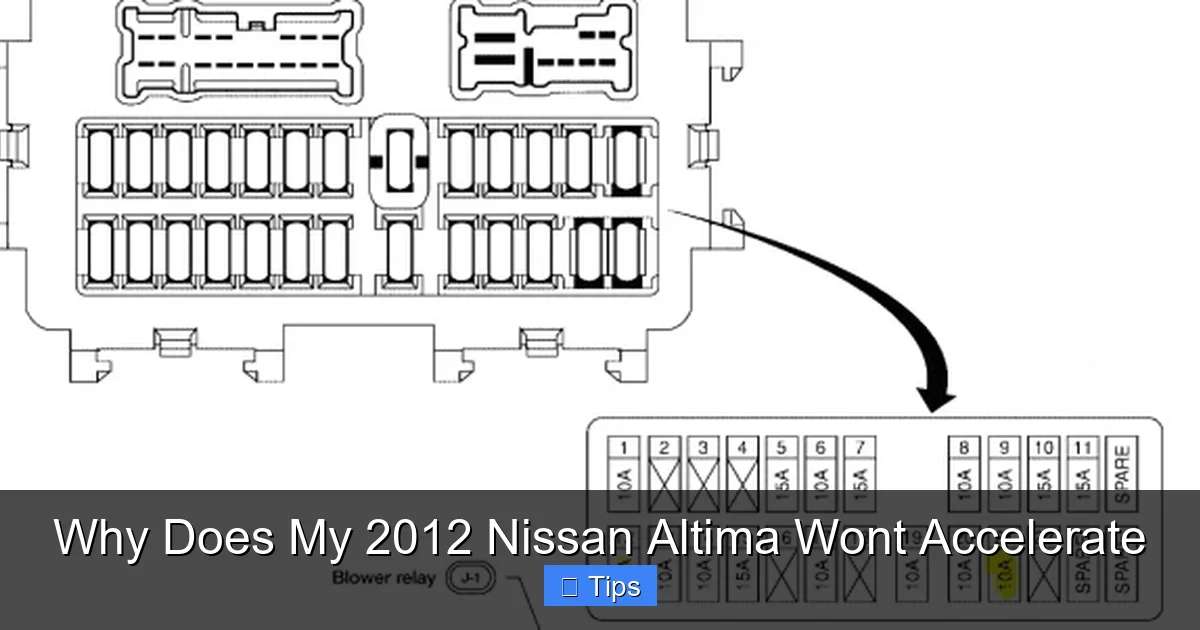
Blown Fuses or Relays: Check the fuse box under the hood and inside the cabin. A blown fuse for the fuel pump, ECU, or throttle system can cause sudden loss of power.
How to check: Use a multimeter to test sensor resistance and continuity in wiring. Look for corrosion or loose pins in connectors.
DIY tip: Spray electrical contact cleaner on connectors to remove dirt and moisture. Reconnect firmly.
If you’re not comfortable with electrical work, consult a mechanic. Misdiagnosis can lead to unnecessary part replacements.
6. Exhaust System and Catalytic Converter Blockage
A clogged catalytic converter can act like a choke, restricting exhaust flow and reducing engine power. This is less common but can happen if the engine is running rich (burning too much fuel) or if oil is burning due to worn piston rings.
Symptoms include:
– Loss of power, especially at higher speeds
– Rotten egg smell from the exhaust
– Check engine light with codes like P0420 (catalyst efficiency below threshold)
How to check: Use a vacuum gauge or backpressure tester. A significant drop in vacuum or high backpressure indicates a blockage.
DIY tip: If the converter is only partially clogged, a catalytic converter cleaner may help. For full blockages, replacement is usually required—and it’s not cheap.
Diagnostic Tools and When to See a Mechanic

Visual guide about Why Does My 2012 Nissan Altima Wont Accelerate
Image source: nissannationpodcast.com
While many issues can be diagnosed at home, some require professional tools and expertise.
Using an OBD2 Scanner
An OBD2 scanner is your best friend when troubleshooting. Plug it into the port under the dashboard (usually near the steering column) and read the diagnostic trouble codes (DTCs). Common codes related to acceleration issues include:
– P0121: Throttle Position Sensor/Switch A Circuit Range/Performance
– P0171: System Too Lean (Bank 1)
– P0300: Random/Multiple Cylinder Misfire
– P0700: Transmission Control System Malfunction
These codes point you toward the right system, saving time and money.
When to Call a Professional
Seek a mechanic if:
– The check engine light is on and you’re getting complex codes
– You suspect transmission or internal engine damage
– Electrical diagnostics are beyond your skill level
– The problem persists after basic fixes
A qualified technician can perform advanced tests like fuel pressure testing, scope analysis of sensor signals, and transmission diagnostics.
Prevention and Maintenance Tips
The best way to avoid acceleration problems is regular maintenance.
– Replace the air filter every 15,000–30,000 miles
– Change the fuel filter every 30,000–60,000 miles
– Use quality fuel and add injector cleaner periodically
– Check transmission fluid level and condition every 30,000 miles
– Clean the throttle body every 50,000 miles
– Address check engine lights promptly
Keeping up with these tasks can extend the life of your Altima and prevent costly repairs.
Conclusion
If your 2012 Nissan Altima won’t accelerate, don’t panic. Start with the basics: check the air filter, fuel system, and throttle body. Use an OBD2 scanner to read codes and guide your diagnosis. Many issues are fixable with simple cleaning or part replacement.
However, if the problem involves the transmission, electrical system, or internal engine components, it’s wise to consult a professional. Ignoring acceleration issues can lead to safety risks and more expensive damage down the road.
With proper care and attention, your Altima can continue to deliver reliable performance for many more miles. Stay proactive, stay informed, and keep driving with confidence.
Frequently Asked Questions
Why does my 2012 Nissan Altima hesitate when I press the gas?
This is often caused by a dirty throttle body, clogged fuel filter, or faulty mass airflow sensor. These components disrupt the air-fuel mixture or throttle response, leading to hesitation.
Can a bad battery cause acceleration problems in my Altima?
Yes, a weak battery can cause voltage drops that affect the electronic throttle system. If the ECU doesn’t get stable power, it may limit engine performance or trigger limp mode.
How often should I replace the fuel filter in my 2012 Altima?
Every 30,000 to 60,000 miles, or if you notice sluggish acceleration or difficulty starting. A clogged filter restricts fuel flow and reduces engine power.
Is it safe to drive my Altima if it won’t accelerate?
No. Loss of acceleration can be dangerous, especially in traffic or at intersections. Have the car towed to a repair shop to avoid accidents or further damage.
Can I clean the throttle body myself?
Yes, with throttle body cleaner and a soft brush. Remove the air intake hose, spray the cleaner, and gently scrub the carbon buildup. Avoid forcing the throttle plate.
Why does my Altima go into limp mode when accelerating?
Limp mode is a safety feature that reduces power when the ECU detects a serious fault, such as a throttle sensor failure or transmission issue. It’s designed to protect the engine and get you to a safe location.

At CarLegit, we believe information should be clear, factual, and genuinely helpful. That’s why every guide, review, and update on our website is created with care, research, and a strong focus on user experience.