
The Jeep Wrangler’s towing capacity is lower than many SUVs because it’s built first for off-road performance, not heavy hauling. Its lightweight body, short wheelbase, and rugged suspension prioritize trail capability over towing strength—but that doesn’t mean it can’t tow safely within its limits.
If you’ve ever looked at a Jeep Wrangler and wondered, “Why can’t this beast tow more?”—you’re not alone. The Wrangler is legendary. It’s the go-anywhere, do-anything icon of the off-road world. It climbs boulders, fords rivers, and laughs in the face of mud pits. But when it comes to towing, it’s surprisingly modest. Compared to SUVs like the Toyota 4Runner, Ford Bronco, or even some full-size trucks, the Wrangler’s towing capacity feels almost… underwhelming.
So why is the Jeep Wrangler towing capacity so low? It’s not that Jeep doesn’t know how to build strong vehicles. It’s that the Wrangler wasn’t built to be a workhorse. It was built to be a trail warrior. Every design choice—from its body-on-frame construction to its short wheelbase—was made with one goal in mind: dominating the off-road. And while that makes it unbeatable in the wild, it comes with trade-offs when you’re backing up to a trailer.
In this guide, we’ll break down the engineering, design, and practical reasons behind the Wrangler’s lower towing numbers. We’ll look at how its DNA as an off-roader shapes its capabilities, what you can realistically tow, and how to do it safely. Whether you’re planning a weekend camping trip or hauling a small boat, understanding these limits will help you get the most out of your Wrangler—without pushing it past its limits.
In This Article
- 1 Key Takeaways
- 2 📑 Table of Contents
- 3 Understanding Towing Capacity: What It Really Means
- 4 The Off-Road DNA: Why the Wrangler Is Built Differently
- 5 Engine and Drivetrain Limitations
- 6 Towing Capacity by Model and Configuration
- 7 How to Safely Tow with Your Jeep Wrangler
- 8 Myths and Misconceptions About Wrangler Towing
- 9 Conclusion: The Wrangler’s Towing Trade-Off
- 10 Frequently Asked Questions
- 10.1 Can a Jeep Wrangler tow a travel trailer?
- 10.2 What is the highest towing capacity for a Jeep Wrangler?
- 10.3 Do I need a special package to tow with my Wrangler?
- 10.4 Can I tow in 4WD with a Jeep Wrangler?
- 10.5 Why was the EcoDiesel Wrangler discontinued?
- 10.6 Is it safe to tow near the Wrangler’s maximum capacity?
Key Takeaways
- Off-road focus over towing: The Wrangler is engineered primarily for rock crawling, mud, and sand—not maxing out trailer weight.
- Lightweight body design: A lighter frame improves agility on trails but reduces structural strength for heavy loads.
- Short wheelbase limits stability: The compact wheelbase enhances maneuverability off-road but reduces towing stability at higher weights.
- Transmission and cooling constraints: Stock cooling systems aren’t optimized for prolonged heavy towing, risking overheating.
- Factory towing packages help: Adding the optional towing group increases capacity and includes critical upgrades like a transmission cooler.
- Real-world towing is still viable: With proper setup, the Wrangler can safely tow boats, campers, and small trailers for most weekend adventures.
- Know your model year and trim: Towing capacity varies significantly between 2-door, 4-door, engine type, and drivetrain configurations.
📑 Table of Contents
- Understanding Towing Capacity: What It Really Means
- The Off-Road DNA: Why the Wrangler Is Built Differently
- Engine and Drivetrain Limitations
- Towing Capacity by Model and Configuration
- How to Safely Tow with Your Jeep Wrangler
- Myths and Misconceptions About Wrangler Towing
- Conclusion: The Wrangler’s Towing Trade-Off
Understanding Towing Capacity: What It Really Means
Before we dive into why the Wrangler’s towing capacity is what it is, let’s clarify what “towing capacity” actually means. It’s not just a number Jeep pulls out of thin air. It’s the maximum weight your vehicle can safely pull behind it, including the trailer, cargo, passengers, and fuel. This number is determined by a combination of factors: the engine’s power, the transmission’s strength, the cooling system, the suspension, the brakes, and the vehicle’s overall structural integrity.
Manufacturers test these limits under controlled conditions and publish ratings based on the weakest link in the chain. For example, even if your engine could theoretically pull 10,000 pounds, if your transmission overheats at 5,000, that’s your real limit. That’s why towing capacity isn’t just about horsepower—it’s about the entire system working together.
Now, here’s the key: the Wrangler’s system is optimized for a different kind of stress. Off-road driving demands quick acceleration, low-end torque, and the ability to handle sudden impacts. Towing, on the other hand, requires sustained power, heat management, and stability over long distances. These are conflicting priorities. The Wrangler leans hard into the first set of demands, which naturally limits its performance in the second.
How Towing Capacity Is Calculated
Towing capacity isn’t a single measurement—it’s the result of multiple engineering evaluations. Jeep (and all automakers) use a standardized process that includes:
– **Gross Combined Weight Rating (GCWR):** The maximum allowable weight of the vehicle, passengers, cargo, and trailer combined.
– **Gross Vehicle Weight Rating (GVWR):** The maximum weight the vehicle itself can safely carry, including fuel and passengers.
– **Curb Weight:** The weight of the vehicle as it sits, with a full tank of gas and standard equipment.
– **Tongue Weight:** The downward force exerted by the trailer on the hitch, typically 10–15% of the total trailer weight.
The towing capacity is essentially:
**GCWR – GVWR – Curb Weight = Maximum Towing Capacity**
But here’s the catch: this calculation assumes ideal conditions. Real-world factors like altitude, temperature, terrain, and driving style can all reduce effective towing capacity. And the Wrangler, with its unique design, is more sensitive to these variables than most SUVs.
The Off-Road DNA: Why the Wrangler Is Built Differently
Visual guide about Why Is Jeep Wrangler Towing Capacity So Low
Image source: koala.sh
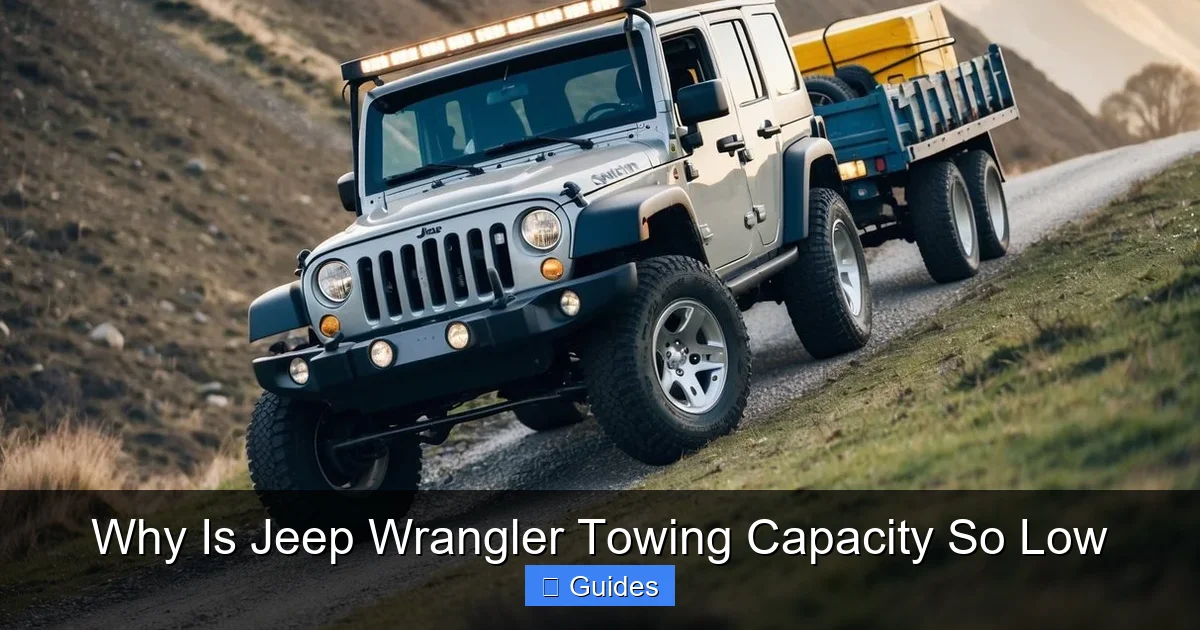
The Jeep Wrangler isn’t just another SUV. It’s a direct descendant of the WWII Willys MB—the original go-anywhere vehicle. That military heritage lives on in every Wrangler, from its rugged body-on-frame construction to its live axles and solid front and rear suspensions. These features are fantastic for off-roading. They provide exceptional wheel articulation, durability over rough terrain, and the ability to handle extreme angles.
But they’re not ideal for towing.
Let’s break down the core design elements that make the Wrangler a trail legend—and a towing underperformer.
Body-on-Frame Construction
The Wrangler uses a traditional body-on-frame design, where the body is bolted onto a separate steel frame. This is great for off-roading because the frame can flex and absorb impacts without damaging the body. It also allows for easy modifications—like lifting the suspension or adding skid plates.
However, this design is heavier and less rigid than unibody construction (used in most crossovers). While the frame is strong, it’s not optimized for the constant, sustained stress of towing. The flex that helps on rocks can translate into sway or instability when pulling a heavy trailer at highway speeds.
Short Wheelbase and Compact Stance
The Wrangler’s short wheelbase—especially on the 2-door model—is a double-edged sword. On the trail, it’s a huge advantage. A shorter wheelbase means a tighter turning radius and better approach/departure angles. You can climb steeper rocks and navigate narrow trails with ease.
But on the highway, that same short wheelbase makes the vehicle more prone to trailer sway. When you’re towing, the trailer’s weight pushes against the rear of the vehicle. With less distance between the axles, there’s less leverage to counteract that force. This makes the Wrangler more sensitive to crosswinds, passing trucks, and uneven road surfaces when towing near its limit.
Live Axles and Solid Suspension
Unlike most modern SUVs that use independent front suspension (IFS), the Wrangler retains solid front and rear axles—also known as live axles. This setup is incredibly durable and allows each wheel to move independently over rough terrain, keeping all four tires grounded.
But live axles are heavier and less refined on pavement. They don’t absorb bumps as smoothly, which can lead to a rougher ride when towing. More importantly, they’re not as effective at managing the dynamic loads created by a trailer. The suspension is tuned for off-road articulation, not for stabilizing a heavy load at speed.
Lightweight Body Panels
Jeep has made efforts to reduce weight in recent Wrangler models, using aluminum for doors, hood, and even the windshield frame. While this improves fuel efficiency and off-road agility, it also reduces the overall mass and rigidity of the vehicle. A lighter vehicle has less inherent stability when towing, especially in windy conditions or on uneven roads.
This isn’t to say the Wrangler is flimsy—it’s far from it. But every pound saved for off-road performance is a pound that could have contributed to towing stability.
Engine and Drivetrain Limitations
Visual guide about Why Is Jeep Wrangler Towing Capacity So Low
Image source: cartireinflator.com
The Wrangler’s engine options are capable, but they’re not built with heavy towing as a primary focus. Let’s look at the current lineup and how each performs under load.
Engine Options and Their Towing Impact
As of 2024, the Wrangler offers several engine choices:
– **2.0L Turbocharged 4-Cylinder:** Produces 270 horsepower and 295 lb-ft of torque. It’s fuel-efficient and responsive, but turbo engines can generate more heat under sustained load—like when towing up a mountain pass.
– **3.6L Pentastar V6:** The traditional workhorse, with 285 horsepower and 260 lb-ft of torque. It’s reliable and has good low-end grunt, but it’s not a high-torque engine like a diesel or larger V8.
– **2.0L Plug-in Hybrid (4xe):** Combines the turbo 4-cylinder with an electric motor for 375 horsepower. While powerful, the hybrid system adds complexity and weight, and the battery range drops significantly when towing.
– **3.0L EcoDiesel V6 (discontinued after 2023):** This was the towing champion of the Wrangler lineup, with 260 horsepower and a whopping 442 lb-ft of torque. It could tow up to 7,000 pounds when properly equipped. Its discontinuation left a gap for serious towers.
None of these engines are inherently weak, but none are optimized for the kind of sustained, high-load towing that trucks or full-size SUVs handle daily.
Transmission and Cooling Challenges
The Wrangler’s standard 8-speed automatic transmission is smooth and efficient, but it’s not built for heavy, continuous towing. Under normal driving, it shifts quickly and keeps engine RPMs low. But when towing, especially in hot weather or uphill, the transmission can overheat.
This is where the optional **Trailer Tow Package** becomes critical. It includes:
– A heavy-duty transmission cooler
– A Class IV hitch receiver
– Wiring harness for trailer lights
– Upgraded cooling system
Without this package, the transmission is at risk of overheating, which can lead to reduced performance, warning lights, or even damage. Even with the package, prolonged towing near max capacity can strain the system.
Drivetrain and Traction Considerations
The Wrangler’s 4×4 system is legendary. With options like Rock-Trac, Tru-Lok lockers, and a disconnecting front sway bar, it can tackle terrain that would stop most vehicles dead.
But when towing, 4WD is often not recommended—especially at high speeds. The added mechanical resistance can increase strain on the drivetrain and reduce fuel efficiency. Most owners tow in 2WD mode, which is fine on flat, dry roads. But if you’re towing up a steep grade or on loose gravel, you may need to engage 4WD low—just be aware of the added stress.
Towing Capacity by Model and Configuration
Visual guide about Why Is Jeep Wrangler Towing Capacity So Low
Image source: towstats.com
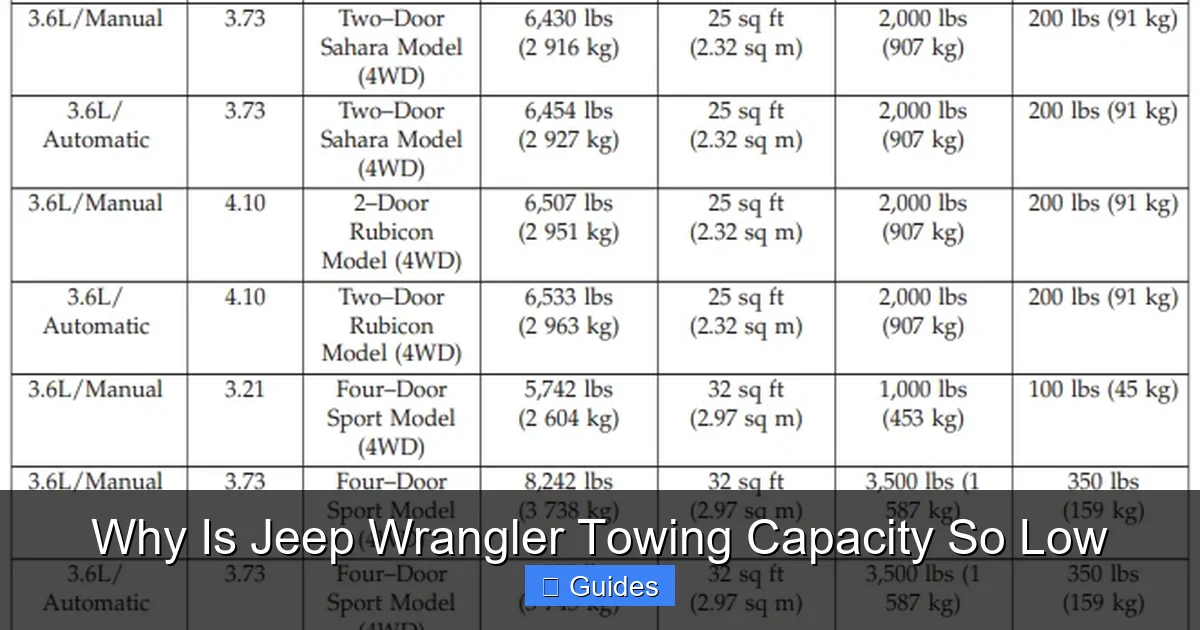
Not all Wranglers are created equal when it comes to towing. The capacity varies significantly based on body style, engine, drivetrain, and equipment. Let’s break it down.
2-Door vs. 4-Door Wrangler
The 4-door Wrangler Unlimited has a longer wheelbase, more cargo space, and generally higher towing capacity. Here’s a quick comparison:
– **2-Door Wrangler (2024):** Max towing capacity of **3,500 pounds** with the towing package.
– **4-Door Wrangler Unlimited (2024):** Max towing capacity of **3,500 to 7,000 pounds**, depending on engine and configuration.
Wait—7,000 pounds? Yes, but only with the right setup.
Engine-Specific Towing Limits
– **2.0L Turbo 4-Cylinder (4-door):** 3,500 lbs
– **3.6L V6 (4-door):** 3,500 lbs (without towing package), up to **7,000 lbs** with the towing package and proper gearing
– **4xe Plug-in Hybrid:** 3,500 lbs (due to added weight and battery limitations)
Note: The 7,000-pound rating is only achievable on the 4-door Unlimited with the 3.6L V6, the towing package, and the correct axle ratio (typically 3.73:1 or higher). Most base models are limited to 3,500 pounds.
Real-World Towing Examples
So what can you actually tow with a Wrangler?
– **3,500 lbs:** Small travel trailers (like a Scamp or Casita), a medium-sized boat with trailer, a small utility trailer loaded with ATVs or furniture.
– **7,000 lbs (properly equipped):** Larger travel trailers, a pontoon boat, a small camper with slide-outs, or a dual-axle utility trailer.
But here’s the catch: even if your Wrangler can technically tow 7,000 pounds, you need to consider:
– **Payload capacity:** The Wrangler’s payload is typically around 1,000–1,300 pounds. That includes passengers, gear, and the tongue weight of the trailer. If you’re carrying four adults and gear, you may have little room left for trailer tongue weight.
– **Tongue weight:** A 7,000-pound trailer should have 700–1,050 pounds of tongue weight. That’s a significant portion of your payload.
– **Braking:** The Wrangler’s brakes are adequate, but they’re not designed for stopping heavy loads. Always use a trailer with electric brakes and a brake controller.
How to Safely Tow with Your Jeep Wrangler
Just because the Wrangler has a lower towing capacity doesn’t mean you can’t tow safely. It just means you need to be smart about it.
Step 1: Know Your Exact Towing Capacity
Don’t guess. Check your owner’s manual or the door jamb sticker. Look for:
– GCWR
– GVWR
– Curb weight
– Maximum tongue weight
Use this formula:
**Towing Capacity = GCWR – GVWR – Curb Weight**
And remember: this is the maximum. For safety and longevity, many experts recommend towing no more than 80% of your vehicle’s rated capacity.
Step 2: Invest in the Right Equipment
If you plan to tow regularly, the **Trailer Tow Package** is non-negotiable. It includes:
– Class IV hitch (2-inch receiver)
– 7-pin wiring harness
– Transmission cooler
– Upgraded cooling system
You’ll also need:
– **Weight distribution hitch:** Essential for trailers over 5,000 pounds to improve stability.
– **Sway control:** Reduces trailer sway caused by wind or passing vehicles.
– **Brake controller:** Required for trailers with electric brakes. Install it inside the cabin for easy access.
Step 3: Load and Distribute Weight Properly
– Keep 60% of the trailer’s weight in the front half.
– Secure all cargo to prevent shifting.
– Check tire pressure on both the Wrangler and trailer.
– Never exceed the trailer’s GVWR or the Wrangler’s tongue weight limit.
Step 4: Drive Smart
– Allow extra following distance.
– Avoid sudden lane changes or hard braking.
– Use lower gears when going downhill to reduce brake wear.
– Take breaks every 2 hours to check hitch, tires, and brakes.
Myths and Misconceptions About Wrangler Towing
There are a lot of myths floating around about the Wrangler and towing. Let’s clear them up.
Myth: “The Wrangler Can’t Tow Anything”
False. A properly equipped 4-door Unlimited can tow up to 7,000 pounds—enough for most small to medium trailers. It’s not a work truck, but it’s far from useless.
Myth: “All Wranglers Tow the Same”
Not even close. A 2-door with a 2.0L engine tows 3,500 lbs. A 4-door with a V6 and towing package can tow double that. Always check your specific configuration.
Myth: “You Can Just Add a Bigger Hitch and Tow More”
No. The hitch is just one part of the system. The transmission, cooling, suspension, and brakes all have limits. Overloading one component can damage the entire vehicle.
Myth: “Off-Road Builds Improve Towing”
Actually, the opposite is often true. Lift kits, larger tires, and added armor increase weight and alter the center of gravity, reducing towing stability. If you’re serious about towing, keep modifications minimal or choose towing-friendly upgrades.
Conclusion: The Wrangler’s Towing Trade-Off
So why is the Jeep Wrangler towing capacity so low? Because it wasn’t designed to be a tow rig. It was designed to be unstoppable off the pavement. Every engineering decision—from its short wheelbase to its live axles—was made to conquer trails, not highways with trailers in tow.
That doesn’t make it a bad vehicle. It makes it a specialized one. The Wrangler excels at what it was built for: adventure, exploration, and freedom. And for most owners, that’s enough. If you need to tow a small camper for a weekend trip or haul a jet ski to the lake, the Wrangler can do it—safely and reliably—as long as you respect its limits.
But if you’re planning to tow a large fifth-wheel or a heavy equipment trailer on a daily basis, you might want to consider a truck or a full-size SUV. The Wrangler is a trail hero, not a workhorse.
In the end, the Wrangler’s lower towing capacity isn’t a flaw—it’s a feature of its identity. It’s a reminder that not every vehicle needs to do everything. Sometimes, doing one thing exceptionally well is better than doing many things mediocrely.
And for those who value off-road capability over towing bragging rights? That’s a trade-off worth making.
Frequently Asked Questions
Can a Jeep Wrangler tow a travel trailer?
Yes, but only if it’s properly equipped and the trailer is within its towing capacity. A 4-door Wrangler Unlimited with the towing package can handle small to medium travel trailers up to 7,000 pounds. Always check your specific model’s rating and use a weight distribution hitch for stability.
What is the highest towing capacity for a Jeep Wrangler?
The highest towing capacity for a Jeep Wrangler is 7,000 pounds, but only on the 4-door Unlimited model with the 3.6L V6 engine, the optional towing package, and the correct axle ratio. Most other configurations are limited to 3,500 pounds.
Do I need a special package to tow with my Wrangler?
Yes, the Trailer Tow Package is highly recommended and often required to achieve the maximum towing capacity. It includes a transmission cooler, Class IV hitch, wiring harness, and upgraded cooling—critical for safe towing.
Can I tow in 4WD with a Jeep Wrangler?
You can tow in 4WD low for short distances on low-traction surfaces like snow or mud, but it’s not recommended for highway towing. Most owners tow in 2WD to reduce drivetrain strain and improve fuel efficiency.
Why was the EcoDiesel Wrangler discontinued?
The 3.0L EcoDiesel V6 was discontinued after 2023 due to stricter emissions regulations and shifting consumer demand toward hybrid and electric options. It was the only Wrangler engine capable of towing 7,000 pounds without the towing package.
Is it safe to tow near the Wrangler’s maximum capacity?
It can be safe if the vehicle is properly equipped, the load is balanced, and you drive cautiously. However, many experts recommend towing no more than 80% of the rated capacity to reduce stress on the engine, transmission, and brakes.

At CarLegit, we believe information should be clear, factual, and genuinely helpful. That’s why every guide, review, and update on our website is created with care, research, and a strong focus on user experience.