
Yes, 33-inch tires can fit a stock GMC Sierra—but with caveats. Depending on the model year, trim level, and factory suspension setup, you may experience rubbing or require minor adjustments. This guide breaks down everything you need to know before making the switch.
So, you’ve got a GMC Sierra—maybe it’s a sleek 1500 Denali, a rugged AT4, or a trusty workhorse 2500HD—and you’re eyeing those beefy 33-inch tires. They look tough, improve off-road capability, and give your truck that aggressive stance everyone notices. But here’s the million-dollar question: *Will 33 inch tires fit a stock GMC Sierra?*
The short answer? **Yes—but it depends.** And that “depends” is where things get interesting. Unlike dropping in a new stereo or swapping out headlights, upgrading to larger tires isn’t just about aesthetics. It affects handling, fuel economy, speedometer accuracy, and even your truck’s safety systems. So before you head to the tire shop and drop a few grand, let’s dig into the details.
In this guide, we’ll walk you through everything you need to know about fitting 33-inch tires on a stock GMC Sierra. We’ll cover model differences, suspension setups, potential rubbing issues, wheel specs, and real-world examples from Sierra owners who’ve made the switch. Whether you’re driving a 2019 Sierra 1500 or a 2023 2500HD, this article will help you make an informed decision—without blowing your budget or damaging your truck.
Let’s get started.
In This Article
- 1 Key Takeaways
- 2 📑 Table of Contents
- 3 Understanding Tire Sizes and What “33-Inch” Really Means
- 4 GMC Sierra Models and Their Stock Clearance
- 5 Potential Rubbing Issues and How to Fix Them
- 6 Wheel Specs: Offset, Backspacing, and Width
- 7 Do You Need a Lift or Leveling Kit?
- 8 Performance and Practical Considerations
- 9 Step-by-Step: How to Test Fit 33-Inch Tires
- 10 Conclusion
- 11 Frequently Asked Questions
- 11.1 Can I put 33-inch tires on a stock GMC Sierra 1500 without a lift?
- 11.2 Will 33-inch tires affect my Sierra’s speedometer?
- 11.3 Do I need to modify my suspension to fit 33s?
- 11.4 What’s the best tire size for a 33-inch look on a Sierra?
- 11.5 Can I use stock wheels with 33-inch tires?
- 11.6 Will larger tires void my GMC warranty?
Key Takeaways
- Most stock GMC Sierras can accommodate 33-inch tires with minimal or no modifications, especially on 4WD models.
- 2WD models may require more caution due to lower ride height and less suspension travel.
- Wheel offset and backspacing matter—aggressive offsets can cause rubbing even if the tire size seems compatible.
- Factory fender liners and suspension components are common rubbing points that may need trimming or removal.
- Lift kits or leveling kits aren’t always necessary, but they improve clearance and performance with larger tires.
- Always check your specific model year and trim—Sierra 1500 vs. 2500HD have different clearances.
- Professional fitment testing is recommended before full installation to avoid damage or unsafe driving conditions.
📑 Table of Contents
- Understanding Tire Sizes and What “33-Inch” Really Means
- GMC Sierra Models and Their Stock Clearance
- Potential Rubbing Issues and How to Fix Them
- Wheel Specs: Offset, Backspacing, and Width
- Do You Need a Lift or Leveling Kit?
- Performance and Practical Considerations
- Step-by-Step: How to Test Fit 33-Inch Tires
- Conclusion
Understanding Tire Sizes and What “33-Inch” Really Means
Before we talk about fitment, let’s clarify what we mean by “33-inch tires.” Tire sizes are usually written in a format like **285/70R17** or **305/65R18**. These numbers represent width, aspect ratio, and wheel diameter. A 33-inch tire typically refers to the overall diameter of the tire when mounted and inflated.
For example:
– A **285/70R17** tire is roughly 32.7 inches tall.
– A **305/65R18** is about 33.6 inches.
– A **275/70R18** comes in at around 33.2 inches.
So when people say “33-inch tires,” they’re usually referring to tires that are *close to* 33 inches in diameter—give or take a half-inch. That small difference matters when it comes to clearance.
Why Tire Diameter Matters
The overall diameter of your tire affects several key areas:
– **Ground clearance**: Larger tires lift your truck slightly, improving off-road performance.
– **Speedometer accuracy**: Bigger tires cover more distance per revolution, which can make your speedometer read slow.
– **Gear ratio impact**: If your truck isn’t geared for larger tires, you might notice reduced acceleration and lower fuel economy.
– **Suspension and steering geometry**: Excessive tire size can strain components like ball joints, tie rods, and CV axles.
So while 33-inch tires are generally manageable on a stock Sierra, it’s not just about whether they *fit*—it’s about whether they *work well*.
GMC Sierra Models and Their Stock Clearance

Visual guide about Will 33 Inch Tires Fit a Stock Gmc Sierra
Image source: tiresdoc.com
Not all GMC Sierras are created equal. The truck has evolved over the years, and different models and trims come with varying levels of factory suspension, ride height, and fender clearance. Let’s break it down by generation and configuration.
GMC Sierra 1500 (2014–2018)
The fifth-generation Sierra 1500 (2014–2018) is a popular choice for tire upgrades. These trucks come with a coil-spring rear suspension (instead of leaf springs), which gives them a smoother ride and better articulation.
– **4WD models**: Most 4WD Sierra 1500s can fit 33-inch tires with little to no modification. Factory ride height is about 8.5 to 9 inches of ground clearance, and the fender wells are fairly generous.
– **2WD models**: These sit lower—around 7 to 7.5 inches of clearance. Fitting 33s may require a leveling kit (1.5 to 2 inches) to avoid rubbing, especially during full suspension compression.
Owners often report success with 285/70R17 or 305/65R18 tires on stock wheels, especially with a slight wheel spacer or adjusted offset.
GMC Sierra 1500 (2019–Present)
The sixth-generation Sierra (2019 and newer) introduced a redesigned chassis, updated suspension, and more aggressive styling. These trucks are even more capable out of the box.
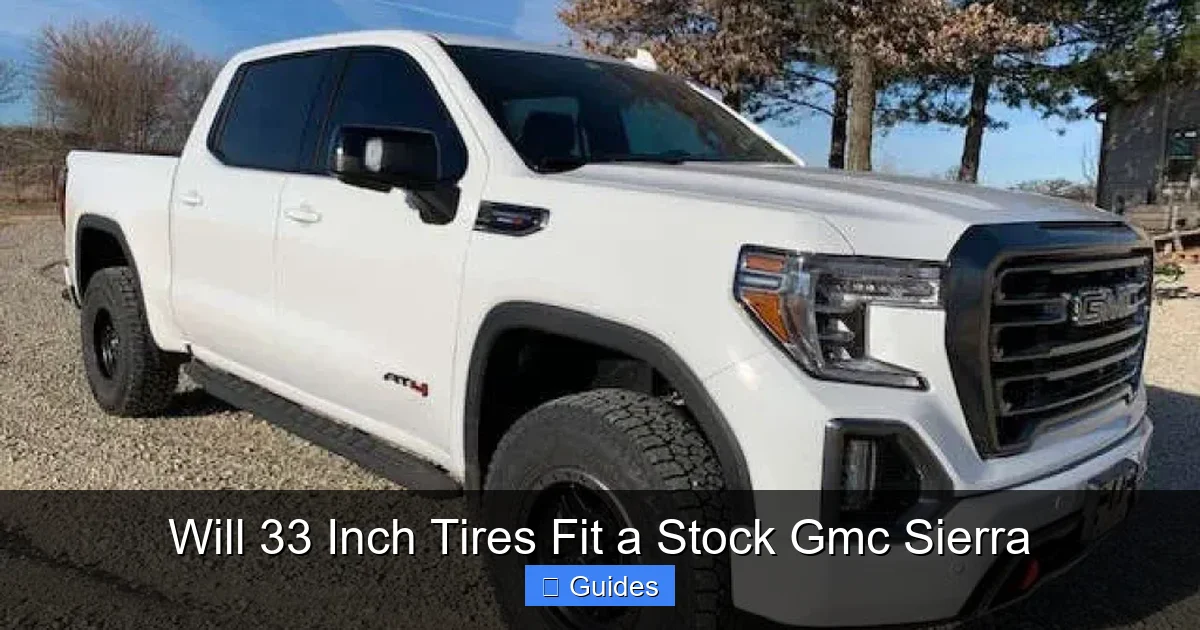
– **4WD models**: Excellent clearance. Many owners run 33s with zero issues. The AT4 trim, in particular, comes with a 2-inch factory lift and wider track, making it ideal for larger tires.
– **2WD models**: Still lower than 4WD, but the updated suspension allows for better articulation. A 1.5-inch leveling kit is often enough to clear 33s without major trimming.
One thing to note: The 2019+ Sierra has tighter fender liners and more plastic body cladding. This can lead to rubbing if you’re not careful with wheel specs.
GMC Sierra 2500HD and 3500HD (2011–Present)
Heavy-duty Sierras are built for towing and hauling, which means they come with stronger suspensions and higher ride heights.
– **4WD models**: These trucks often have 9 to 10 inches of ground clearance stock. 33-inch tires fit easily—many owners go even bigger.
– **2WD models**: Still higher than 1500s due to leaf spring rear suspension. 33s usually fit without issues, though rear axle clearance should be checked during full droop.
HD models also have wider fender flares, which help accommodate larger tires without looking cramped.
Potential Rubbing Issues and How to Fix Them
Visual guide about Will 33 Inch Tires Fit a Stock Gmc Sierra
Image source: tiresdoc.com
Even if your Sierra *can* fit 33-inch tires, you might run into rubbing—especially during turns, over bumps, or when the suspension is fully compressed. Here are the most common trouble spots.
Front Fender Liners
The plastic liners inside the front wheel wells are the #1 culprit for rubbing with larger tires. They’re designed for stock tire sizes and don’t leave much room for expansion.
**Solution**: Trim the liner with a utility knife or Dremel tool. Many owners remove the front portion of the liner where it meets the bumper. This is a common mod and doesn’t affect functionality.
Lower Control Arm and Suspension Components
On 4WD models, the front differential and lower control arms sit close to the tire’s inner sidewall. Aggressive wheel offsets (like +12mm or less) can push the tire into these parts.
**Solution**: Use wheels with proper backspacing (4.5 to 5 inches is ideal) or add 1-inch wheel spacers. Avoid ultra-aggressive offsets unless you’re willing to modify suspension components.
Rear Wheel Wells and Leaf Springs (HD Models)
On 2500HD and 3500HD trucks, the rear leaf springs and shock mounts can interfere with larger tires—especially during articulation.
**Solution**: A rear lift block or add-a-leaf can provide extra clearance. Some owners also trim the rear fender liner slightly.
Steering Stop Mod
When you turn the wheel fully, the tire can contact the steering knuckle or frame. This is more common with wider tires (like 305mm or 315mm).
**Solution**: Install steering stop spacers or modify the factory stops. This limits how far the wheels can turn, preventing contact.
Wheel Specs: Offset, Backspacing, and Width
Visual guide about Will 33 Inch Tires Fit a Stock Gmc Sierra
Image source: tiresdoc.com
Tire size isn’t the only factor—your wheels play a huge role in fitment. Even if you have the right tire diameter, the wrong wheel can cause problems.
Wheel Width
Most 33-inch tires are designed for 8.5 to 10-inch wide wheels. Stock Sierra wheels vary:
– 1500 models: Typically 8 to 8.5 inches wide.
– HD models: Often 8.5 to 9 inches.
If your stock wheels are too narrow, the tire may bulge or not seat properly. Consider aftermarket wheels if you’re upgrading.
Offset and Backspacing
Offset is how far the wheel’s mounting surface is from the centerline. Negative offset pushes the wheel outward; positive offset tucks it in.
– **Stock Sierra offset**: Usually +24mm to +35mm (positive).
– **Ideal for 33s**: +10mm to +20mm, or use 4.5 to 5 inches of backspacing.
Too much negative offset can cause rubbing on suspension parts. Too much positive offset may make the tire rub the fender.
Real-World Example
A 2020 GMC Sierra 1500 AT4 owner swapped stock 275/65R18 tires (32.1 inches) for 305/65R18 (33.6 inches) on +18mm offset wheels. Result? No rubbing, even off-road. The key was the factory 2-inch lift and proper wheel specs.
Do You Need a Lift or Leveling Kit?
Here’s a common myth: *You need a lift to fit 33-inch tires.* Not necessarily.
Leveling Kits (1.5 to 2 Inches)
A leveling kit raises the front of the truck to match the rear. It’s the most common mod for fitting larger tires.
– **Pros**: Inexpensive ($100–$300), easy to install, improves appearance.
– **Cons**: Doesn’t increase rear clearance; may affect ride quality slightly.
Most 2WD Sierras benefit from a leveling kit when running 33s. 4WD models often don’t need one.
Full Lift Kits (3 to 6 Inches)
Lift kits raise both front and rear suspension. They’re overkill for just 33-inch tires but great if you plan to go bigger later.
– **Pros**: Maximum clearance, improved off-road performance.
– **Cons**: Expensive ($800–$2,000+), may require drivetrain modifications, can affect handling.
Unless you’re serious about off-roading, a leveling kit is usually sufficient.
No Lift Needed? Yes, It’s Possible
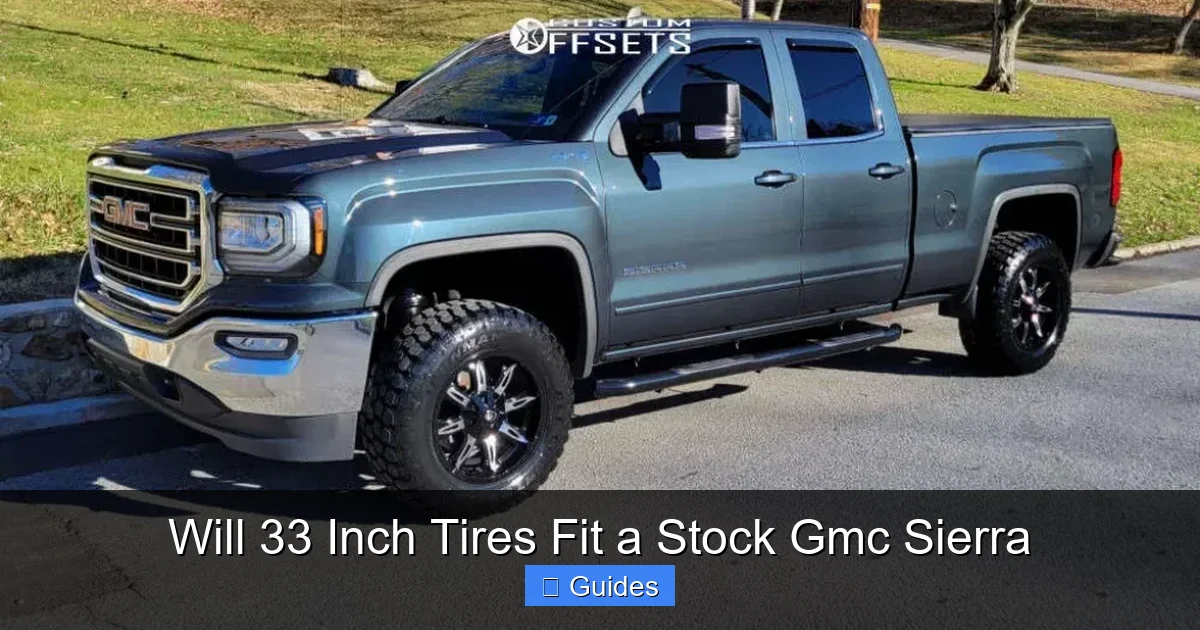
Many Sierra owners run 33s with zero lift. A 2017 Sierra 1500 4WD with stock suspension and 285/70R17 tires is a perfect example. No rubbing, no mods—just careful wheel selection.
Performance and Practical Considerations
Fitting 33-inch tires isn’t just about clearance—it affects how your truck drives and performs.
Fuel Economy
Larger, heavier tires increase rolling resistance. Expect a 1–2 MPG drop, especially in city driving.
Speedometer Accuracy
Your speedometer is calibrated for stock tire size. With 33s, it may read 5–7% slow. For example, at a true 70 mph, your gauge might show 65–66 mph.
**Fix**: Reprogram your truck’s ECU using a tuner like Hypertech, DiabloSport, or HP Tuners. This adjusts the speedometer and can also optimize shift points.
Towing and Payload
Larger tires can reduce effective gear ratio, making towing feel sluggish. If you tow often, consider regearing (e.g., from 3.42 to 4.10) or using a performance tuner.
Warranty and Insurance
Modifying your truck doesn’t void the factory warranty—unless the mod directly causes a failure. However, some insurers may view larger tires as a modification that affects coverage. Check with your provider.
Step-by-Step: How to Test Fit 33-Inch Tires
Before committing, test fit your new tires. Here’s how:
1. **Mount one tire and wheel** on the front hub.
2. **Turn the wheel lock-to-lock** (full left and right) while parked.
3. **Drive slowly over bumps** and listen for rubbing.
4. **Check clearance** at full suspension compression (have someone push down on the bumper while you inspect).
5. **Inspect after 100 miles**—sometimes rubbing only shows up after heat and wear.
If you hear rubbing, note the location and adjust accordingly (trim liner, change wheels, etc.).
Conclusion
So, will 33-inch tires fit a stock GMC Sierra? **Yes—most of the time.** Whether you drive a 1500 or a 2500HD, 2WD or 4WD, there’s a good chance you can make it work with minimal effort.
The key is understanding your truck’s specific setup, choosing the right tire and wheel combination, and being prepared for minor modifications like trimming fender liners or adding a leveling kit. With the right approach, you can enjoy the look and performance of 33-inch tires without sacrificing reliability or safety.
Remember: Every truck is a little different. What works for your neighbor’s Sierra might not work for yours. Take your time, do your research, and when in doubt, consult a professional installer.
Upgrade smart, drive safe, and enjoy the ride.
Frequently Asked Questions
Can I put 33-inch tires on a stock GMC Sierra 1500 without a lift?
Yes, many 4WD GMC Sierra 1500 models can fit 33-inch tires without a lift, especially with proper wheel offset and minor fender liner trimming. 2WD models may benefit from a 1.5- to 2-inch leveling kit.
Will 33-inch tires affect my Sierra’s speedometer?
Yes, larger tires can cause your speedometer to read slow by 5–7%. You can correct this by reprogramming the ECU with a performance tuner.
Do I need to modify my suspension to fit 33s?
Not always. Most stock Sierras have enough clearance, but you may need to trim fender liners or adjust wheel specs. A leveling kit helps on 2WD models.
What’s the best tire size for a 33-inch look on a Sierra?
Popular choices include 285/70R17, 305/65R18, and 275/70R18. These offer a true 33-inch diameter and fit well on most stock setups.
Can I use stock wheels with 33-inch tires?
It depends on the wheel width and offset. Stock wheels may work, but aftermarket wheels with proper backspacing (4.5–5 inches) often provide better clearance.
Will larger tires void my GMC warranty?
No, modifying your tires won’t void your warranty unless the modification directly causes a mechanical failure. Always keep records of professional installations.

At CarLegit, we believe information should be clear, factual, and genuinely helpful. That’s why every guide, review, and update on our website is created with care, research, and a strong focus on user experience.