
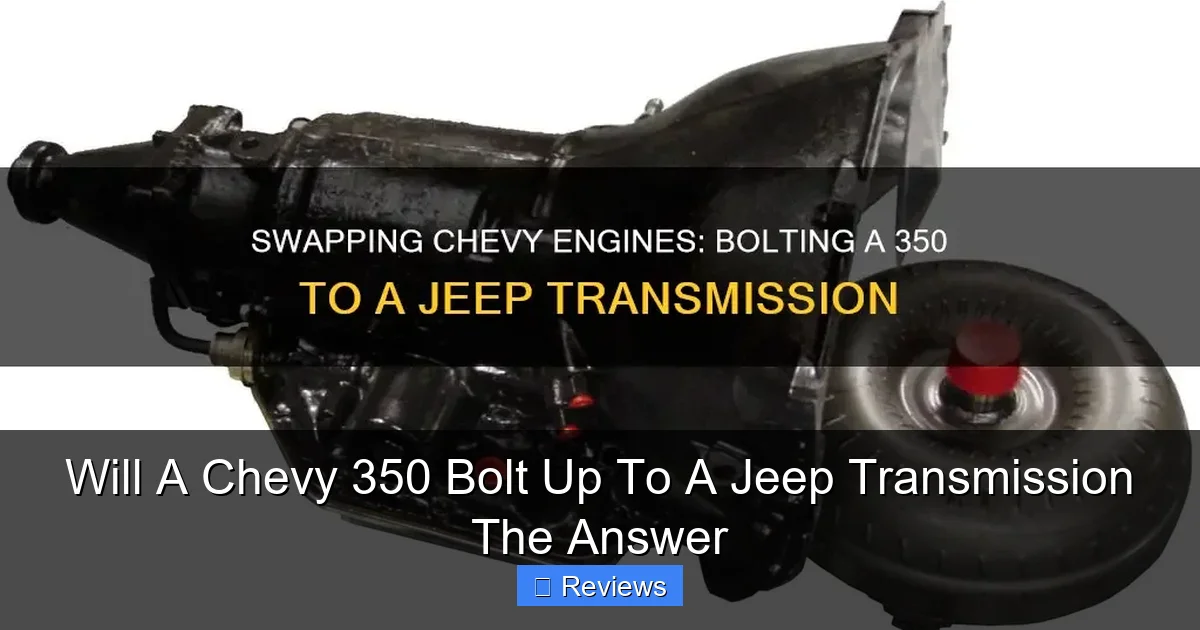
Featured image for will a chevy 350 bolt up to a jeep transmission
Image source: shunauto.com
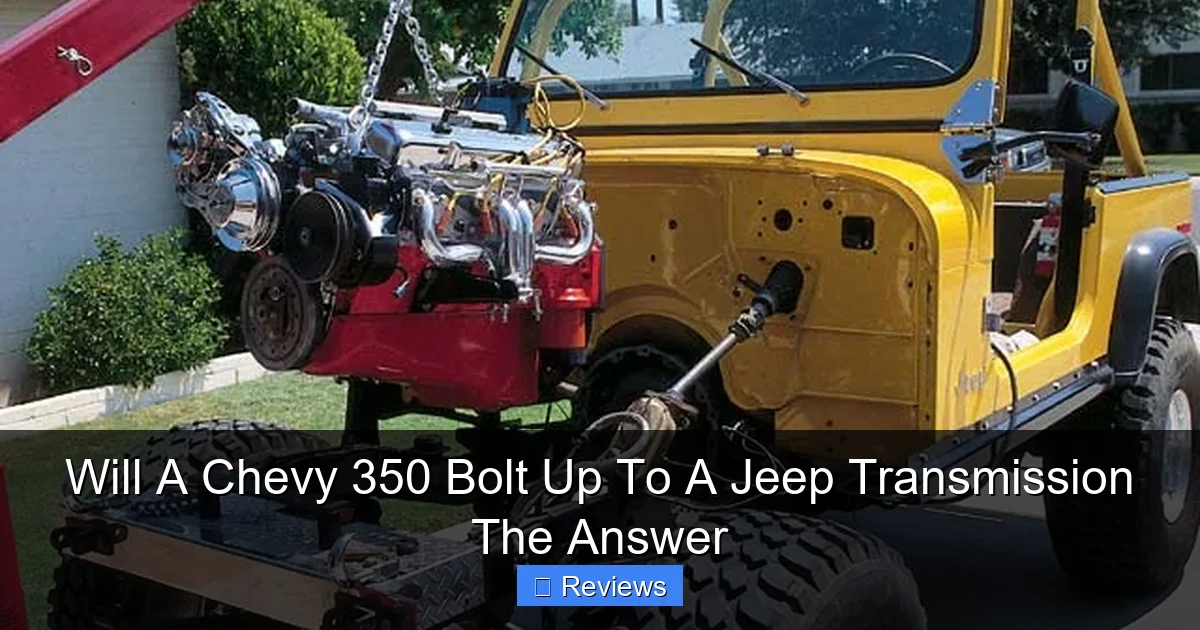
No, a Chevy 350 engine will not directly bolt up to most Jeep transmissions without significant modifications. Due to differing bellhousing bolt patterns and input shaft sizes, an appropriate adapter kit is almost always required for a successful installation. This popular engine swap is achievable but necessitates careful planning for components like clutches, flywheels, engine mounts, and driveline adjustments to ensure compatibility and reliable performance.
Welcome to the ultimate deep dive into one of the most frequently asked questions in the Jeep and hot-rodding communities: “Will a Chevy 350 bolt up to a Jeep transmission?” It’s a question that echoes through garages, over campfires, and across online forums, sparking debates and inspiring countless weekend warrior projects. The allure of combining the legendary reliability and power of a Chevrolet Small Block 350 V8 with the rugged, go-anywhere spirit of a Jeep is undeniable.
For decades, the Chevy 350 has been the undisputed king of engine swaps. Its compact design, massive aftermarket support, incredible power potential, and sheer abundance make it an ideal candidate for breathing new life into older, underpowered Jeeps. Imagine the roar of a V8, the surge of torque, and the confidence of knowing you have a bulletproof powertrain ready for any trail. But bridging the gap between two different automotive manufacturers’ engineering philosophies is rarely a simple “bolt-on” affair. This comprehensive guide will dissect every aspect of this popular swap, providing you with the definitive answer and all the crucial details you need to know.
From bellhousing compatibility to adapter plates, clutch systems to transfer cases, we’ll cover the intricacies that determine whether your dream of a V8-powered Jeep can become a reality. We’ll explore specific Jeep transmission models, highlight the challenges, offer practical solutions, and arm you with the knowledge to approach this ambitious project with confidence. So, grab a wrench, metaphorically speaking, and let’s unravel the mystery of mating a Chevy 350 to a Jeep transmission!
“`html
In This Article
- 1 Key Takeaways
- 2 The Allure of the Chevy 350: Why This Swap?
- 3 Understanding the Core Challenge: Bellhousing and Adapter Plates
- 4 Jeep Transmissions: A Deep Dive into Compatibility
- 5 Beyond the Bellhousing: Comprehensive Drivetrain Considerations
- 6 The Practicalities of the Swap: Tips, Tricks, and Common Pitfalls
- 7 Jeep Transmission Compatibility Data Table
- 8 Conclusion
- 9 Frequently Asked Questions
- 9.1 Can a Chevy 350 engine directly bolt up to a Jeep transmission?
- 9.2 What components are required to connect a Chevy 350 to a Jeep transmission?
- 9.3 Which Jeep transmissions are commonly adapted to a Chevy 350 swap?
- 9.4 Are there common challenges when mating a Chevy 350 with a Jeep transmission?
- 9.5 Is swapping a Chevy 350 into a Jeep with its original transmission a cost-effective modification?
- 9.6 Will a Chevy 350 provide significant performance improvements in a Jeep when paired with the right transmission?
Key Takeaways
- No Direct Fit: A Chevy 350 engine won’t directly bolt to most Jeep transmissions.
- Adapter Kits Essential: An adapter kit is almost always required for this engine swap.
- Bellhousing Compatibility: Ensure you have a matching bellhousing for proper fitment.
- Clutch & Flywheel: Expect to source custom clutch and flywheel components.
- Assess Transmission Strength: Verify if your Jeep transmission can handle the 350’s power.
- Research Specific Models: Always confirm compatibility for your exact engine and transmission.
- Complex Undertaking: This swap is intricate and requires careful planning and expertise.
“`
The Allure of the Chevy 350: Why This Swap?
Before diving into the technicalities of mating a Chevy 350 to a Jeep transmission, it’s worth understanding why this particular engine swap holds such a revered status. The motivations behind this perennial favorite speak volumes about its capabilities and the needs of Jeep enthusiasts.
The Legendary Small Block V8
The Chevrolet Small Block V8, specifically the 350 cubic inch variant, is arguably one of the most successful internal combustion engines ever produced. Introduced in 1967, it has powered everything from muscle cars and trucks to luxury sedans and even boats. Its design is a masterpiece of simplicity and efficiency, leading to incredible durability and a virtually endless supply of parts.
- Durability and Reliability: The Chevy 350 is renowned for its robust construction. Its cast-iron block and simple pushrod valvetrain make it incredibly resilient, capable of shrugging off abuse that would destroy lesser engines. For a vehicle like a Jeep, which often faces extreme conditions, this inherent toughness is a massive advantage.
- Power and Torque: Even in its most basic form, a Chevy 350 offers a significant power and torque upgrade over most stock Jeep engines. Early CJs and YJs, for example, often came with inline-4 or inline-6 engines that, while reliable, simply lacked the grunt needed for serious off-roading, highway cruising, or towing. The V8’s broad torque curve provides excellent low-end power, perfect for crawling over obstacles.
- Aftermarket Support: This is where the Chevy 350 truly shines. An entire industry exists around modifying, repairing, and enhancing the Small Block Chevy. From mild cam upgrades to forced induction, carburetors to electronic fuel injection (EFI) conversion kits, every conceivable part is available, often at very competitive prices. This ensures that maintenance and performance upgrades are always within reach.
- Availability: Go to any junkyard or scour online classifieds, and you’re likely to find dozens of Chevy 350 engines. They were produced in such vast numbers that finding a suitable donor engine is rarely an issue, keeping the initial cost of the swap relatively low.
Benefits for a Jeep
Integrating a Chevy 350 into a Jeep transforms the vehicle in several key ways, addressing common limitations of stock setups.
- Enhanced Off-Road Capability: More power and torque mean easier rock crawling, better hill climbing, and less strain on the drivetrain. The ability to maintain momentum without constantly shifting or bogging down significantly improves the off-road experience.
- Improved On-Road Performance: Let’s face it, many older Jeeps feel lethargic on the highway. A Chevy 350 swap dramatically improves acceleration, allows for easier merging and passing, and makes long-distance driving much more enjoyable, especially when equipped with an appropriate Jeep transmission and gearing.
- Increased Towing Capacity: While a Jeep will never be a heavy-duty tow rig, a V8 engine substantially boosts its ability to haul trailers, whether it’s a small utility trailer or another ATV to the trails.
- Modernization Potential: Swapping in a newer EFI Chevy 350 (like an LS-based engine, which shares the 350-ci displacement in some variants but is technically a Gen III/IV Small Block) can bring modern drivability, fuel efficiency, and emissions control to an older Jeep chassis.
The core appeal, then, lies in taking an already capable platform – the Jeep – and injecting it with a massive dose of readily available, powerful, and dependable American muscle. But how does one actually connect this power plant to the existing Jeep drivetrain? That’s where the real engineering challenge, and the focus of our discussion, begins.
Understanding the Core Challenge: Bellhousing and Adapter Plates
The fundamental question, “Will a Chevy 350 bolt up to a Jeep transmission?”, boils down almost entirely to one critical component: the bellhousing. This is the cast metal casing that encloses the flywheel, clutch, and front input shaft of the transmission, acting as the structural bridge between the engine and the gearbox.
Visual guide about will a chevy 350 bolt up to a jeep transmission
Image source: transmissioncar.com
The Crucial Connection Point
Engines and transmissions are designed with specific bolt patterns on their respective mounting flanges. These patterns are unique to manufacturers and, often, to different engine families within a manufacturer. A Chevrolet Small Block 350 has a distinct bolt pattern that is different from virtually all Jeep engines (AMC, Chrysler, or PowerTech). Therefore, a stock Chevy bellhousing will not directly bolt up to a stock Jeep transmission, and vice-versa.
Think of it like trying to connect two different types of LEGO bricks – they don’t have the same studs and holes. To make them fit, you need a special adapter piece.
The Role of Adapter Plates
This “adapter piece” in the automotive world comes in the form of an adapter plate or, in some cases, a custom bellhousing. These components are precision-machined to bridge the incompatibility gap.
- Adapter Plate (Engine-to-Transmission): This is the most common solution. An adapter plate is a flat or shaped piece of metal that bolts to the rear of the engine block (matching the Chevy pattern) and then provides a new bolt pattern on its other side that matches the front of the Jeep transmission. The original Jeep bellhousing is typically retained or sometimes replaced with an aftermarket bellhousing designed for the Jeep transmission but with a Chevy engine bolt pattern.
- New Bellhousing: In some rare instances, a completely new bellhousing might be manufactured that has the Chevy engine bolt pattern on one side and the Jeep transmission pattern on the other. This is less common than adapter plates for manual transmissions, but more common for adapting automatic transmissions.
Beyond simply matching bolt patterns, an adapter also needs to account for:
- Input Shaft Length: The distance the transmission’s input shaft protrudes must be correct to engage the pilot bushing/bearing in the crankshaft and the clutch disc. An adapter might include a spacer or require a different input shaft.
- Spline Count: The splines on the input shaft must match the splines on the clutch disc (for manuals) or torque converter (for automatics). Adapters usually specify compatibility or require specific clutch kits.
- Pilot Bushing/Bearing: The Chevy crankshaft’s pilot bore might be a different size than what the Jeep transmission’s input shaft requires. A custom pilot bushing or bearing is often supplied with the adapter kit.
- Starter Clearance: The adapter needs to ensure proper clearance for the starter motor and its engagement with the flywheel.
- Flywheel/Flexplate: The Chevy 350 will require its own flywheel (for manuals) or flexplate (for automatics). The adapter kit ensures this works with the chosen Jeep transmission.
Common Adapter Plate Manufacturers
Fortunately, the popularity of the Chevy 350 to Jeep transmission swap has led to specialized companies developing high-quality, proven adapter solutions. The two giants in this field are:
- Novak Conversions: Known for their comprehensive and robust kits, Novak offers solutions for almost every imaginable engine and transmission combination into a Jeep. They provide adapter plates, bellhousings, clutch kits, and all necessary hardware, often with detailed instructions.
- Advance Adapters: Another industry leader, Advance Adapters provides a vast catalog of conversion components. They specialize in a wide range of adapters for engine, transmission, and transfer case swaps, making them a go-to for complex drivetrain modifications.
Both companies have extensive experience and technical support, making them invaluable resources for anyone undertaking a Chevy 350 swap into a Jeep. Consulting their catalogs and contacting their technical support should be one of the first steps in planning your project, as they often have specific recommendations for each Jeep transmission variant.
Jeep Transmissions: A Deep Dive into Compatibility
The “Jeep transmission” isn’t a single entity; over the decades, Jeeps have utilized a wide array of manual and automatic gearboxes. The compatibility of a Chevy 350 depends heavily on the specific transmission model you have or plan to use. Some are easily adaptable, others less so, and some are simply not worth the effort due to their inherent weakness or design.
Visual guide about will a chevy 350 bolt up to a jeep transmission
Image source: ridecove.com
Manual Transmissions and Their Adaptability
Manual transmissions are generally the preferred choice for a Chevy 350 swap into a Jeep, especially for off-roading, due to their simplicity, strength, and direct feel. However, not all manual Jeeps transmissions are created equal.
Borg-Warner T-150 (CJ5, CJ7 – 1972-1979)
- Description: A three-speed, top-shifted manual transmission, common in early CJs. It’s relatively robust for a three-speed, but its ratios aren’t ideal for a V8 or serious off-roading.
- Chevy 350 Compatibility: Adaptable via an adapter plate (e.g., from Novak or Advance Adapters). These kits typically involve replacing the T-150’s input shaft and using a custom pilot bushing and clutch.
- Recommendation: While adaptable, the T-150’s three gears and wide ratio spread make it a less-than-ideal mate for a powerful V8. Many choose to swap the transmission as well when installing a Chevy 350.
Borg-Warner T-176 (CJ7, YJ – 1980-1986)
- Description: A four-speed manual with a synchronized first gear, providing better gearing than the T-150. It’s a reasonably strong transmission for its size.
- Chevy 350 Compatibility: Good. Adapter kits are readily available to mate a Chevy 350 to the T-176 bellhousing. This often involves a new input shaft and a custom pilot bushing.
- Recommendation: A decent option for a mild Chevy 350. It handles moderate V8 torque well, and its four speeds are an improvement.
Aisin AX-15 (YJ – 1988-1995, TJ – 1997-1999, XJ – 1987-1999)
- Description: A five-speed manual transmission, very popular and generally considered robust. It offers good gear spacing and an overdrive gear.
- Chevy 350 Compatibility: Excellent. This is one of the most common and recommended Jeep transmissions for a Chevy 350 swap. Novak and Advance Adapters offer comprehensive kits, often including a new bellhousing or an adapter plate that mounts between the Chevy engine and a custom bellhousing designed for the AX-15. These kits typically manage input shaft length, pilot bushing, and clutch spline compatibility.
- Recommendation: Highly recommended. The AX-15’s five speeds, including overdrive, make it excellent for both highway driving and off-road use with a V8. It can handle the torque of a mild to moderately built Chevy 350.
New Venture Gear NV3550 (TJ – 2000-2004, XJ – 2000-2001)
- Description: A five-speed manual, essentially an upgraded replacement for the AX-15, offering similar ratios and strength.
- Chevy 350 Compatibility: Excellent, mirroring the AX-15. Adapter kits are available from the major manufacturers, usually involving a new bellhousing designed to fit the Chevy 350 block and accept the NV3550.
- Recommendation: Another strong contender, very similar to the AX-15 in terms of swap desirability and capabilities.
Older Heavy-Duty Manuals (T-18, SM465)
- Description: These are not typically stock Jeep transmissions but rather heavy-duty manual transmissions often swapped into Jeeps alongside a V8. The Ford T-18 and GM SM465 are legendary for their stump-pulling low “granny” first gear and extreme durability.
- Chevy 350 Compatibility: Excellent. Since the SM465 is a GM transmission, it often bolts directly to a Chevy 350 bellhousing. The Ford T-18 would require a Ford bellhousing, which then needs an adapter to the Chevy engine, or a custom bellhousing. However, if you’re swapping a Chevy 350, integrating a matching heavy-duty GM transmission like the SM465 makes a lot of sense, simplifying the engine-to-transmission connection significantly.
- Recommendation: If extreme strength and a very low first gear are paramount, swapping in one of these transmissions with your Chevy 350 is a popular and effective choice, often simplifying the engine-to-transmission adapter situation.
Automatic Transmissions and Their Adaptability
Automatic transmissions offer ease of driving and can be excellent for certain types of off-roading, like rock crawling, due to their torque multiplication and smooth power delivery. However, adapting them to a Chevy 350 can sometimes be more complex or less desirable than manual swaps.
TorqueFlite TF-999 / TF-904 (CJ, YJ)
- Description: Chrysler’s three-speed automatic transmissions, common in CJs and YJs. The 999 is the heavier-duty version. They are simple, robust for their original applications, and reliable.
- Chevy 350 Compatibility: Good. Adapter kits are available to mate a Chevy 350 to the TF-999/904. These kits typically include a custom flexplate, a crankshaft adapter bushing, and a special torque converter spacer or custom torque converter to accommodate the differing bolt patterns and pilot diameters.
- Recommendation: A viable option for a mild Chevy 350, especially if you prefer an automatic. However, the lack of an overdrive gear means higher RPMs on the highway and potentially worse fuel economy with a V8.
Aisin-Warner AW4 (XJ – 1987-2001)
- Description: A very strong and reliable four-speed automatic with overdrive, electronically controlled, found in Cherokee XJs.
- Chevy 350 Compatibility: Very Difficult. The AW4 is electronically controlled and designed to work specifically with Jeep’s 4.0L engine management system. Adapting it to a Chevy 350 would require an aftermarket stand-alone transmission controller (e.g., from Compushift or PCS) to manage shift points and lockup. While technically possible, the complexity and cost usually make it an unappealing option compared to swapping in a GM automatic.
- Recommendation: Generally NOT recommended for a Chevy 350 swap. If you want an automatic, a GM automatic transmission (like a TH350, 700R4, or 4L60E) is almost always a simpler and more cost-effective choice.
Newer Jeep Automatics (42RLE, 545RFE, etc.)
- Description: These are the modern, electronically complex automatics found in TJ Wranglers (2003-2006), JK Wranglers, and other later Jeep models.
- Chevy 350 Compatibility: Extremely Difficult to impossible. These transmissions are deeply integrated with the vehicle’s CAN-BUS system and engine control unit (ECU). Adapting them to a non-native engine, especially a non-Chrysler engine, would be an engineering nightmare, requiring highly sophisticated standalone controllers and extensive custom wiring.
- Recommendation: Absolutely NOT recommended. If you have a newer Jeep and want a Chevy 350, you will undoubtedly be swapping out the factory automatic transmission for a compatible GM automatic.
The Bellhousing Dilemma for Each Transmission
For almost every Jeep transmission, the solution to mating it with a Chevy 350 involves one of two main approaches from the adapter manufacturers:
- Adapter Plate Between Engine and Original Jeep Bellhousing: This is common for manual transmissions where the Jeep bellhousing itself has enough material and space to accept the adapter. The adapter bolts to the Chevy 350, and then the original Jeep bellhousing bolts to the adapter. This often requires a new input shaft for the transmission, a specific pilot bushing, and a custom clutch/pressure plate combination.
- New Bellhousing: For certain transmissions (like the AX-15 or NV3550), companies like Novak or Advance Adapters offer a completely new bellhousing. This bellhousing is designed to bolt directly to the Chevy 350 block and then accept the front of the specific Jeep transmission. This simplifies the input shaft and pilot bushing issues, as the new bellhousing is designed to align everything correctly.
- Adapter Plate Between Engine and GM Transmission (then adapter to Jeep Transfer Case): This is another common scenario for those who choose to swap out the Jeep transmission entirely for a stronger, more compatible GM transmission (e.g., TH350, 700R4, 4L60E, NV4500). In this case, the GM transmission bolts directly to the Chevy 350, and the “adapter” comes into play between the GM transmission and the original Jeep transfer case (or a new transfer case). This often simplifies the engine-to-transmission part of the swap but adds complexity to the transmission-to-transfer case part.
The choice of which Jeep transmission to keep, or whether to swap it for a GM unit, is one of the most significant decisions in a Chevy 350 swap. It impacts cost, complexity, performance, and long-term reliability.
Beyond the Bellhousing: Comprehensive Drivetrain Considerations
While the bellhousing and adapter plate are the linchpins of mating a Chevy 350 to a Jeep transmission, a successful engine swap is far more than just connecting two major components. It’s a comprehensive drivetrain overhaul that affects numerous other systems in the vehicle. Neglecting these areas can lead to immediate problems or long-term failures.
Visual guide about will a chevy 350 bolt up to a jeep transmission
Image source: motortrend.com
Clutch and Flywheel Setup (for Manual Transmissions)
For manual transmissions, the clutch system is critical. A Chevy 350 requires a flywheel designed for its crankshaft bolt pattern. The clutch disc, pressure plate, and throw-out bearing must then be compatible with both the Chevy flywheel and the Jeep transmission’s input shaft spline count and pilot bushing. Adapter kits typically include or recommend the correct components, often a hybrid setup combining Chevy and Jeep parts, or completely custom units.
- Flywheel: Must be for a Chevy 350, ensuring correct balance (internal vs. external).
- Clutch Disc: Must have the correct diameter for the pressure plate and the correct spline count for the Jeep transmission’s input shaft.
- Pressure Plate: Matched to the Chevy flywheel.
- Pilot Bushing/Bearing: Critical for supporting the transmission’s input shaft in the Chevy crankshaft. Often custom-made or supplied with adapter kits to bridge the size difference.
- Clutch Linkage: If the Jeep originally had a mechanical clutch linkage, it may need to be converted to a hydraulic system to work with the V8 and new bellhousing.
Transfer Case Compatibility
Once the engine and transmission are mated, the transmission must then connect to the transfer case. Most Jeep transfer cases (like the Dana 300, NP231, NP207, NP241, etc.) have a standard bolt pattern on their input side. However, the input shaft length and spline count of the transfer case must match the output shaft of the newly installed transmission (or its adapter).
- Input Shaft: Some adapter kits for the Chevy 350 to Jeep transmission swap might also include or require a new input shaft for the transfer case to properly mate with the output of the adapted Jeep transmission.
- Clocking: The orientation (“clocking”) of the transfer case relative to the transmission output can sometimes be an issue, affecting ground clearance and driveshaft angles. Some adapter kits allow for different clocking positions.
- Strength: A V8 significantly increases torque. Ensure your chosen transfer case is strong enough to handle the increased power of the Chevy 350. Upgrading to a heavier-duty unit like an Atlas II or an NP205 might be necessary for extreme applications.
Driveshafts: Length and U-Joints
Changing the engine and transmission almost always changes the overall length of the drivetrain. This means the original front and rear driveshafts will likely be too long or too short. You will need custom-length driveshafts.
- Measurement: Take precise measurements once the engine, transmission, and transfer case are fully mounted in the chassis.
- U-Joints: Ensure the U-joints on your new driveshafts match the yokes on your transfer case and axles. Upgrading to stronger U-joints (e.g., 1310 to 1350 series) is often a good idea with a V8.
- Angles: Pay attention to driveshaft angles to prevent vibrations and premature wear, especially if you have a suspension lift. Double Cardan (CV) driveshafts are often recommended for lifted Jeeps.
Engine Mounting and Motor Mounts
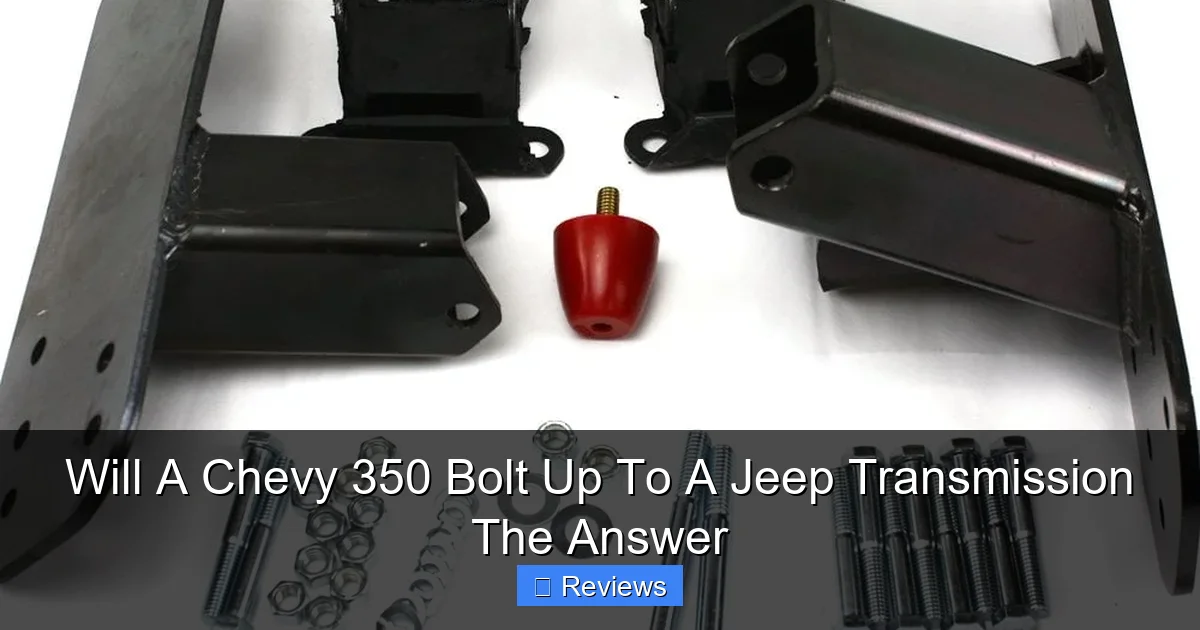
A Chevy 350 will not share the same motor mount locations or bracketry as the original Jeep engine. Custom motor mounts and frame brackets are essential. These can be fabricated, or you can purchase specific swap kits from manufacturers like Novak Conversions or Advance Adapters.
- Placement: Proper engine placement is crucial for driveshaft angles, oil pan clearance, and exhaust routing.
- Vibration Control: Use good quality rubber or polyurethane motor mounts to absorb engine vibrations.
Radiator and Cooling System
The Chevy 350 generates significantly more heat than most stock Jeep engines. The original radiator will almost certainly be inadequate. An upgraded cooling system is a must.
- Radiator: A larger, often aluminum, radiator with higher cooling capacity is required. Specific swap radiators are available that fit the Jeep’s grille opening but offer V8 cooling.
- Fan: A powerful mechanical fan (clutch fan) or dual electric fans capable of moving sufficient airflow are necessary, especially for low-speed off-roading.
- Hoses and Thermostat: Custom radiator hoses and a thermostat appropriate for the V8.
Exhaust System Fabrication
The original exhaust manifolds/headers and exhaust system will not fit the Chevy 350. This will require custom fabrication.
- Headers/Manifolds: Shorty headers or block-hugger manifolds are often used for clearance in a narrow Jeep engine bay.
- Routing: The exhaust pipes will need to be custom-routed around the frame, transmission, and transfer case, leading to new mufflers and tailpipes.
- Oxygen Sensors: If using an EFI Chevy 350, O2 sensor bungs will need to be welded into the exhaust.
Fuel System Upgrades
The fuel requirements of a Chevy 350 are different from many stock Jeep engines.
- Carbureted: If using a carbureted Chevy 350, a mechanical fuel pump on the engine or an aftermarket electric low-pressure fuel pump will be needed.
- Electronic Fuel Injection (EFI): If using an EFI V8, a high-pressure electric fuel pump (in-tank or external) capable of supplying 40-60 PSI is essential, along with a return line to the fuel tank and an appropriate fuel pressure regulator. The original Jeep fuel tank might need to be modified or replaced to accommodate an in-tank pump.
Wiring and ECU Integration
This is where the swap can get very complex, especially with EFI engines.
- Carbureted: Simpler, requiring only power, ground, ignition, and connections for gauges.
- EFI 350: Requires a standalone wiring harness and Engine Control Unit (ECU) for the Chevy 350. This involves integrating sensors, injectors, ignition, and oxygen sensors. You’ll also need to wire in the engine’s power, ground, and ignition, and connect necessary signals to the Jeep’s gauges.
- Gauges: Adapting the original Jeep gauges (oil pressure, water temperature, tachometer) to work with the Chevy sensors often requires sending unit adapters or aftermarket gauges.
Each of these areas requires careful planning, budgeting, and often, custom fabrication. A comprehensive swap kit typically addresses many of these points, but expect to encounter unforeseen challenges that will require ingenuity and additional parts.
The Practicalities of the Swap: Tips, Tricks, and Common Pitfalls
Undertaking a Chevy 350 to Jeep transmission swap is a rewarding project, but it’s not for the faint of heart. It demands patience, mechanical aptitude, and a willingness to solve problems. Here are some practical tips and common pitfalls to help guide your journey.
Planning is Paramount
This cannot be stressed enough. Before you turn a single wrench, spend significant time researching and planning every detail.
- Define Your Goals: What do you want your Jeep to do? Daily driver? Hardcore rock crawler? Trail rig? Your goals will influence engine choice (carb vs. EFI), transmission choice (manual vs. automatic, specific model), and budget.
- Research Compatibility: Consult resources from Novak Conversions, Advance Adapters, and reputable forums. Understand exactly what adapters, custom parts, and modifications will be needed for your specific Chevy 350 and Jeep transmission combination.
- Create a Detailed Parts List: Go beyond just the engine and transmission. List every hose, wire, sensor, bolt, and fluid you’ll need. Don’t forget consumables like gaskets and seals.
- Document Everything: Take photos before, during, and after. Label wires, bolts, and small parts. This will save immense headaches during reassembly or troubleshooting.
Budgeting for the Unexpected
A common pitfall is underestimating the true cost of an engine swap. While the Chevy 350 itself can be inexpensive, the supporting components quickly add up.
- Hidden Costs: Expect to spend money on driveshaft modifications, cooling system upgrades, fuel system parts, wiring harnesses, exhaust fabrication, motor mounts, fluids, and tools you didn’t know you needed.
- The “While I’m In There” Syndrome: Once you have the drivetrain apart, you’ll inevitably find other things that “might as well be replaced” – worn u-joints, weak axles, tired suspension components. Factor this in.
- Add a Contingency: Always add 20-30% to your initial budget for unforeseen expenses. You will use it.
Donor Engine Selection
The type of Chevy 350 you choose will significantly impact the swap’s complexity.
- Carbureted 350 (Gen I Small Block): Generally simpler from a wiring perspective. Requires fewer sensors and no ECU. However, performance and fuel economy might be lower, and emissions can be a concern. Ideal for older Jeeps where simplicity is key.
- Electronic Fuel Injection (EFI) 350 (e.g., TBI, TPI, or particularly LS-based 5.3L/5.7L which are technically Gen III/IV but displace 350ci): Offers better drivability, fuel economy, and emissions. However, it requires a full standalone wiring harness and ECU, which adds significant complexity and cost. Modern EFI engines also have more sophisticated sensor requirements.
- Condition: Regardless of type, start with a known good engine. A compression test and inspection are critical. Rebuilding the engine before installation is often a wise investment.
Custom Fabrication Skills
Unless you’re buying a complete, bolt-in kit for every single component (which is rare), you will need some level of fabrication skills. Even with kits, modifications are often required.
- Welding: Expect to do some welding for motor mounts, exhaust, and potentially crossmembers. If you can’t weld, factor in professional fabrication costs.
- Cutting and Grinding: Modifying existing brackets, trimming sheet metal for clearance, and other tasks.
- Problem-Solving: Be prepared to solve unexpected clearance issues, routing challenges, and electrical glitches. This is where experience and a good network of fellow enthusiasts come in handy.
Legal and Emission Considerations
This is often overlooked but can be a major roadblock, especially in states with strict emissions testing.
- Smog Laws: Many states have laws that prohibit engine swaps into older vehicles unless the new engine meets the emissions standards of the vehicle’s original model year OR the new engine is from a newer vehicle and all its original emissions equipment is retained. This usually means an EFI V8 with all catalytic converters, EVAP system, etc., intact.
- Visual Inspection: Some jurisdictions require a visual inspection to ensure the swapped engine is from a similar class of vehicle and all emission components are present.
- Title and Registration: Ensure your engine swap is legal for your vehicle’s year and your state’s regulations to avoid issues with registration and insurance. Consult your local Department of Motor Vehicles (DMV) or equivalent agency.
The Chevy 350 to Jeep transmission swap is an iconic modification for a reason. It truly transforms the vehicle. But success hinges on thorough preparation, a realistic budget, and a willingness to learn and adapt. Approach it with these considerations in mind, and you’ll be well on your way to enjoying a powerful, V8-equipped Jeep.
Jeep Transmission Compatibility Data Table
This table provides a quick reference for common Jeep manual and automatic transmissions, their general characteristics, and their typical compatibility with a Chevy 350 via readily available adapter kits.
| Transmission Model | Type | Gears | Common Jeep Models | Strength Rating (1-5, 5=High) | Chevy 350 Compatibility | Notes/Considerations |
|---|---|---|---|---|---|---|
| Borg-Warner T-150 | Manual | 3-Speed | CJ5, CJ7 (72-79) | 2.5 | Adaptable (requires kit) | 3-speed limits utility, wide ratios. Less common for V8 swaps. |
| Borg-Warner T-176 | Manual | 4-Speed | CJ7, YJ (80-86) | 3 | Good (requires kit) | Better ratios than T-150. Decent for mild 350s. |
| Aisin AX-15 | Manual | 5-Speed (OD) | YJ (88-95), TJ (97-99), XJ (87-99) | 3.5 | Excellent (kits widely available) | Highly Recommended. Overdrive for highway, good strength. |
| New Venture Gear NV3550 | Manual | 5-Speed (OD) | TJ (00-04), XJ (00-01) | 4 | Excellent (kits widely available) | Highly Recommended. Modern 5-speed, strong, similar to AX-15. |
| Borg-Warner T-4 / T-5 | Manual | 4/5-Speed (OD) | CJ (80-86) | 2 | Poor / Not Recommended | Weak transmission, not suitable for V8 torque. Avoid for 350. |
| Chrysler TF-904 / TF-999 | Automatic | 3-Speed | CJ, YJ | 3 | Good (requires kit) | Reliable 3-speed, but no overdrive means higher RPMs with 350. |
| Aisin-Warner AW4 | Automatic | 4-Speed (OD) | XJ (87-01) | 4 | Very Difficult / Not Recommended | Electronically controlled, requires expensive standalone controller. Better to swap a GM automatic. |
| Chrysler 42RLE / 545RFE | Automatic | 4/5-Speed (OD) | TJ (03-06), JK (etc.) | 4.5 | Extremely Difficult / Not Recommended | Deeply integrated electronics. Swap with GM automatic. |
| GM SM465 | Manual | 4-Speed (Granny Low) | (Commonly swapped into Jeeps with 350s) | 5 | Excellent (often direct bolt-up to 350 bellhousing) | Extremely strong. Often swapped *with* the 350, simplifying engine-to-trans. |
| GM TH350 / 700R4 / 4L60E | Automatic | 3-Speed / 4-Speed (OD) | (Commonly swapped into Jeeps with 350s) | 4-5 | Excellent (direct bolt-up to 350) | Strong, readily available. 700R4/4L60E offer overdrive. Often chosen as a new transmission with the 350. |
Note: Strength ratings are relative to stock Jeep applications and general V8 use. “Requires kit” implies the need for an adapter plate, custom bellhousing, input shaft, clutch components, or other specific parts from a specialty manufacturer like Novak Conversions or Advance Adapters.
Conclusion
So, “will a Chevy 350 bolt up to a Jeep transmission?” The definitive answer is: not directly, but almost certainly with the right adapter components. The dream of marrying the raw power and legendary reliability of a Chevrolet Small Block 350 V8 with the rugged capability of a Jeep is entirely achievable, thanks to a robust aftermarket industry dedicated to making these iconic swaps a reality.
The journey involves navigating a series of critical compatibility points, starting with the crucial bellhousing and the indispensable role of adapter plates. Whether you’re aiming to retain your existing Jeep transmission like the robust AX-15 or NV3550, or opting to swap in a more compatible and often stronger GM transmission alongside your Chevy 350, the path requires meticulous planning and attention to detail. Beyond the primary engine-to-transmission connection, a successful swap demands a holistic approach to the entire drivetrain and vehicle systems – from driveshaft lengths and cooling capacity to fuel delivery and complex wiring harnesses.
While the prospect of a V8-powered Jeep is exhilarating, it’s a project that rewards thorough research, a realistic budget, and a healthy dose of mechanical aptitude. Embracing the complexities, understanding the various adapter options, and anticipating the myriad supporting modifications will transform what could be a daunting task into a deeply satisfying endeavor. The roar of that V8 under the hood, the surge of torque on the trail, and the undeniable sense of accomplishment will be a testament to your hard work and ingenuity. With the right information and a methodical approach, your dream of a V8-powered Jeep is well within reach, ready to conquer any terrain with unmatched authority.
Frequently Asked Questions
Can a Chevy 350 engine directly bolt up to a Jeep transmission?
Generally, no, a Chevy 350 will not directly bolt up to most stock Jeep transmissions without significant modifications. The bellhousing bolt patterns are different between the Chevy small-block engine and the various transmissions found in Jeeps. You will almost always need an adapter kit to make this connection.
What components are required to connect a Chevy 350 to a Jeep transmission?
The primary component required is an adapter kit, which typically includes an adapter plate, a new flexplate or flywheel, and sometimes a pilot bushing or bearing. You might also need a custom starter, and potentially modifications to your drivelines and engine mounts to accommodate the new engine and transmission pairing.
Which Jeep transmissions are commonly adapted to a Chevy 350 swap?
For a Chevy 350 swap, robust Jeep transmissions like the AX-15 (manual), NV3550 (manual), or the TF999/TF727 (automatic) are frequently used, especially when upgraded. These transmissions are known for their durability and ability to handle increased power from a larger V8 engine like the Chevy 350.
Are there common challenges when mating a Chevy 350 with a Jeep transmission?
Yes, common challenges include ensuring proper driveline angles, adequate cooling for the more powerful engine, and customizing engine and transmission mounts. You may also encounter issues with exhaust clearance, shifter placement, and integrating the speedometer or other electrical components, depending on the specific Jeep model and transmission.
Is swapping a Chevy 350 into a Jeep with its original transmission a cost-effective modification?
While the Chevy 350 itself can often be acquired affordably, the overall swap, including the adapter kit, driveline modifications, cooling system upgrades, and potential transmission rebuilds, can add up significantly. It’s often more about gaining substantial power and reliability than strictly saving money, as the total cost can be substantial.
Will a Chevy 350 provide significant performance improvements in a Jeep when paired with the right transmission?
Absolutely. A Chevy 350 engine offers a substantial increase in horsepower and torque compared to most stock Jeep engines, such as the 4-cylinder or smaller 6-cylinder units. When combined with a properly geared and robust Jeep transmission, it dramatically improves acceleration, towing capacity, and off-road capability.

At CarLegit, we believe information should be clear, factual, and genuinely helpful. That’s why every guide, review, and update on our website is created with care, research, and a strong focus on user experience.